Fluid flow phenomena are so prevalent, that perhaps one is not aware of their all-encompassing presence. As such, fluid mechanics is not only the providence of the mechanical engineer, but is truly a multi-disciplinary field attracting researchers in chemical engineering, materials science, petroleum engineering, civil engineering, environmental science, meteorology, geology, and astronomy. However, even though we are surrounded by fluid flow phenomena, to isolate and measure fluid flow properties is a difficult endeavor, even for the simplest cases.
To gain insight into some of the most basic tools available in experimental fluid mechanics, three labs are available:
-
Losses in Piping Elements, Valves, and Fittings
Objectives:
The goals of the following set of experiments are flow and pressure measurement, determination of flow losses and pressure progression in pipes and special pipe components.
The following phenomena can be investigated:
- Pressure losses in pipes and fittings
- Influence of flow speed on pressure loss
- Determination of coefficients of resistance
- Function and principle of flow rate measurement
- Comparison of experimental and theoretical values

-
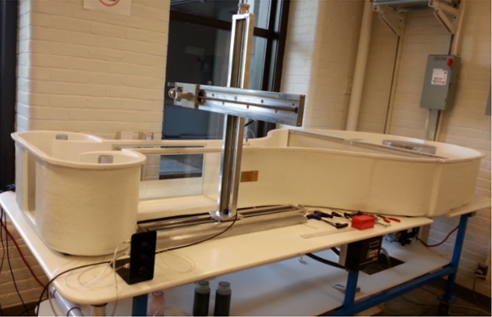
Qualitative and Quantitative Flow Measurement Techniques Using the Water Tunnel
Objectives:
- To investigate both qualitative and quantitative flow measurement techniques using the water tunnel
- To observe the flow structures of test models via dye injection
- To compare qualitative and quantitative measurements to identify the static stall angle
- To measure the shedding frequency from a cylinder
-
Study of Drag and Lift Coefficients in Subsonic Wind Tunnel
Objectives:
- Investigate the relationship between the Reynolds number and drag coefficients for models of different shapes with similar equatorial diameter
- Comparing those values with what is available in the literature
- Investigate the relationship between the angle of attack and the coefficients of lift and drag for aerofoil with closed and open flap arrangements.
