

Bicentennial Family Science Day
We're celebrating 24h de science and McGill's Bicentennial as we move into another century of community outreach! The Science Outreach groups have all kinds of fun in store in this Faculty of Science Signature Event. Join in the celebration!
Family Science Day: What is neuroscience? History of neuroscience at McGill
As part of McGill’s Bicentennial and 24h de science, join BrainReach on a virtual tour of the brain and its fascinating neurons followed by a brief history of neuroscience. Young minds will discover how scientists at McGill set on a journey to understand the human brain.
Greater need to talk about equity, diversity and inclusion in STEM
| ANALYSIS |
Lucia Wang, master’s student in Pharmacology and Therapeutics at McGill, shares her perspective on the role of equity, diversity, and inclusion in STEM education.

Student art exhibition to highlight McGill Bicentennial
The Faculty of Science is celebrating McGill’s 200th anniversary with a student art exhibition on the theme of “Science!”. McGill students at all levels and all faculties are invited to submit works in any medium, expressing what science means to them.
Faculty of Science bicentennial committee member, Torsten Bernhard, says the aim of the exhibition is to celebrate science in all its forms.
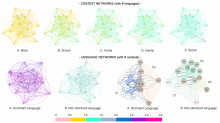
Network science study of Montreal bilinguals could deepen understanding of real-world language use
Psychology researchers at McGill University have used network science – a mathematical technique for revealing connections and patterns – to gain novel insights into Montrealers’ experience of using French and English.
The unique approach has brought to light subtle differences as to which social settings Montreal bilinguals discuss certain topics and whether they use French, English or both languages to discuss those topics.
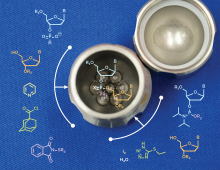
A more sustainable way to make DNA-based medications
Scientists at McGill University have developed a solvent-free method for making oligonucleotides, short strands of DNA of growing significance in research and the pharmaceutical industry.

Cause-and-effect approach could help machines become better learners
For human beings, the ability to generalize – to extract broad principles from our experiences of the world and use these principles to help us make decisions in new situations – is an essential skill for navigating everyday life. But for those working in the field of artificial intelligence, getting machines to generalize in this way has been a notoriously difficult challenge.

Innovative simulations and analysis accelerate search for COVID-19 treatment
McGill University researchers are using cutting-edge computer simulations and analytical techniques to identify and validate promising compounds in the search for a treatment for COVID-19.
Nicolas Moitessier, a professor in the Department of Chemistry, is using computer simulation software that he has developed over the past 15 years to predict the properties of molecules that have yet to be made.

McGill-made instrument reveals previously unseen quantum mechanical behaviour
In a step forward for the field of quantum mechanics, McGill University researchers have achieved a breakthrough in sensitive measurements of the wave-like properties of electrons.
Faculty of Science – Statement on racism and injustice
The events of the past weeks have brought into sharp focus, yet again, the systemic racism and pervasive inequalities that are so deeply entrenched in our societies.
The magnitude of the worldwide public response reflects pain in the face of violence, anger and frustration in the face of persistent injustice, and recognition of the urgent and overdue need for change.

Debbie Moskowitz wins Gold Medal Award for Distinguished Lifetime Contributions to Canadian Psychology
Debbie Moskowitz of McGill University is the 2020 recipient of the Canadian Psychological Association (CPA) Gold Medal Award for Distinguished Lifetime Contributions to Canadian Psychology. This award is presented to recognize CPA Members or Fellows who have given exceptional and enduring lifetime contributions to Canadian Psychology during their career.

Smash hit food chemistry course to run in summer 2020
For the first time ever, McGill University will run a summer-semester version of CHEM 181, its enormously popular course on the chemistry of food.
Enrolments are now open for a June 2020 edition of the course that has been taken by tens of thousands of students over its nearly 40-year history.
Making sense of food

Potential energy saving solution for making vital chemicals
Researchers at McGill University have discovered a new, energy-efficient way to make key ingredients for the production of pharmaceuticals, polymers and fine chemicals.

McGill's Chemistry Outreach Group wins Principal's Prize
The Chemistry Outreach Group has taken home the Principal’s Prize for Public Engagement through Media, winning the inaugural 'Collaboration' category for groups of undergraduate or graduate students that engage with the external community and/or the media.

New technique for measuring greenhouse gas production from thawing permafrost
A research team led by McGill University geochemist Peter Douglas has used a new method for measuring the rate at which methane is produced by microbes breaking down thawing permafrost. The breakthrough could lead to an improvement in our ability to predict future releases of the potent greenhouse gas as long‑frozen layers of soil begin to thaw.