


New report on protecting democratic expression online | Public Policy Forum
Supported by the Max Bell School's Centre for Media, Technology and Democracy, the Canadian Commission on Democratic Expression has released a new report detailing six recommendations to enable citizens, governments and platforms to deal with online hate speech in Canada.

Trump’s social-media ban clouds a bigger crisis: the power and systemic failure of Big Tech | The Globe and Mail
January 14, 2021 | In his opinion piece in The Globe and Mail, Max Bell School professor Taylor Owen discusses the effects of the recent social-media ban imposed on Donald Trump. Take a look at the article to understand how Trump's de-platforming scratches the surface of the deeper issues plaguing the current online ecosystem.

The vaccine will only work if enough people take it | Globe and Mail
January 5, 2020 | While the COVID-19 vaccine offers us an eventual way past the pandemic, many Canadians are unsure about taking or unwilling to take a vaccine. In this Globe and Mail article, Max Bell School Professor Taylor Owen and other researchers at the Media Ecosystem Observatory unpack the cause and solutions to vaccine hesitancy in Canada.
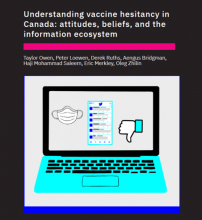
Understanding vaccine hesitancy in Canada: attitudes, beliefs, and the information ecosystem
December 2020 | This new report by the Media Ecosystem Observatory looks into vaccine hesitancy in Canada in the lead-up to the development of a vaccine. Key findings included that 65% of Canadians intend to take a vaccine, and that the best opportunity to reach those who are unsure is to address important concerns around the safety and effectiveness of the vaccine.

New Centre for Media, Technology and Democracy launched at McGill University’s Max Bell School of Public Policy
The Centre is McGill’s focal point on critical research and public debate about the role of media and emerging technologies in shaping democracy and public life

Implications of a Moratorium on Public Use of Facial Recognition Technology in Canada | Tech Informed Policy
August 17, 2020 | Since the start of this year, there have been increasing calls for the Canadian government to impose a national moratorium on facial recognition technology. This demand arises from the possibility that law enforcement will use facial recognition to discriminate against certain demographics and worsen discrimination in the justice system.

Algorithm 'gatekeepers' undermine democracy and health | Montreal Gazette
August 6, 2020 | Social media and other digital platforms have begun to overtake traditional journalism as our primary sources of information. The communications difficulties surrounding the COVID-19 pandemic have demonstrated how this trend will prove to have drastic consequences on the reliability of information in our democracies.

COVID-19: Social media users more likely to believe false information
FOR IMMEDIATE RELEASE Montreal, July 29, 2020
A new study led by researchers at McGill University finds that people who get their news from social media are more likely to have misperceptions about COVID-19. Those that consume more traditional news media have fewer misperceptions and are more likely to follow public health recommendations like social distancing.

Can an ad boycott fix Facebook's hate speech problem? | CBC News
July 6, 2020 | Over 800 companies are pulling their ads from Facebook in response to the Stop Hate for Profit boycott, led by civil rights groups who want to remove hate speech from the platform. Will threatening the company's bottom line motivate them into action? Max Bell School Professor Taylor Owen goes on the CBC's Front Burner to discuss the propagation of hate speech on social media.

COVID-19 pandemic unites Canadians like no other event in recent history: study | CTV News
May 25, 2020 | The study co-led by Professor Taylor Owen found that among Canadians, there is cross-partisan consensus on the threat the virus poses and measures that need to be taken to battle it. The study also found that when there isn’t a consensus – which is the case in the United States – compliance with physical distancing guidelines is undermined, which poses an obvious threat.

A Rare Moment of Cross-Partisan Consensus: Elite and Public Response to the COVID-19 Pandemic in Canada | Canadian Journal of Political Science
April 16, 2020 | The COVID-19 pandemic has placed nearly unprecedented pressure on policymakers and citizens alike. Effectively containing the pandemic requires a societal consensus. However, a long line of research in political science has told us that polarization tends to occur on highly salient topics because partisans “follow the leader.” Elite consensus is thus essential to fight the COVID-19 pandemic in Canada.

The Causes and Consequences of COVID-19 Misperceptions: Understanding the Role of News and Social Media | OSF Preprints
May 4, 2020 | This research investigates the relationship between media consumption, misinformation, and important attitudes and behaviours during the COVID-19 pandemic in Canada. Professor Taylor Owen, co-author of this article, finds that comparatively more misinformation circulates on social media platforms, while traditional news media tend to reinforce public health recommendations like social distancing.

Anti-intellectualism and Information Preferences during the COVID-19 Pandemic | OSF Preprints
May 14, 2020 | The COVID-19 pandemic necessitates widespread voluntary and sustained public compliance with expert-guided public health directives, like social or physical distancing. Understanding which citizens seek out and engage with expert messages regarding COVID-19 is thus of central importance. Anti-intellectualism - the generalized distrust of experts and intellectuals – is likely to be a dominant factor.

Prospective Economic Costs Undermine Expectations of Social Distancing | OSF Preprints
May 20, 2020 | The COVID-19 pandemic has placed an extraordinary burden on governments and citizens alike. In order to contain the spread of the pandemic and limit its effect on health care systems, citizens have been asked to forego social and economic activity to protect others at a tremendous cost to themselves.

A Post-COVID-19 Digital Bretton Woods | Project Syndicate
April 17, 2020 | The digital age has completely disrupted global governance. Now that COVID-19 has disrupted nearly everything else, it is time to start planning for what comes next, say Max Bell School professor Taylor Owen and Rohinton P. Medhora.