May 27, 2026 | MPP'26 Woyesa Worana examines the conditions surrounding Ethiopia's June 1st national election in a new piece for Policy Magazine. Worana argues that while electoral institutions remain formally intact, ongoing conflict and narrowing civic space have weakened the substantive conditions that give an election democratic meaning, leaving "the question of process… decoupled from the question of democratic credibility."

Category:
Published on: 29 May 2026

April 2, 2026 | MPP'25 Elijah Maubert spoke to CBC about algorithmic pricing as Manitoba moves to ban the tactic under Bill 49. Drawing on a 2025 Max Bell Policy Lab project co-authored for the Competition Bureau of Canada, Maubert weighs both sides: AI pricing can help smaller firms compete, but it can also produce unintentional collusion when competitors rely on the same software.
Category:
Published on: 21 Apr 2026
March 24, 2026 | In a feature for Maclean's, Alexandra Ages MPP'21 reflects on her experience of Canada's increasingly precarious rental market.
Through a personal account of housing instability across multiple cities, she highlights the structural challenges facing renters, including aging housing stock and limited policy attention. Ages argues that current housing policy continues to prioritize homeownership, leaving renters increasingly insecure. She underscores the need for reforms that improve stability and housing quality across the country.
Category:
Published on: 25 Mar 2026
February 24, 2026 | In an article published by Policy Magazine as part of the Emerging Voices program, MPP student Shane Joy examines the cultural and political foundations required to sustain Canada's planned defence expansion.
Joy argues that long-term legitimacy will depend on embedding a deeper national security culture, aligning industrial strategy with a coherent National Security Strategy. He writes that a transformation of this scale will require Canadians to view defence as a permanent component of sovereignty, rather than a discretionary one.
Category:
Published on: 25 Feb 2026
February 9, 2026 | In Policy Options, MPP'25 Graduates Kiran Gill and Gabriel Blanc examine how Canada's tax and benefit system affects young adults and outline a proposal for a Youth Employment Supplement (YES) to the Canada Workers Benefit. Building on research from the Policy Lab on building wealth for young Canadians, they explore how a targeted supplement for workers aged 19-29 could support employment and improve economic security for younger Canadians.
Category:
Published on: 9 Feb 2026
January 26, 2026 | MPP student Woyesa Worana wrote for the Policy Magazine on Ethiopia's rapidly shrinking civic space as the country approaches its June elections. He argued that the rollback of press freedom and civil society protections marks a sharp reversal from the optimism of the 2018 reforms. He further added that citizens are increasingly being excluded from decisions actively shaping their lives.
Category:
Published on: 28 Jan 2026
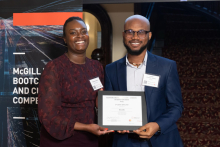
We are proud to celebrate MPP '25 Husein Pumaya Yakubu, whose social enterprise SheaMe placed second in both the Mastercard Foundation Dobson Start-up Awards and the Dobson Bootcamp and Cup Competition, 2025 — two of the most competitive entrepreneurship programs hosted by the McGill Dobson Centre for Entrepreneurship and supported by the Mastercard Foundation Scholars Program at McGill University.
Category:
Published on: 12 May 2025

April 15, 2025 | MPP '25 Husein Pumaya Yakubu highlights the limitations of transparency in Ghana’s post-pandemic governance. While former president Nana Akufo-Addo’s transparent communication during COVID-19 initially unified citizens, Yakubu argues it masked deeper issues like economic mismanagement and rising debt. Drawing a parallel with Canada, Yakubu suggests that transparency, while crucial during crises, must be sustained through regular financial updates, stronger oversight, and grassroots participation.
Category:
Published on: 17 Apr 2025
July 24, 2024 | Our alumni, Anil Wasif, from the MPP Cohort of 2020-21, who also sits on the advisory board of the Max Bell School of Public Policy wrote an article on the current upheaval in Bangladesh. "The past week’s events in Bangladesh, where nearly 200 people have lost their lives in a violent crackdown on student-led protests, is just the latest reminder of the underlying social and political issues plaguing Bangladeshi society.
Category:
Published on: 30 Jul 2024

June 30, 2024 | The digital brigade, powered by e-transfers, PayPal and Apple Pay, has gained unprecedented momentum. This is leading towards a cashless society, as Canadians tend to embrace electronic methods of payments. However, cash holds many significance in the social and economic realm. CBC News featured one of our MPP alum, Aftab Ahmed for their news article about the harm of leaping towards the cashless Canadian economy.
Category:
Published on: 3 Jul 2024
May 8, 2024 | In Policy Magazine’s Emerging Voices series each year, Max Bell School MPPs are asked to write articles on issues important to them. In the fifth article for 2024, Asha Sivarajah underscores the importance of safeguarding privacy rights while ensuring transparency and accountability in public institutions' use of surveillance technologies.
Category:
Published on: 9 May 2024

April 26, 2024 | Abdelrahman Sherif, born and raised in Cairo, Egypt, is part of the fifth cohort of MPPs. His expertise in management consulting has allowed him to make significant contributions to a diverse array of transformational and strategic projects, providing firsthand insight into the impact of public policy in the MENA Region.
Category:
Published on: 2 May 2024

December 2, 2023 | Kim Brunhuber speaks with MPP alumni Henna Hundal, a delegate to the U.N. Climate Change Conference, about what to expect from U.S. Vice President Kamala Harris at the COP28 climate conference.
She also talks about COP28 being the first climate conference to have a dedicated day for health effects of climate change.
Category:
Published on: 5 Dec 2023
Can the Liberal government’s Indigenous Justice Strategy catalyze a new era of transformative reconciliation? The ball is in Justice Minister Arif Virani’s court.
Category:
Published on: 5 Sep 2023

January 12, 2023 | Aftabuddin Ahmed, a current MPP student, stated that this year will define whether Bangladesh can preserve its institutional ambitions towards being a liberal democracy. This brand of political illiberalism, methodically and deliberately camouflaged by ruling elites under the aegis of economic growth, indicated that there is enough apprehension surrounding Bangladesh signing a death warrant for democratic practices.
Category:
Published on: 13 Jan 2023
Pages
