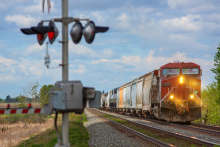
Trains began to trundle along the tracks of Canada’s two major railways on Monday after the federal labour board ended a four-day work stoppage that snarled supply chains and upended commutes. Amid a bitter labour dispute, the Canada Industrial Relations Board on Saturday ordered Canadian National Railway Co. and Canadian Pacific Kansas City Ltd. to resume operations and 9,300 workers to return to their posts at 12:01 a.m. ahead of binding arbitration set to begin this week. The union has vowed to fight the labour board’s decision in court, framing the outcome as a win for big business.
Category:
Published on: 26 Aug 2024

On June 18, Boeing CEO Dave Calhoun will testify before a Senate panel about the company's safety crisis, addressing lawmakers' questions on quality control issues and whistleblower allegations (CNBC).
Category:
Published on: 17 Jun 2024

While the air transport industry welcomed news that millions of unvaccinated Canadians will soon be allowed to fly, experts and unions said a new influx of travellers could worsen the ongoing delays at airports across the country. The government announced that starting June 20 proof of vaccination will not be required to board a train or a plane in Canada. As of May 22, just over 18 per cent of Canadians — almost seven million people — did not have at least two doses of the COVID-19 vaccine.
Category:
Published on: 16 Jun 2022

The McGill Media Relations Office suggests the following sources for your holiday stories:
Exercise and staying active | Giving back | Mental health | New Year's resolutions and goals | Safer holidays |Sustainable tree shopping | Traveling during the Holidays |
Category:
Published on: 20 Dec 2021

The cost of just about everything in Canada was more expensive in September, pushing headline inflation to its highest in almost two decades and complicating the Bank of Canada’s plans to keep interest rates pinned near zero until well into 2022. Prices are being driven higher around the world by an extreme mismatch between supply and demand. Suppliers are now scrambling to catch up, clogging ports and other transportation lanes that are dealing with their own pandemic-related issues. (
Category:
Published on: 27 Oct 2021

The U.S. Department of Transportation is seeking a $25.5 million US penalty against Air Canada for "failing to provide consumers prompt refunds" after cancelling their flights amid the COVID-19 pandemic. In a "notice of enforcement proceeding" issued by the department on Tuesday, June 15, the Office of Aviation Consumer Protection says Air Canada "unlawfully failed to provide timely refunds" for flights between the United States and Canada that were cancelled or significantly changed. (CBC News)
Category:
Published on: 15 Jun 2021
The federal government has approved Air Canada's purchase of competing airline Transat A.T. Inc. under a series of strict terms and conditions the government says "are in the interest of Canadians." A statement released by the transport minister's office said the impact of COVID-19 was a key factor in the final decision to approve the purchase. (CBC News)
Here are some experts from McGill University that can provide comment on this issue:
Category:
Published on: 12 Feb 2021
The federal government has unveiled new protections for airline passengers, rules designed to make sure both airlines and the people who fly on them are up to date on what they are entitled to when things go wrong. (Source: CBC)
Category:
Published on: 16 Jul 2019
Air Canada will buy Air Transat, offering $13 a share, or about $ 520 million, for its rival. (La Presse)
Here are experts to comment what this transaction means for the consumers and the industry:
Category:
Published on: 16 May 2019
"A jetliner carrying 157 people crashed shortly after takeoff from the Ethiopian capital Sunday, killing everyone aboard and carving a crater into the ground, authorities said. At least 35 nationalities were among the dead, including 18 Canadians." (CBC)
Category:
Published on: 11 Mar 2019
“A new U.S. airline start-up announced its plans Tuesday to buy 60 Airbus A220-300 aircraft, with deliveries beginning in 2021. (…) Airbus markets and supports the A220 aircraft, which is manufactured under the recently finalized partnership agreement between Airbus, Bombardier & Investment Québec.” (Fox)
Category:
Published on: 17 Jul 2018
“A new air passenger bill of rights would punish airlines for keeping people on the tarmac longer than three hours, forcing them to compensate passengers. But it would not compel carriers to disembark a plane delayed for long periods.” (CBC)
John Gradek, lecturer, School of Continuing Studies, McGill University
Category:
Published on: 2 Aug 2017
