About
Since its inception, the QSP has given Quebecers, Canadians and international students the chance to improve their knowledge of many important issues that have defined and continue to define and redefine Quebec, including the North American Free Trade Agreement, the evolution of the Canadian constitutional debate, the reform of social programs, provincial linguistic policies, native issues, regional differences and relations between the anglophone, allophone and francophone communities.
This testimony from one of our recent graduates gives a vivid picture of the opportunities afforded by the program.
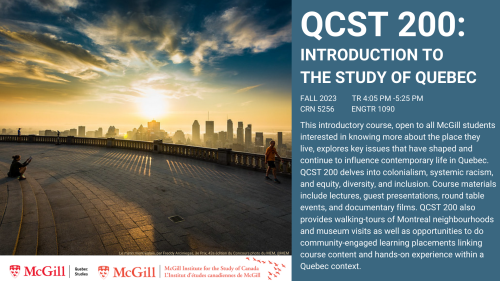
The QSP is responsible for the following courses: QCST 200  qcst_200_-_syllabus_2020.pdf Introduction to the Study of Quebec and QCST 440, Contemporary Issues in Quebec - Living in Montreal: Ethnicity and "Race" from Past to Present) qcst_440_and_cans_413_-_summary_2020.pdf. PLEASE NOTE that QCST 300 will be cross-listed with CANS 300 this year - a course on food and agriculture in Canada, with special emphasis on Quebec. Students who took QCST 300 in the past can therefore take it for credit. There is also a BRAND NEW Quebec literature course that may be taken, as well:
QCST 200 is given in English and QCST 440 is given in both English and French. The title (or sub-title) of each course indicates the language in which it is offered. As is the case with most other courses at McGill, term papers and exams may be written in either language. (One exception are courses offered by the Département des littératures de langue française, de traduction et de création, where all papers must be submitted, and all exams must be written, in French.)
Please note that it is necessary to be able to read French in order to follow all of the required courses offered by the Program except for QCST 200, as well as the "Core Courses." All the other Québec Studies courses included in the Minor or Major Concentration are the responsibility of the departments who offer them and it is those departments that determine the language of some or all of the readings and the language in which the lectures will be given. To obtain a complete description of these courses and the admission requirements where applicable, students should read the relevant sections of the McGill Calendar and, if necessary, consult with the departments concerned, bearing in mind that not all courses are available in any given year. It is a the student's responsibility to ensure that he or she has successfully completed any course prerequisites.
Minor Requirements
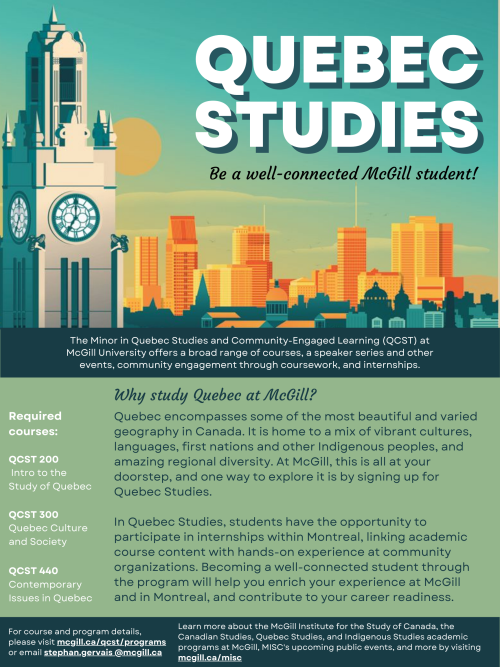
Required Courses 9 credits
Required courses normally completed in the following order:
QCST 200 - Introduction to the Study of Quebec (U0 or U1)
QCST 300- Quebec Culture and Society (U1 or U2)
QCST 440 - Contemporary Issues in Quebec (U2 or U3) - Winter 2026
Complementary Courses 9 credits
Of these 9 credits, 6 credits must be core courses or courses approved by the Program Director and 3 credits must be taught in the French language and can be chosen from French as a Second Language course offerings
https://www.mcgill.ca/flc/courses-and-programs
At least 3 of the 9 complementary credits must be at the 300 level or above.
The selection of courses will be made in consultation with the Program Director and will vary depending on the major concentration or honours program of each student.
Here is a non-exhaustive list of core courses.
Fall 2026
CANS 300/QCST 300: Quebec Politics and Memory
CANS 401/POLI 427: Canadian Constitution
FREN 382: Littérature québécoise 2
FREN 461 — Enjeux littéraires et culturels 1
Géographies littéraires : Montréal dans la littérature
HIST 303: History of Quebec
HIST 333: Indigenous Peoples and French
POLI 226: La vie politique québécoise
Winter 2027
FREN 252 Littérature québécoise
FREN 450 Question de littérature québécoise
Other courses could be considered core course with the approval of program Director, Professor Pascal Brissette
Complementory Courses:
Fall 2026
HIST 202 : Survey: Canada to 1867
POLI 221 Government of Canada
SOCI 222 Urban Sociology
SWRK 221 Public Social Services in Canada
Winter 2027
HIST 203: Survey: Canada since 1867
POLI 222 : Political Process and Behaviour in Canada