Background and objectives
Small-scale women farmers and youth in Ghana face challenges in expanding their businesses or starting new ones due to limited skills, educational opportunities, and support systems. New strategies are needed to open alternative paths to entrepreneurial success.
The Youth and Rural Women Entrepreneurship: Creating and Sustaining Alternative Livelihoods Options in Ghana (Y&RWE) Project aims to support rural women working in agricultural-related businesses in the Sekesua Community to nurture alternative income sources by bringing together women gari (toasted cassava flour) processors and university graduates to explore their mutual interests in developing agriculture-related businesses.
This project seeks to:
- Identify the challenges faced by rural women in the cassava-gari value chain.
- Assess their training needs.
- Identify desired alternative livelihood options of interest to women gari processors.
- Encourage and support the creation of joint agriculture enterprises between university graduates and rural women.
This project is a collaboration between McGill University, the University of Ghana Nutrition Research and Training Centre (NRTC), the University of Ghana Business School (UGBS), and the Association of Ghana Industries (AGI).
Funding: McGill University Mastercard Foundation Transitions Fund Project
Who is it for?
The project brought together a hundred women gari processors in the Sekesua community and seven university graduate teams to explore mutual interest in developing new agriculture-related businesses.
The following alternative livelihoods were proposed by women gari processors and served as the basis for developing a targeted call for proposals for graduates:
- Animal husbandry
- Soap making
- Mushroom and cashew farming
- Retailing
- Palm oil production
- Pastry making.
Information about these desired alternative livelihood options allowed the graduates to think innovatively about the business ideas they could explore with the women gari processors to benefit themselves and these rural women.
What the project did?
The entrepreneurial needs of 100 women gari processors were assessed in the Eastern Region of Ghana to identify alternative livelihood options and training needs through a needs and collaboration opportunity assessment.
The following training needs were identified by women gari processors:
- Basic literacy and numeracy skills
- Financial and business management: Bookkeeping, record keeping, saving, and investing.
- Professional training: customer relations and building professional networks.
- Product development: Adding value to Gari through fortification, producing variants for different buyers, manufacturing organic fertilizers from cassava peels, and better packaging.
- Marketing skills: How to identify and exploit new markets and negotiate prices
- Safety and hygiene training
Training sessions were conducted to foster understanding and promote respectful collaboration between women gari processors and university graduates in their joint enterprises. The women's training took place in person at the University of Ghana Nutrition Research and Training Center located in Asesewa, and that for graduates took place virtually via Zoom Video Conferencing.
The training sessions can be found at training materials.
Methods
The project involved a hundred rural women and seven university graduate teams who were trained and supported to create an alternative source of income.
The women
A needs assessment was conducted to identify the challenges of the existing gari-making business, as well as other desired alternative livelihood options among rural women in the cassava-gari value chain. From their experiences, these rural women identified critical problems and opportunities in the community and proposed alternative livelihood options. The women also expressed interest in training to identify and exploit new markets and negotiate prices. The project organized training sessions to equip rural women with financial management and leadership skills to manage a successful business. Before interacting with university graduates, the project team hired a business coach to explain core business principles to the women.
The needs assessment provided an overview of the challenges the rural women in the cassava-gari value chain face and the training needs of these women.
The university graduates
A call for applications was launched to invite university graduates or graduate teams across Ghana interested in agriculture-related businesses to submit their business proposals. Seven top graduate teams were selected from a pool of twenty-six team applicants and allowed to interact with the hundred Sekesua women.
The key criteria were for the applicants to elaborate on how their innovative business ideas address or respond to the identified needs/challenges in Sekesua, business scalability, and how they envision collaborating with the Sekesua women to ensure mutual benefit.
Graduate - Women interactions
Through Graduate-Women interactions, the seven graduate teams presented their business proposals to the women, and the women joined the team whose business aligned with their interests.
The seven teams of university graduates and Sekesua women were formed and taken through a series of entrepreneurial training modules to equip all members with the necessary knowledge and skills to ensure success and mutual benefits in their newly joint businesses.
The seven teams pitched their business ideas to a panel of judges on the 20th of September, 2023, at the Accra International Conference Center during a national entrepreneurship pitch competition as part of AGI's Ghana Industrial Summit and Exhibition 2023. Three viable businesses (oyster mushroom farming, snail farming, and composite flour pastry production) were chosen to tap into a pool of funds for their start-ups. Each viable business has been mentored to develop and present business budgets after the contest. Currently, the three businesses have been established in the Sekesua community.
How much is the award?
Three viable businesses (oyster mushroom farming, snail farming, and composite flour pastry production) were selected during the Entrepreneurship Pitch Competition to share 30,000 CAD for their newly formed enterprises in Sekesua.
The pitch competition event can be seen at: AGI Ghana Industrial Summit & Exhibition 2023
Our PIs
Priscilla Boadi
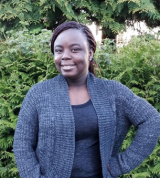 Priscilla Boadi is the Project Lead for the Youth and Rural Women Entrepreneurship Project which aims at creating and sustaining alternative livelihood options in Ghana. Priscilla has a Bachelor of Science in Natural Resources Management from the Kwame Nkrumah University of Science and Technology (Ghana). In 2016, she obtained a Master of Science in International Forestry from the University of British Columbia (Canada) as a MasterCard Foundation Scholar. Her research interests include nutrition-sensitive agriculture, women's empowerment, women's and youth nutrition, agripreneurship, poverty alleviation, and sustainable food systems. Her doctoral research aims to assess the nutrition sensitivity of food and agricultural policies and investments in Ghana.
Prof. Thomas Anning-Dorson
 Prof. Thomas Anning-Dorson is an Associate Professor at the University of the Witwatersrand in Johannesburg. He is also a Researcher at the UGBS Innovation and Incubation Hub at the University of Ghana Business School. His research interests include enterprise and socio-economic development, gender and enterprise development, innovation management, and consumer and societal well-being. He has held research positions at various institutions, including the Oxford Internet Institute, University of Oxford, McGill University, University of Ghana, and Wits Business School. Currently, he serves as the Research Director at the School of Business Sciences, University of the Witwatersrand, and is a Co-PI on the Youth and Rural Women Entrepreneurship Project at McGill University.
Dr. Grace Marquis
 Dr. Grace Marquis is Associate Professor in the School of Human Nutrition at McGill University (Canada) and Affiliate Associate Professor at Iowa State University (USA). She received her doctorate in international nutrition from Cornell University. Her research program began at the Nutrition Research Institute in Lima, Peru, and expanded to Ghana, West Africa. Her community-based research has examined (i) determinants of diet and nutritional status of women and children living in poverty and the means by which families, communities, and societies can intervene to promote optimal feeding and caregiving. Over the last 20 years, her research group has developed cross-sector, integrated strategies that support health and growth, with a special focus on those living in rural communities. Her long-term collaboration with the University of Ghana led to the building of the Nutrition Research and Training Centre in 2010 in the Eastern Region of Ghana. Today, the Centre provides support for diverse research projects and houses the training of local and international graduate students and professional interns. Dr. Marquis was Canadian Research Chair in Social and Environmental Aspects of Nutrition for 10 years (maximum award) and received a Doctorate of Laws, honoris causa, for her contribution to tertiary education from the University of Ghana in 2013.
Prof. Richmond Aryeetey
 Prof. Richmond Aryeetey is a co-investigator of the Youth and Rural Women Entrepreneurship project. He is a Professor of Public Health Nutrition in the Department of Population, Family and Reproductive health at the University of Ghana School of Public Health. His multidisciplinary research experience over the past twenty years focuses on Maternal, Infant and Young Child Nutrition, Food systems, and nutrition policy analysis. His previous research has been supported with funding from diverse global funding agencies including European Commission, Global Affairs Canada, New York Population Council, Bill and Melinda Gates Foundation, Family Larsson-Rosenquist Foundation, FAO, UNICEF, WFP, and IFPRI. Prof Aryeetey has worked with multidisciplinary teams on various projects focused on maternal and child nutrition including Nutrition Links, Becoming Breastfeeding Friendly initiative, the #breastfeed4Ghana, and Transform Nutrition West Africa. Currently, Prof. Aryeetey serves on various National Committees including the Salt Iodization Committee, and the SUN movement Capacity working group in Ghana. He also serves on various international committees including the WHO’s STAGE (MNCAHN) and the Executive Committee of the SUN Movement. He has several research collaborations across multiple institutions in Sub-Saharan Africa, North America, and Europe. He has authored more than 150 peer-reviewed journal articles and books/book chapters on various subjects spanning his research interests.
Dr. Diana Dallmann
 Diana holds a PhD in Human Nutrition from McGill University and is interested in understanding the drivers of successful implementation of policies and interventions to improve maternal & child nutrition. Her PhD research combined quantitative and qualitative methods to evaluate women’s participation in a nutrition-sensitive agriculture intervention in Ghana. Diana believes in the importance of capacity building and knowledge sharing, and accumulated over ten years of training & teaching experience in low-, middle-, and high-income countries. She also has experience collaborating with NGOs addressing food insecurity in different countries, where she developed surveys, trained field research assistants, analyzed data, and wrote reports. Currently, she's working remotely as an independent researcher.
Dr. Agartha Ohemeng
 Dr. Agartha Ohemeng is a Senior Lecturer of Nutrition at the Department of Nutrition and Food Science, University of Ghana, Legon. Her research interests are MaternaI and Young Child Nutrition, School Child Nutrition, and Diet and Disease. Dr. Ohemeng has about sixteen years of experience in community-based nutrition research activities and has conducted research and published on using integrated education intervention and moringa fortificant to address complementary feeding, household food insecurity and child health, nutrition among school-aged children, and nutrition among children with sickle cell disease. She is currently the programme coordinator of the University of Ghana Nutrition Research and Training Centre in Asesewa and the Director of the Dietetic Internship in Rural Community Nutrition Program.
Abubakar Mohammed
 Abubakar Mohammed is currently the Project Coordinator for the Youth and Rural Women Entrepreneurship Project in Ghana. Abubakar holds a Bachelor of Arts in Political Science Education from the University of Education, Winneba. He previously worked as a Research Assistant to Dr. Thomas Anning-Dorson for almost eight years, working towards improving the livelihood of women in Sekesua. Abubakar was also a Fieldworker for the Nutrished Project, which aimed to tackle the issue of malnutrition using a food system approach. The project was sponsored by IMANNA, Sheffield University, and focused on understanding the food flow from farm to plate, identifying specific challenges at each stage. Abubakar's research interests include Development Studies and International Relations.
Academic partners
University of Ghana Nutrition Research and Training Center, Ghana
Dr. Agatha Ohemeng
Dr. Agatha Ohemeng is a Senior Lecturer of Nutrition at the Department of Nutrition and Food Science, University of Ghana, Legon. Her research interests are MaternaI and Young Child Nutrition, School Child Nutrition, and Diet and Disease. Dr. Ohemeng has about sixteen years of experience in community-based nutrition research activities and has conducted research and published on using integrated education intervention and moringa fortificant to address complementary feeding, household food insecurity and child health, nutrition among school-aged children, and nutrition among children with sickle cell disease. She is currently the programme coordinator of the University of Ghana Nutrition Research and Training Centre in Asesewa and the Director of the Dietetic Internship in Rural Community Nutrition Program.
University of Ghana Business School, Ghana
Dr. George Acheampong
Industry partners
Association of Ghana Industries, Ghana
Johnson Opoku Boateng
 Johnson Opoku Boateng is a trained ISO Quality and Food Safety Auditor with auditing experience including Unilever companies across Africa and the Middle East. He holds an MSc. in Food Science and Technology from KNUST and a BSc. Biological Sciences from KNUST. He spent almost twelve years of his working life in Unilever Ghana Ltd and has worked as a Factory Hygienist/ISO Scientist and QA Manager with Regulatory Affairs responsibility in the QA department. He is a trained Quality Auditor and has audited several Unilever companies across Africa and the Middle East. In 2009 he was appointed the Asst. Production Manager for the Foods business and subsequently to Procurement operations where he worked for almost 3 years. He served on the technical committees for Foods and Cosmetics at the Ghana Standards Authority for 3 years. Johnson also worked as R&D Manager for Unilever West Africa (Personal Care, Home Care, Food and Beverages) for 3 years before resigning into training and consultancy.
Johnson has since 2010, been teaching Food Safety and HACCP at the Food Science and Nutrition department at the University of Ghana in their Food Safety & HACCP summer training programme, which pulls participants from manufacturing industries across the sub-region, government institutions, hospitals etc. He has also served as the Ag. CEO of GS1 Ghana, a company responsible for issuing barcodes to manufacturing and some service clients for an annual fee. In addition to managing QA Consult, a company he founded, he is the Director of Business Development Services at the Association of Ghana Industries.
Johnson Opoku-Boateng has worked with local and international agencies in areas of Business Development, Quality and Food Safety to support businesses in the manufacturing, hospitality, and service sectors of the economy. He has expertise in Business Development to support SME’s, Quality and Food Safety Management Systems, Capacity Building and Organisational Development, ISO Management Systems, Supply Chain Management, and Research & Development (Food and Cosmetics).
Daniel Okyere Tweneboah
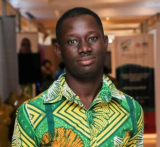 Daniel Okyere Tweneboah has a combined work experience of 10 years in the private sector. He has previously worked with Databank Financial Services, and UMB Bank and currently works with the Association of Ghana Industries. Daniel is passionate about realizing a competitive business climate where enterprises in Ghana can compete internationally. During the last six years, Daniel has worked closely with 350 local businesses in areas such as facilitating access to funding, access to new markets, and enterprise development. Daniel has successfully designed and implemented impactful business support services, with funding support worth $ 1.5 million from GIZ, the World Food Programme, and the Mastercard Foundation. Daniel currently leads the coordination of the Entrepreneurship Pitch Contest, a collaboration between the Association of Ghana Industries (AGI) and McGill University in Canada. Through his leadership, twelve startups have received an excess of $ 100,000 funding support coupled with enrolling in fully sponsored courses that are run by the McGill University. As his way of giving back, Daniel offers free business coaching and advisory services to six youth-led startups.
