A team of scientists has calculated the strength of the material deep inside the crust of neutron stars and found it to be the strongest known material in the universe.

Matthew Caplan, a postdoctoral research fellow at McGill University, and his colleagues from Indiana University and the California Institute of Technology, successfully ran the largest computer simulations ever conducted of neutron star crusts, becoming the first to describe how these break.
Classified as: Nuclear pasta, neutron stars, gravitational waves, Matthew Caplan, science and technology
Category:
Published on: 18 Sep 2018

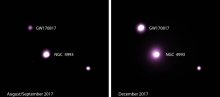
The afterglow from the distant neutron-star merger detected last August has continued to brighten – much to the surprise of astrophysicists studying the aftermath of the massive collision that took place about 138 million light years away and sent gravitational waves rippling through the universe.

Classified as: neutron star, merger, gravitational waves, Chandra X-ray Observatory, astrophysics, astronomy, Haggard, Ruan, Nynka, LIGO, Virgo, science and technology, McGill Space Institute
Published on: 18 Jan 2018

The discovery of a gravitational wave caused by the merger of two neutron stars, reported today by a collaboration of scientists from around the world, opens a new era in astronomy. It marks the first time that scientists have been able to observe a cosmic event with both light waves -- the basis of traditional astronomy -- and gravitational waves, the ripples in space-time predicted a century ago by Albert Einstein’s general theory of relativity.

Classified as: gravitational waves, daryl haggard, McGill Space Institute, physics, astronomy, neutron stars
Category:
Published on: 16 Oct 2017

The Nobel Prize in Physics 2017 was divided, one half awarded to Rainer Weiss, the other half jointly to Barry C. Barish and Kip S. Thorne "for decisive contributions to the LIGO detector and the observation of gravitational waves". (Nobel Prize)

Classified as: Nobel prize, physics, gravitational waves
Category:
Published on: 3 Oct 2017

"The first direct detection of gravitational waves is now widely expected to be announced on 11 February by the Advanced Laser Interferometer Gravitational-Wave Observatory (LIGO). Using LIGO's twin giant detectors — one in Livingston, Louisiana, and the other in Hanford, Washington — researchers are said to have measured ripples in space-time produced by a collision between two black holes." (Nature News)

Classified as: McGill, pulsars, robert ferdman, gravitational waves, einstein, theory of general relativity
Category:
Published on: 10 Feb 2016
Back to top