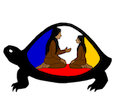
Over the years, cultural items have been integrated to the respective Manuals that guide facilitators during the delivery of the 14 sessions. All First Nations have developed their own version.
Listening to One Another / A good way of Life
MA7 YAGTWILC (Secwepemc)
NTOH-TAH-TO-TAN (Swampy Cree)
BII-ZIN-DA-DE-DAH (Anishinabe)
DESTI-NATIONS / S’ÉCOUTER LES UNS LES AUTRES (Innu)
SIGSATULTIEG: Weleuti’ Ewei (Mi’gmaq)
What is cultural adaptation?
The process of adding relevancy to a universal health program that was originally designed for the general population.
Why is it important?
A meaningful program takes into account the historical context and current living conditions of local populations. Cultural assertion is an important health determinant. Years of oppression and cultural depreciation had some repercussion on health of Indigenous People around the world.
How to proceed?
1) Formation of a local committee: to identify local strengths and needs in order to insert relevant cultural values and activities.
2) Balancing fidelity and flexibility: cultural insertions that are acceptable to the community while keeping evidence-based components.
3) Training facilitators: to spread both cultural & health competency.
4) Documenting the process of adaptation for research purposes.
Preferably respected community members who are known for their wisdom and sense of judgment.
Not only participants to the program, but also partners who prepare it and who deliver it.
What are the extended benefits?
Knowledge, cultural continuity and organizational skills are social determinants that enhance health of an entire community.
Stories, ceremonies and rituals show the symbolical richness of the Indigenous cultures. Each year, new refinements are integrated into each cultural version. Some of the sessions are more focused on learning social skills, while others discuss values and ways of living that are suitable to the insertion of culture. Below you will find some examples of cultural items that have been integrated into the generic manual:
Session 1: The Story of the Sacred Tree
The Sacred Tree is a gathering place for everyone. Here we find healing, power, wisdom, and security. The ancient ones taught that the life of the Tree is the life of the people. If one wanders too far from the shadow of the tree, or forgets to seek the nourishment, turn against, or try to destroy it; great sorrow will fall upon the people. Therefore, the Tree is under great protection. Only the humble and dedicated souls will guide anyone who is honestly and sincerely seeking along the path leading to the protecting shadow of the Tree.
Session 2: The Creation Story
It is the story of Ake (Mother Earth), the moon (Grandmother) and the sun (Grandfather).
Session 3: The Talking Circle
A Talking Circle is a safe place to share, discuss and be respectful to others by listening with all of our senses. Eyes are windows to the soul and can communicate our feelings. Our eyes also help us observe how others are feeling. Our ears, of course, are used to listen to what others are saying.
Session 4: The Good Way of Life
At all 7 stages of life, there are corresponding experiences and activities to be explored. For instance, the first stage is from birth to seven years old; a time of innocence and spontaneity, joy, and capacity to believe in the unseen.
Session 5: The important role of Tobacco in seeking help
Elders are respected because they transmit Teachings and values that are linked to ways of living a good life. When seeking their help and to thank them for sharing their knowledge and experience, the elders accept tobacco as a gift of appreciation and a sign of gratitude. Tobacco (Semah) is one of the four sacred plants (sweet grass, cedar and sage), as a gift it is offered in the form of a tobacco pouch or tobacco tie (loose tobacco wrapped in a small cloth). The plant is highly respected because it symbolizes a bond between earthly and spiritual realms since its roots go deep into the ground and its smoke rises high into the sky. As the pouch or tie is being made it is good to think about what you are asking for, and put good thoughts and prayers into the offering. Tobacco is generally not smoked, except on special ceremonial occasion.
Session 6: Anger management
The goal of our Anishinabe ancestors was to maintain harmony at all times. Typically, we might think of harmony as an aspect of nature in that all things are interconnected. Our ancestors remembered to treat living things with respect in order to maintain balance. Harmony can also be found within ourselves: to react to anger in a negative way is to disrupt harmony. Every action we take has a reaction in the world around us: a consequence.
Anger in situations of controversy is not bad. In fact, it is a necessary reality. When we experience anger in times of controversy and conflict, our emotions may seem to overwhelm logic and facts. We may be tempted to react rather than to reason and take action. The challenge for each of us is to recognize anger, whatever leads us to experience it or triggers it, and to deal with it in a positive manner.
Session 7: Learning skills ‘How to help yourself and your friends’
Session 8: Learning skills ‘How to solve problems’
Session 9: The Culture Tree
Roots: the history and ancestors of our tribe.
Trunk: the values that our tribe lives by.
Leaves: the visual aspects of our tribe that everybody sees or doesn’t see.
Session 10: Learning skills ‘Qualities of friendship’
Session 11: Learning skills ‘Refusal skills’
Session 12: Learning skills ‘Trust building or destroying behaviours’
Session 13: Learning skills ‘Promoting community empowerment’
Session 14: Blanket Ceremony
Traditionally, the Blanket Ceremony was conducted at puberty as a rite of passage. The parent gave a Blanket to his/her child and cut off a piece that was kept as a symbol of an everlasting bond between them. The child was old enough and had developed skills to protect himself/herself and was ready to follow the path on his/her life journey, yet the parent would always be a guardian, caring for his/her safety. In the program, the Blanket is also a graduation gift that underscores the youth and parent’s accomplishment for attending each session together despite possible.