New detections of radio waves from a repeating fast radio burst have revealed an astonishingly potent magnetic field in the source’s environment, indicating that it is situated near a massive black hole or within a nebula of unprecedented power.

The findings by an international team of astronomers, including Victoria Kaspi and Shriharsh Tendulkar of McGill University, appear in the January 11 edition of Nature and are highlighted on the cover of the journal.

Classified as: fast radio burst, astrophysical, magnetized, FRB 121102, Kaspi, Tendulkar, Arecibo, Green Bank, CHIME, telescope
Category:
Published on: 10 Jan 2018

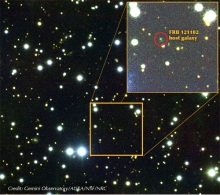
Astronomers have pinpointed for the first time the home galaxy of a Fast Radio Burst, moving scientists a step closer to detecting what causes these powerful but fleeting pulses of radio waves. FRBs, which last just a few thousandths of a second, have puzzled astrophysicists since their discovery a decade ago.

Classified as: astrophysics, galaxy, Kaspi, telescope, science and technology, Fast Radio Bursts, FRB, neutron star, magnetar, CHIME, Tendulkar, American Astronomical Society, Astrophysical Journal Letters, astronomers
Published on: 4 Jan 2017

McGill professor Vicky Kaspi, a world-renowned astrophysicist known for her cutting-edge work on neutron stars and pulsars, was awarded the Killam Prize today, one of the country’s most prestigious awards for academic-career achievement. The $100,000 prize was granted for outstanding scholarship in the natural sciences. Five awards – one each in the categories of the humanities, social sciences, natural sciences, health sciences and engineering -- are distributed every year by the Canada Council for the Arts.

Classified as: cosmology, astrophysics, Kaspi, Killam, McGill News, Canada Council for the Arts, magnetars, neutron stars, pulsars
Published on: 14 Apr 2015

Brief pulse detected by Arecibo telescope appears to come from far beyond our galaxy

Classified as: astrophysics, Astrophysical Journal, Kaspi, Arecibo, Cordes, fast radio burst, Max Planck Institute, Parkes Observatory, Spitler
Category:
Published on: 10 Jul 2014
Back to top