
Table of Contents
Keywords: Crack propagation, density, elasticity, English Yew, hollow trunk, internal roots, microfibril angle, modulus of elasticity (MOE), shape-memory effect, Taxus baccata, Yew tree
Abstract
The yew tree is a paradox of nature: a conifer whose wood is both dense and elastic, allowing it to withstand forces that would break most other species. This rather unusual combination of properties is what has enabled the yew tree to survive so long, thriving in shaded understories and harsh climates while simultaneously resisting disease, decay, and stresses. This essay explores the yew tree from a physical perspective, analyzing how its structure embodies key mechanical principles. First, the yew’s survival strategy as a young sapling is explored, then as it matures, it’s adaptability to extreme temperatures and mechanical stress. Next, the balance between elasticity and density is explored, specifically through its microfibril angle and shape-memory effect. The durability of the tree is reflected by its crack propagation mechanism and regeneration techniques. These investigations reveal that the Yew tree is more than a biological specimen, but rather a physical model of resilience. By connecting physics with ecology and cultural history, the essay emphasizes how the yew embodies a design principle of strength through a balance of flexibility and durability, in ways that continue to inspire engineering.
Introduction
Trees are natural structures that have physical properties like any engineered material. Each branch that bends under snow or each trunk that resists decay demonstrates a set of physical principles at work. Therefore, trees can be studied in engineering, as their anatomy acts as a model of elasticity, strength, and resilience. Exploring trees through the lens of physics emphasizes how their structures have been optimized for survival and durability across centuries. By analyzing how trees interact with external forces such as gravity, wind or snow load, the design strategies that enable them to endure and adapt can be discovered.
A tree that models these remarkable physical principles is the Taxus Baccata, more commonly known as the yew tree (Fig. 1). This tree has a very wide geographical distribution: The Pacific Yew’s (Taxus brevifolia) natural habitat is along the Pacific coast, while the Japanese Yew (Taxus cuspidate) is native to Japan, Korea, and northeastern China. Finally, the common yew, also known as the English Yew, has a wide distribution across Europe. However, the ancient tree population is mostly concentrated in the mainland of Britain (Kinmonth, 2006). In general, the yew tree is found in temperate regions of the Northern Hemisphere (Fig. 2) (Thakur & Kanwal, 2024).

Fig. 1. The yew tree (Taxus Baccata) (Julian, 2023).

Fig. 2. Distribution of Taxus in the world (Thakur & Kanwal, 2024).
Modern taxonomists like to divide the native yews into seven or eight species, all mostly found along a continuous belt across northern temperate zones. Conversely, others tend to think that the named species are geographical variations of a single species that covered the planet’s land mass before the continents drifted apart (Hartzell, 1995). The yew tree is quite puzzling: it is an evergreen and a conifer, although it has no resin or resin ducts. Resin is a thick sticky substance produced especially by conifers like pine, fir, and spruce that serves as a defense against injury. In addition, while the word “conifer” means “cone-bearing”, the Yew does not produce the typical seed cone (The Canadian Encyclopedia, n.d.). Instead, the females carry their seeds in a red berrylike structure called an aril (Fig. 3). This evolutionary difference emphasizes the Yew’s unique biology, which shapes its physics.

Fig. 3. Red berrylike aril (Max, 2023)
The trees grow extremely slowly, both in height and even slower in girth (Springer, 2012). This slowness is not a weakness, but rather is part of its ecological strategy. Slow growth produces denser wood with narrow growth rings (Fig. 4.), enhancing toughness (Keunecke, Stanzl-Tschegg, & Niemz, 2007). This slow, steady growth also contributes to its extraordinary longevity. Yew trees can live over 5,000 years, outlasting other long-lived species such as oak (700–1,000 years), giant sequoia (3,000+ years), and even the bristlecone pine (4,900+ years) (Thomas, n.d.). Fossil imprints of a branchlet with needles and an aril indicated that yew inhabited the earth over 200 million years ago (Hartzell, 1995), placing their presence as far back as the early Jurassic period. This indicates that yews have survived multiple mass extinction events, some of those being those at the end of the Triassic, Cretaceous, and the Ice Age (Scotland’s Yew Trees, n.d.). Remarkably, around 75% of species on earth vanished during these events, but the yew endured and adapted to a wide range of climates (Scotland’s Yew Trees, n.d.). Its survival already is the evidence of its physical design. Additionally, there is remarkable genetic diversity within the yew species, manifesting in both visible physical traits and internal biological functions. The variety is seen in the trunk, branches, bark, and leaves, but additionally through photosynthesis organs, lead stomata, and more (Springer, 2012).

Fig. 4. Narrow Growth Rings (Lignoma, n.d.).
The yew tree in southernmost England is often associated with churchyards. There are around 500 churchyards in England in which the yew trees are older than the buildings themselves. Throughout history, cultures have used the yew wood not only for its symbolic value but also for its fantastic material properties. The yew wood was additionally prized for weaponry such as the English longbow (Fig. 5).

Fig. 5. A modern yew longbow (Initiative, 2020).
The elasticity, durability, and toughness of the wood are ideal properties to withstand the tension and compression needed to shoot the arrows at long distances (Bolsinger & Jaramillo, 1990). In addition, this cultural symbolism extends beyond historical contexts and into modern storytelling. In the Harry Potter franchise, Voldemort’s wand is famously crafted out of yew. This symbolic choice comments on the tree’s associations with death, immortality, and transformation. These cultural and symbolic uses all relate to the same fundamental idea; what began as cultural reliance of yew wood’s mechanical properties in fact has guided scientific investigation into the physical properties of this resilient wood.
While the cultural and symbolic significance of the yew is important, it also has a range of scientific characteristics that make it an ideal subject of physical study. For centuries, the yew tree was widely ignored by the science field in Europe and America since it is not a forest tree. Only in 1964, when a tumor-active substance was discovered in yew bark, did the biological and medical research of the tree begin (Hageneder, 2013).
The yew tree, commonly known as the “tree of the dead”, because of its historical association with churchyards and its toxic nature, can ironically live over 2,000 years (Meredith & Fry, 2016). How does it survive so long? What about the wind, the snow loads, the temperature fluctuations, potential fractures, and decaying?
Early Life: Saplings in the Understory
To understand the longevity of the yew tree, its life story from sampling to mature tree must be analyzed. The young yew grows in the understory layer of a forest, a zone of vegetation that exists between the forest floor and the upper canopy (Cambridge University Press, n.d.). The upper canopy of this environment provides natural protection. The larger overstory trees protect the young trees from harsh winds, snow loads, and sunlight. However, the lack of sunlight can also be a problematic. The yew uses its natural shade tolerance as an adaptive strategy, enabling saplings to survive under very low light levels, sometimes receiving as little as 3% of full sunlight (Iszkuło & Boratyński, 2005).
To survive despite the lack of sunlight, young yews adapt their physiology. They develop thinner leaves with higher chlorophyll density and reduce their root biomass to conserve energy (Springer, 2012). Though these adaptations enable survival, extended periods of dim conditions are unsustainable. Growth is slowed, leading to a reduced height, stem diameter and biomass (Springer, 2012). On the contrary, saplings under lighter canopies, such as those beneath oak trees, receive more light and have the potential to grow taller. This illustrates an energy-optimization strategy for the young yew. Given the challenges of its environment, the yew adapts itself to balance light capture, structural development, and resource allocation.
During these early years, yew saplings grow very slowly, having up to a 20 mm girth increase per year. However, if the tree were to be in a more shaded woodland, it would have a slower rate of growth (Moir et al., 2013). Conversely, if the overstory is removed or thinned, the trees' growth rate increases considerably, 0.18 cm per year as compared to trees under dense overstories at 0.06 cm per year (Bolsinger & Jaramillo, 1990). In terms of their height, there is a large variety depending on the specific species and their environment. In fact, yew trees can be found both in tree-size specimens and as shrub form. It is still unclear the cause of the difference in dimensions, which could be genetical or environmental. The Pacific Yew, for example, grows up to 60 cm in Diameter at Breast Height (d.b.h.) and 18 m in height. Table 1 describes the average height by diameter class in d.b.h of Pacific Yews in Oregon and Washington (Bolsinger & Jaramillo, 1990).
Table 1. Average height by diameter class of Pacific yews in Oregon and Washington, adapted from (Bolsinger & Jaramillo, 1990).
| Diameter at Breast Height (m) | Total Height (m) |
|---|---|
| 0.10 | 6 |
| 0.20 | 8 |
| 0.30 | 10 |
| 0.40 | 11 |
| 0.50 | 13 |
| 0.60 | 15 |
The table demonstrates the overall linear trend between the d.b.h. and the height of the tree. This slow growth is in fact not a disadvantage because it allows the tree to gradually build strength and structural resilience while still under the protection of larger trees (Moir et al., 2013). By slowly increasing the density of its wood, yew develops mechanical stability, preparing it to withstand environmental stresses later in life.
Yew trees can be found as solitary individuals or as small clusters. Observations of 617 individuals of T. baccata taller than 1 m reveal that older seedlings tend to form clumped distributions, while very young yew seedlings are more evenly spaced (Fig. 6).

Fig. 6. Difference in T. baccata seedlings distribution depending on seedling age, where (A) is made up of very young seedlings, and (B) mostly made up of older seedlings between 3-10 years old. The circles represent the crown perimeter projections of each seedling found, indicating the ground area vertically covered by the tree’s crown. Notice how in (A) the distribution is much more even while in (B) the saplings are in clumped distributions (Iszkuło & Boratyński, 2005).
The clumped distribution of trees is an engineering protective solution. Trees growing together can protect one another from mechanical stresses, while growing alone can lessen competition for nutrients and light, demonstrating the adaptability of the tree's ecological strategies.
This tree of death survives as a sapling in harsh climates and faced with many mechanical stresses thanks to these design solutions. It is shielded by the canopies of overstory trees and their clumped seedling distribution. Sheltered, it can take its time to go slowly but becoming denser and stronger. Though being an understory is necessary for protection, it decreases the amount of light the tree receives. Thankfully, the tree has designed yet another solution for this dilemma, it changes its physiology in dimmer conditions to capture light.
Mature Yew: Elasticity and Density
To survive the many mechanical stresses of its environment, the mature Yew genus has evolved into a unique recipe: it is both highly elastic and dense, allowing it to occupy an ecological niche that other trees cannot. Through an evolutionary lens, plants are either dense or elastic, not both. On one hand, a higher density would lead to stronger and stiffer wood, reducing its flexibility. This adaptation would prevent the tree from buckling under its own weight. On the hand, higher elasticity refers to a tree’s ability to reversibly bend or stretch under mechanical stress and return to its original shape measured by the Modulus of Elasticity (MOE) (Asghar et al., 2023). The yew tree’s evolutionary need to combine both density and elasticity makes it especially unique amongst trees. In this essay, we will often compare the yew to the Norway spruce as it is commonly taken as a reference in wood science due to being well-studied, and its properties are often used as references in mechanical testing for a representative soft wood (Alfredsen et al., 2021).
A mini glossary is provided to contextualize and clarify the relevant mechanical properties of wood in an engineering context:
| Term | Definition |
|---|---|
| Elasticity | The ability of a material to deform reversibly under stress (Ashgar et al., 2023). |
| Plasticity | The extent to which a material undergoes irreversible deformation after stress is applied (Gibson, 2012). |
| Stiffness | Resistance of a material to deformation under applied force, directly related to MOE (Asghar et al., 2023). |
| Toughness | The total energy a material can absorb before failure (Gibson, 2012). |
| Resilience | The ability of a material to absorb energy and return to its original shape without permanent deformation (Ashgar et al., 2023). |
Table 2. Relevant mechanical properties of wood in an engineering context.
To begin, the density of the Pacific yew tree is of 620-720 kg/m3 (Keunecke et al., 2009), heaviest of the U.S. conifers when compared to ash, oak and hard maple which are all hardwoods (Bolsinger & Jaramillo, 1990). Yew is in a unique space between the world of hardwoods and softwoods (Keunecke & Niemz, 2009). Hardwoods are angiosperms that are characterized as having higher density, higher MOE, and slow growth, whereas softwoods are gymnosperms with lower densities, higher flexibility and lower MOE. Yew is unusual, as it’s a gymnosperm with a higher density and higher flexibility (Duffield Timber, 2021).
Wood is a material with multiple levels of structural organizations, exhibiting anisotropic properties. Anisotropy is the property of exhibiting different mechanistic properties and values when measured from different directions (Encyclopedia Britannica Editors, n.d.). Wood cells are orientated along three axes, longitudinal, tangential, and radial, and thus each direction exhibited different values for elasticity (Zhang et al., 2025). The elasticity of yew wood can thus be measured both longitudinally, along the grain, and radially, outwards from the center of the tree (Asghar et al., 2023).
Elasticity is quantified using the Modulus of Elasticity (MOE), equivalent to Young’s Modulus (E). It measures the stiffness of a material, in this case the elastic resistance of the wood under tensile or compressive stress. Young’s modulus (E) is defined as (Encyclopedia Britannica, 2019):

where stress is the force applied to the unit of area (Pa) and the strain is the relative deformation (dimensionless), with E being typically given in GPa, gigapascals.
So how is the yew able to be elastic while simultaneously dense? A key design solution is its large microfibril angle (MFA), which is the angle of bundles of cellulose fibers in the cell wall relative to the stem axis (Keunecke et al., 2009). This parameter affects the inherent fiber strength properties (Petroudy, 2017). Cell walls in tracheids, or xylem cells, are divided into different layers, each with microfibril arrangements that give them different material properties. The main layers are the primary and secondary layers, with the secondary layer being divided into three sublayers: S1, S2, and S3 (Fig. 7). Microfibril angle is measured on the S2 layer. The S2 is the thickest layer of the secondary cell wall, accounting for 75%-85% of the thickness, and therefore greatly influences the mechanical strength of the cell, while S1 or S3 layers are not discussed as they are thinner and less influential on mechanical properties (Plomion et al., 2001).

Fig. 7. Three-dimensional structure of the secondary cell wall of a tracheid. The secondary cell wall is the most important structure in terms of mechanical strength and is made up of three layers: S1, S2, and S3. The primary layer is not discussed due to its irregular microfibrillar angles and thinness, contributing less to the strength of the cell wall (Plomion et al., 2001).
Microfibrils in the S2 layer wind helically around the cell wall, reinforcing the cell. By approximating these structures like springs, we can easily picture how microfibrils help the yew tree mechanistically. The larger the microfibril angle, the more pronounced the helical winding of cellulose fibers, and the higher the “spring constant” of the “spring”, as seen in Figure 8. According to Hooke’s law, an increase in the spring constant, k, increases the amount of force necessary to displace the spring, which the yew tree utilizes to allow it to be both elastic like a spring and resistant to force simultaneously (Tabet & Fauziah Abdul Aziz, 2013).

Fig. 8. Cellulose microfibril winding in a helical shape in a wood cell cross section. Notice the micro fibril angle, MFA, measured against the fiber axis. As the MFA increases, the microfibrils appear more and more helical (Tabet & Fauziah Abdul Aziz, 2013).
The yew’s longitudinal modulus of elasticity has been recorded to be between 6.2 and 12 GPa (Keunecke et al., 2008), and these values were consistent throughout different yew trees. To contextualize this value, fiberboard has a modulus of elasticity around 4 and lead is around 13.8 (The Engineering Toolbox, 2003). Tests conducted on the solid-wood level such as the three-point bending tests according to the German standard DIN 52186, and at the tissue level, concluded that the adult yew has almost half the value of MOE than the spruce heartwood, which was used as a reference (Fig 9D). Figure 9A represents the stress-strain curves of yew compared to the spruce fibers. The response of the spruce tree is linear elastic. However, the biphasic curve of the yew tree, common in high MFA trees, can be separated into a steep linear segment followed by a declining slope.
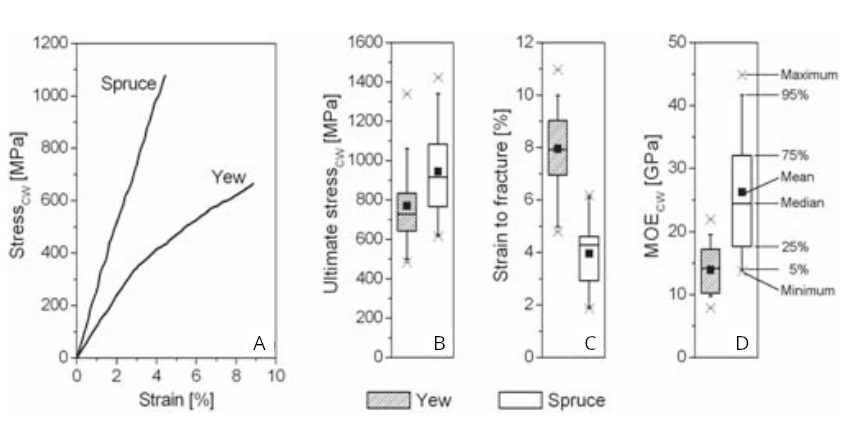
Fig. 9. (A) Representative stressCW–strain curves of one yew and one spruce fiber subjected to longitudinal tension. Spruce shows roughly linear-elastic response while yew is characterized by biphasic behavior. Statistical spread of (B) ultimate stressCW, (C) strain to fracture, and d MOECW determined in 18 yew and 21 spruce experiments. MOE, modulus of elasticity; CW, values based on the cell wall cross-sectional area. Microfibril angles measured on the tissue slices used for fiber isolation were 15°–20° for yew and 0°–5° for spruce (Keunecke et al., 2008)
Generally, MFA is largest at the base of the tree and decreases with height, though it remains consistent within the same species (Donaldson, 2008). The MFA of the yew stays between 27-35˚ in the S2 layer depending on the literature (Fox & Schimleck, 2024; Kornienko, 1970). Compared to the spruce, the microfibrillar angle of the S2 layer is distinguishably larger in yew, at 5°-20° for yew and 0°-5° for spruce (Keunecke et al., 2008).
In conclusion, a larger microfibrillar angle in the cellular level causes a lower modulus of elasticity, an increase in the elasticity of the yew tree in the longitudinal direction (Reiterer et al. 1999). Table 2 compares the longitudinal modulus of elasticity between the hierarchal level of the yew and spruce tree to reveal consistently lower stiffness of the former through all levels. An overview of all the mechanical properties of the yew wood compared to the spruce wood is given in Table 3 (Keunecke et al., 2007).
Table 3. Mean axial stiffness of yew and spruce determined at the finer level and at a higher hierarchal level at 20°C and 65% relative humidity (Keunecke et al., 2008).
| Species | Hierarchical level | MOECW (GPa) | MOECSA (GPa) |
|---|---|---|---|
| Yew | |||
| Fiber | 13.9 (36.6%) | - |
| Tissue | 15.6 (26.9%) | 7.0 (23.9%) |
| Solid wood | 14.3 (20.3%) | 9.7 (17.0%) |
| Spruce | |||
| Fiber | 26.2 (28.3%) | - |
| Tissue | 29.4 (18.6%) | 9.9 (21.5%) |
| Solid wood | 28.1 (8.4%) | 12.1 (12.2%) |
Some studies also observe variables such as tensile strength, compression strength and bending strength. Next to the spruce tree, the yew wins all categories, scoring three times as high in impact bending strength (147 kJ m-2), (Sell, 1997) and a mean bending strength of 118 MPa, 40% higher than the corresponding spruce value (Keunecke et al. 2007). This suggests that the microstructure and mechanical properties of the tree balance both strength and elasticity. These engineering solutions like microfibril angles provide resilience to the yew under mechanical loads or environmental conditions.
How To Survive an Ice Age: The Yew Tree’s Tips and Tricks!
Evidently, these mechanical advantages do not exist in isolation. The yew’s response to environmental stress such as temperature changes, freeze-thaw cycles, and snow accumulation demonstrates how its structure dynamically adapts to varying physical conditions. As yew trees commonly grow in colder northern regions, the constant exposure to low temperatures exerted selective pressure on yew trees, favoring traits that enhance low temperature tolerance and resilience to freeze-thaw cycle. The natural climate of the Pacific yew, for example, can reach annual minimum temperatures from -15 °C to -12 °C according to a study performed in 1990 (Bolsinger & Jaramillo, 1990). These extreme conditions could damage cells and branches, but the dense yet flexible wood allows the tree to bend under stress and recover its shape.
The mechanical stability of yew depends on factors such as age, habitat, and modulus of elasticity (MOE). This was studied in T. baccata over an 11-year period (2014-2025) in Donetsk (Ukraine) to assess the dependence of elasticity on temperature. They observed the tree in two different conditions. Firstly, in natural conditions, in a clump of 50-year-old common yew plants growing without the influence of human factors. As well as a common yew, age 15, growing in a private collection, where the time the tree spent under loads, such as snow, was controlled (Kornienko, Shkirenko et al. 2025).
The following experimental setup simulates the bending of branches under natural loads to calculate the modulus of elasticity. A cut branch was bent, and force required to break it was calculated according to the following formula:

where C, I, and d stand for the cylinder (branch) rigidity, length, and diameter respectively. The rigidity was calculated using the mass of the applied load, the gravitational constant and the displacement of the free end of the branch accordingly:

The results demonstrated that the modulus of elasticity of the T. baccata decreased as temperature rose, making it more flexible in hotter weathers in the following range: 11.5 +/- 0.55 GN m-2 (T = 255 K), 8.8 +/- 0.31 GN m-2 (T = 288 K), and 6.9 +/- 0.47 GN m-2 (t = 308 K) (Kornienko, Shkirenko et al. 2025).The dependence between the temperature and the T. baccata sample MOE can be graphed, in Figure 10, by a decreasing nonlinear function, with a power regression R2 = 0.98 (Kornienko, Shkirenko et al. 2025).

Fig. 10. Temperature dependence of the elastic modulus for all studied samples of T. baccata (Kornienko, Shkirenko et al. 2025)
However, temporary sharp jumps in temperature are much more threatening for the stability of a tree than gradual changes in weather from one season to another (Kornienko, Shkirenko et al. 2025). With freeze-thaw cycles, the yew’s mechanical resistance is reduced by 20-22%. As such, the tree should be in a critical and vulnerable position. Though, the tree has an adaptive strategy which conserves the structure of the conifer to protect it from any physical damage done by snow accumulation, strong winds or falling branches. Though the high elasticity and density of the tree play a role in protecting it from these heavy loads, these variables can be combined into a secret evolutionary trick: the shape memory effect (SME) (Kornienko, Shkirenko et al. 2025).
The SME is enabled by the combination of the high microfibril angles (MFA) in the S2 layer of the tracheid cell walls, the anisotropic elasticity of the wood, and the gradient in density between earlywood and latewood. Because of the high MFA in the cellulose fibers, the branches of the tree can bend along the grain without breaking (Keunecke et al., 2008). Furthermore, the small density gradient between earlywood and latewood allows the tree to store energy (Stanzl-Tschegg et al., 2011). These structural features, amongst others, enable the tree to conserve its shape and recover once the mechanical stress, such as snow load or wind, is removed. Thus, the tree preserves its structural integrity and its exceptional resilience.
From observations between 2017 to 2025, the plants, in the natural environment, restored their crown architecture once the snow load was removed. A notable example is after a strong snowstorm in 2017 (Kornienko, Shkirenko et al. 2025):

Fig. 11. Mechanical resistance of T. baccata after the 2017 snowstorm: (A) under the load; (B) after the recovery (Photo by V. Kornienko, territory of the Arboretum of the Botanic Garden, Donetsk).
The younger, self-grown and shelter-less yew tree behaved in a similar fashion. In 2023, after a snowstorm, the tree was heavily bent, from 20˚ to 160˚ from the vertical position. Once the load was artificially removed, the crown of the plant regained its original shape (Kornienko, Shkirenko et al. 2025):
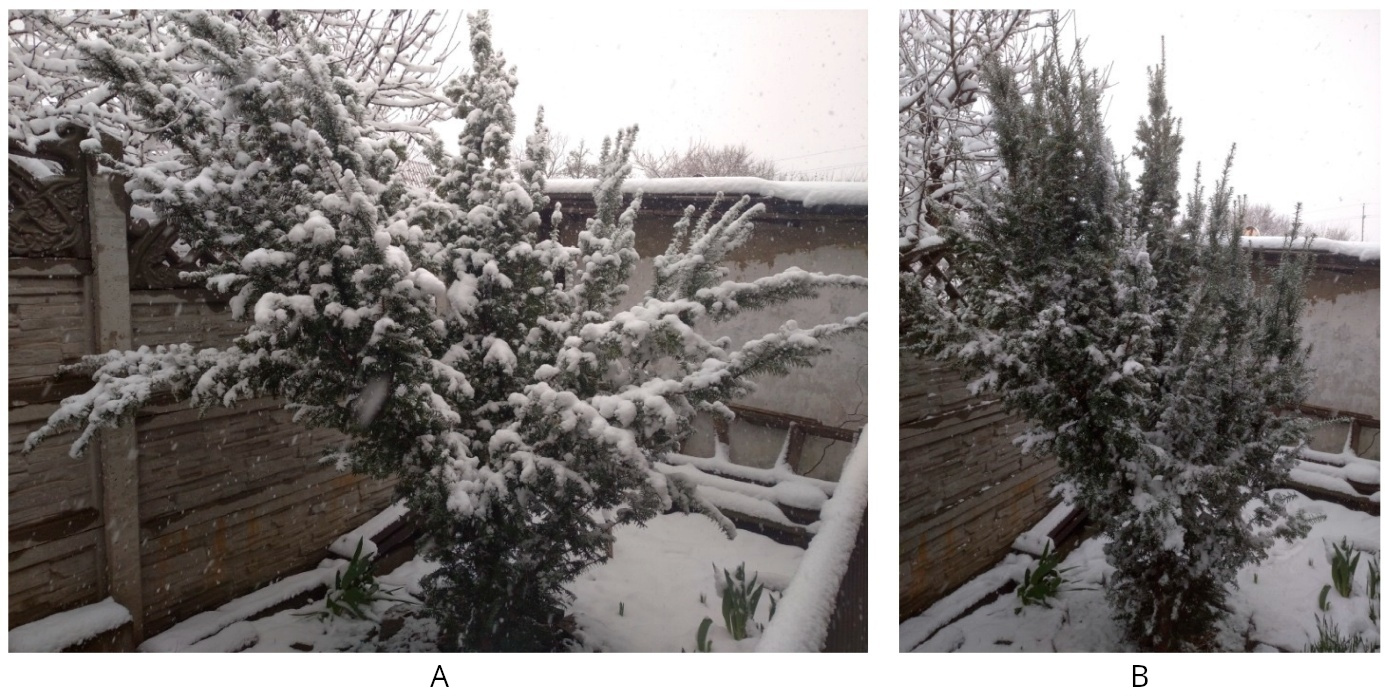
Fig. 12. The condition of the solitary plant after two- and three-fold loading, in the season of 2022–2023 (Photo by V. Kornienko, territory: private collection of English yew, Donetsk). Notes: (A)—with load; (B)—after two- and three-fold artificial removal of load.
This shape memory effect of the English yew is an exclusive behavior compared to other plants growing in the same region. Faced with the same conditions, these plants, such as the J. virginana, F. sylvatica, Ulmus pumila L., and Acer negundo l, undergo irreversible deformations like trunk and skeletal branch breakage (Kornienko, Shkirenko et al. 2025). Since the elastic and dense material properties of the yew tree have evolved to bend under heavy loads and restore its shape once the load is removed, the yew species can preserve their integrity and survive longer than most other species in northern climates.
Protecting Your Battle Scars: How the Yew Tree Resists Cracking
Knots found on trees are remnants of old branches, battle-scars upon which new tissue has grown over dead or atrophied wood. These knots are considered weak points for mechanical stress. For example, the modulus of rupture, the stress at which the material stops bending and breaks, of timber containing knots could be reduced by up to 50% compared to timber without knots. They also significantly affect the modulus of elasticity as well as the bending strength at those points (Cao et al., 2018). Yew is characterized by its knots and contains, like any tree, other fragile elements such as grain deviation and irregularities in the growth ring structure, which can also make it more likely to crack and break.
To analyze fracture and material behavior and examine how the yew tree overcomes these natural defects, the wedge splitting test is used. This test produces a load-displacement diagram that allows the analyzation of the behavior of the material before and after the maximum load, answering three key questions: how much force does it take to crack? Does it continue to crack? And how does the material resist and slow down the propagation of the initial crack?
To analyze fracturing behavior, Keunecke et al. (2007) conducted a micro-wedge splitting experiment using dried yew and spruce wood sawed into 26 mm x 30 mm slats with a 50 mm thickness. A razor blade was used to cut a thin 1 mm notch into each sample, establishing a crack tip to serve as the weak point where the fracture would originate. A loading head generated a force, F, upon the wood slats. Friction was minimized by transmitting the force using roller bearings. The force delivered by the loading head was mostly horizontal and forced the wood apart, splitting the wood along the plane of the initial 1 mm notch. The contact force and the vertical displacement of the loading head were measured by the micro-wedge splitting mechanism through a load cell and a linear variable differential transformer, and the final crack paths were examined using an electron microscope and a stereo microscope. This setup can be seen in Figure 13.

Fig. 13. (A) Illustration of the micro wedge splitting mechanism. The large irregular rectangular piece represents the experimental wood slats and (B) the micro wedge mechanism in practice (Keunecke, Stanzl-Tschegg, & Niemz, 2007).
The information collected from micro wedge splitting tests is presented as a load-displacement graph, seen in Figure 14, showing the load force generated by the loading head upon the wood and the displacement of the loading head. This represents moments where cracks propagate and the material gives way to the force exerted (Keunecke, Stanzl-Tschegg, & Niemz, 2007).

Fig. 14. Stable crack propagation in the radial-tangential direction for a Yew wood. Highlighted in green is the linear elastic response where the slop is Kinit, corresponding to the elasticity of the material. The blue circle indicates the maximum load, Fcrit, where the initiation of the macro-crack takes place, seen as a sharp peak followed by a gradual, stepwise decrease. (modified from Keunecke, Stanzl-Tschegg, & Niemz, 2007).
Yew specimens show a curve progression after the maximum load, the sharp peak just after the linear section known as the linear elastic range where a crack has yet to form. Spruce often fails immediately after the initial macro crack, while yew shows a slow stepwise decrease in load, observed in Figure 11, in the non-highlighted area of the curve. This indicates a slower and more controlled crack propagation. How is the Yew able to resist cracking when its softwood counterparts fail?
We must begin by dissecting the structure of timber itself. Wood can be characterized into two types, earlywood, which has larger cells with weaker cell walls, and latewood, which is stronger, denser, and made of thicker tracheids, which are long lignified cells in the xylem (Pallardy, 2008). Another integral component of wood are ray cells, or radial xylem parenchyma cells, which are parenchyma cells that expand radially across the wood in contrast to axial parenchyma which makes up most of the tree. They are highly lignified, contributing to the reinforcement of wood tissue, as well as being vital to metabolic processes. Tracheids and ray cells often interact and connect with each other, creating interfaces which are weak points in the wood (Słupianek, Dolzblasz, & Sokołowska, 2021).
In softwoods such as spruce and yew, we’d thus expect to see mostly cell wall fracture in the thin walls of earlywood cells, as cracks take the path of least resistance and attack weak points. This is exactly what was observed in Figure 15B, where spruce earlywood cell walls tore in half and fractured, with the crack propagating through the cells themselves. However, in yew, a predominantly intercellular fracture was observed, as seen in Figure 15A, where the crack propagated through the interfaces between cells.

Fig. 15. Crack paths in the tangential-radial (TR) orientation of Yew earlywood (A), and spruce earlywood and latewood (B). In yew earlywood (A) and in latewood of spruce (B), predominantly intercellular fracture is observed where the cell wall remains intact, and the crack path propagates between the cells instead of through them. In spruce earlywood, there is predominant cell wall fracture labeled in green (modified from Keunecke, Stanzl-Tschegg, & Niemz, 2007).
This can be explained with several adaptations. Firstly, yew wood tracheids are particularly strong. They have high cell wall to lumen ratios at 0.23 compared to spruce’s 0.11, which is more than twice the cell wall thickness. This makes their cells resistant to cell wall fracture, resulting in the observed intercellular fractions. However, more interestingly, it is not only strong in material strength but also in its structure as it partakes in fiber bridging. According to Huxford, Ronan, and Russell, fiber bridging is “an extrinsic toughening mechanism whereby fibers from neighboring plies remain attached to both delaminated layers” (2022). Fiber bridging creates force resisting the crack and increases energy required to continue propagating the crack to the next layer, and it is currently a design strategy utilized in composite material engineering. It allows energy to be dissipated instead of continuing the crack front. Compared to spruce wood, which has little to no fiber bridging, Yew wood has an extremely large amount of fiber bridging almost spanning the entire area behind the crack front, as seen in Figure 16, contributing to its crack resistance (Keunecke, Stanzl-Tschegg, & Niemz, 2007).

Fig. 16. Fiber bridging in Yew specimens in the tangential-radial (TR) (A) and radial-tangential (RT) (B) orientation. The dark zones between the two halves are tracheids performing fiber bridging. (Keunecke, Stanzl-Tschegg, & Niemz, 2007).
Secondly, yew’s thinner growth rings, as seen in Figure 17, allow cracks to propagate into stronger latewood instead of earlywood. To add to this effect, the density gradient between Yew’s latewood and earlywood is relatively small, with a mean cell wall thickness difference of 3.5 microns compared to 7.2 microns. Thus, instead of having cracks that solely run through its weakest parts and resulting in drastic breakage and immediate material failure, Yew wood crack paths move from earlywood to latewood, crossing ring boundaries, and slows the cracking (Keunecke, Stanzl-Tschegg, & Niemz, 2007).

Fig. 17. Ring sizes in Yew wood and spruce wood. Notice that the Yew wood has much thinner rings. (Keunecke, Stanzl-Tschegg, & Niemz, 2007).
It was also observed that yew wood can form “relief cracks”, where at a certain load, another crack appears close to the original main crack and crack branching occurs (Stanzl-Tschegg et al., 2011). That is, the propagating main crack splits into two or more cracks, expending energy and slowing complete material failure. This effect often occurs with microcracking, where very small cracks form around the primary crack, essentially shielding the material from direct stress (Breder, 2000). The primary crack can be seen labeled as a. while the smaller relief crack is labeled as b. in Figure 18 below.

Fig. 18. Crack branching mechanisms in Yew wood in the radial-tangential (RT) direction. The crack labeled a) is the primary, original crack, while b) is the secondary branching crack. Notice that still, the main failure mechanism is intercellular fracture with the cell walls remaining undamaged (modified from Stanzl-Tschegg et al., 2011).
Finally, the high ray cell content in yew wood temporarily delays crack propagation and creates cushioning layers to soften impact. Yew wood has a higher percentage of ray cells at 14% compared to spruce at 5%, not only slowing crack propagation but allowing it to have a higher strain resistance in the radial-tangential direction than spruce with almost twice as high maximum load (Keunecke, Stanzl-Tschegg, & Niemz, 2007).
Structural Challenges and Resistance
Structurally, the yew exhibits one of nature’s most efficient engineering solutions: a hollow cylindrical trunk that minimizes weight while preserving maximum strength. A challenge faced by the yew tree is the gradual hollowing of its trunk. Over time, internal decay and fungal activity cause the interior wood to break down, leaving the tree hollow inside. This phenomenon creates difficulties for scientists attempting to determine the true age of ancient Yews, though younger ones are easy to date. Typically, dendrochronology - the study of annual growth rings - is used to approximate a tree’s age. Each year one lighter zone of earlywood appears in spring and early summer, and one darker zone of latewood in late summer and autumn. This means that in a full year, the tree will have grown one light ring and one dark ring of wood (Fig. 19).

Fig. 19. Cross section of a Yew tree showing annual growth rings. One pair of rings, light and dark, is equal to one year of growth, since the lighter zone appears early in the year and the darker one later in the year (Pawlos, 2025).
While the extreme narrowness of yew rings already makes it difficult to study, the loss of the innermost wood compounds the problem. As the hollowing progresses, the oldest rings disappear entirely, making it difficult to count back to the tree’s origin and making it difficult to estimate the tree’s age (Hindson & Moir, 2023). However, despite the difficulty of this task, scientists have developed methods to approximate the age of yew trees. The first one is the relation between the tree’s age and its height, or even its girth. Remarkably, however, this hollowing does not threaten the life of the tree. The yew’s essential living tissues, the cambium, and the outer sapwood, exist only in the outermost layers of the trunk. While these layers remain untouched, the tree will keep adding wood to the outside over the years and will remain strong and stable even if its heartwood is missing.
Despite the hollowness of the tree representing a problem for scientists, it helps the tree maintain its stability. The “hollow cylinder” structure adopted by the tree not only keeps it alive but reinforces it and enhances its mechanical strength in multiple ways (Managing Churchyards and Burial Grounds Section A5. Yews and Other Veteran Trees, n.d.). First, a cylinder's exterior shell (Fig. 20), not its core, provides most of its mechanical strength when bent. The second moment of area principle, which states that material farther from the centre resists bending more efficiently, is the cause of this. The formula for the second moment of area of a hollow cylinder is:

with 𝑅ₒ being the outer radius, 𝑅ᵢ being the inner radius, and 𝐼 being the second moment of area. This equation establishes a proportional relation between 𝐼, which contributes to bending resistance, and the fourth power of the distance from the centre. This shows how the yew protects the portion of its trunk that supports its structure the most by maintaining a strong outer layer made of sapwood and cambium, as stated previously.
Secondly, in comparison to a solid trunk, a hollow one is by far lighter. Indeed, the yew lessens the pressure on its base and roots by removing its decomposing core. As a result, the tree becomes less likely to break under its own weight or in a storm. Finally, yew’s capacity to develop internal roots inside the hollow trunk adds an additional layer of resistance and stability (Fig. 20). Like braces, these roots support the hollow shell from the inside. They grow from top to bottom inside the trunk and tap into the tree’s nutrient and water supply system. This phenomenon helps provide nutrients to the tree as well as provide structural support. This impressive characteristic shows how the Yew transforms what first seem like a weakness, its hollow trunk, into a feature that enhances its longevity and resilience (Andrews, n.d.).

Fig. 20. Side-by-side comparison of a hollow cylinder and a hollow tree trunk (Yew), illustrating the similarity in structural form. (Accucalculator, 2023; Lewis, 2011)
Instead of breaking under pressure, the trunk can therefore withstand strong winds. In addition to its structural advantage, a hollow trunk also contributes to the ecosystem. The pockets created during the hollowing process often provide shelter for many animals or species, like birds, bats, and small mammals, which use the tree to nest. The tree also offers coverage for insects and fungi. This shows that the longevity and the resilience of the Yew tree serve not only its own interests but also benefits the numerous species that rely on it to survive (Thomas & Polwart, 2003). While the exact number of organisms harbored by the Yew tree is difficult to determine, studies show that invertebrate species like Hybocoptus decollatus (maned balloon-head money spider) or Hyptiotes paradoxus (triangle spider) are commonly found on Yew (Jonathan, 2014).
Conclusion
In conclusion, each of the features establish the Yew as an excellent example of how its physical properties enable survival. The ideal balance between density and elasticity as well as its strategies of slow growth and regeneration allow the yew to withstand environmental extremes for centuries. As the tree is analysed through the lens of physics, it becomes clear how the Yew tree offers lessons for design and engineering:
Design Challenges and Solutions:
How does the yew tree ensure longevity and survive its vulnerable sapling stage? Solution: The yew grows in an understory layer, protected by larger trees. It grows exceptionally slowly, producing dense wood, so by the time the bigger trees die, the yew has had the chance to mature steadily and thus become very strong.
How does the yew tree withstand temperature extremes and mechanical stress? Solution: the tree reflects the material property of elasticity, shown especially by its shape-memory effect.
Although, if the tree is elastic, how can it still be dense? Solution: The composition of the yew tree has a high microfibril angle. The tree becomes a coil which can bend without breaking.
How does the yew tree prevent fracture despite its weak points? Solution: Crack propagation resistance through strong structures such as fiber bridging and relief cracking mechanisms. This allows the wood to absorb impact without fatal damage.
How does it maintain stability after decay? Solution: The yew tree redistributes its weight by growing internal roots inside the hollow trunk. It reinforces itself from the inside and sometimes even forms an entirely new trunk.
Together, all these strategies reveal an overarching design principle: resilience through adaptability. This approach mirrors sustainable engineering systems that prioritize flexibility, redundancy, and self-repair.
References
References
Accucalculator. (2023). Hollow Cylinder Volume Calculator. In accucalculator.com. https://accucalculator.com/hollow-cylinder/
Alfredsen, G., Brischke, C., Marais, B. N., Stein, R. F. A., Zimmer, K., & Humar, M. (2021). Modelling the Material Resistance of Wood—Part 1: Utilizing Durability Test Data Based on Different Reference Wood Species. Forests, 12(5), 558–558. https://doi.org/10.3390/f12050558
Asghar, M., Khan, R., Li, J., & Smith, P. (2023). Mechanical characterization of wood under different loading directions. Wood Science and Technology, 57(2), 101–120.
Asghar, R., Khan, M. A., Alyousef, R., Javed, M. F., & Ali, M. (2023). Promoting the green Construction: Scientometric review on the mechanical and structural performance of geopolymer concrete. Construction and Building Materials, 368, 130502. https://doi.org/10.1016/j.conbuildmat.2023.130502
Benham, S. E., Houston Durrant, T., Caudullo, G., & de Rigo, D. (2016). Taxus baccata in Europe: Distribution, habitat, usage and threats. In J. San-Miguel-Ayanz, D. de Rigo, G. Caudullo, T. Houston Durrant, & A. Mauri (Eds.), European atlas of forest tree species (pp. e015921+). Publications Office of the European Union.
Bevan-Jones, R. (2002). The Ancient Yew: A History of Taxus baccata. Windgather Press.
Bolsinger, C. L., & Jaramillo, A. E. (1990). Taxus brevifolia Nutt. Pacific Yew. Silvics of North America, 1, 573–579.
Breder, K. (2000). Toughening Mechanisms in Short Fiber and Particle Toughened Ceramics. Elsevier EBooks, 4, 77–93. https://doi.org/10.1016/b0-08-042993-9/00089-9
Britannica Editor. (n.d.). Taxaceae | plant family | Britannica. Www.britannica.com. https://www.britannica.com/plant/Taxaceae
Cambridge University Press. (n.d.). Understorey. In Cambridge Dictionary. Retrieved September 21, 2025, from https://dictionary.cambridge.org/dictionary/english/understorey
Cao, Y., Street, J., Mitchell, B., To, F., DuBien, J., Seale, R. D., & Shmulsky, R. (2018). Effect of Knots on Horizontal Shear Strength in Southern Yellow Pine. BioResources, 13(2). https://doi.org/10.15376/biores.13.2.4509-4520
Cutting Terminology, Adventitious Roots. (n.d.). Propg.ifas.ufl.edu. https://propg.ifas.ufl.edu/05-cuttings/01-terminology/01-cuttingterms-adventitiousroot.html
Donaldson, L. (2008). Microfibril angle: Measurement, variation and relationships–a review. IAWA Journal, 29(4), 345–386.
Duffield Timber. (2021, October 21). Hardwood vs. Softwood: Differences, Uses, Species & Examples. Duffield Timber. https://duffieldtimber.com/the-workbench/timber-trends/hardwood-vs-softwood-what-are-the-differences
Encyclopedia Britannica Editors. (n.d.). Anisotropy | Definition, Examples, & Facts. Encyclopedia Britannica. https://www.britannica.com/science/anisotropy
Encyclopedia Britannica. (2019). Young’s modulus. In Encyclopædia Britannica. https://www.britannica.com/science/Youngs-modulus
Erwin, L. (n.d.). Taxus sp | Conifers of UBC. https://blogs.ubc.ca/conifersubc/?page_id=72
Fox, G., & Schimleck, L. (2024). Microstructural properties of Pacific Yew as determined with SilviScan. IAWA Journal, 46(1), 147–159. https://doi.org/10.1163/22941932-bja10172
Gibson, L. J. (2012). The mechanical behavior of cellular solids. Journal of Biomechanics, 45(8), 1224–1231.
Gregarious Inc. (2024). Ultimate guide to temperature for Pacific Yew. Greg App. https://greg.app/pacific-Yew-temperature/
Hageneder, F. (2013). Yew. Reaktion Books.
Hartzell, H. R. (1995). Yew and us: A brief history of the Yew tree. In Taxol: Science and applications (pp. 27–34). CRC Press. https://doi.org/10.1201/9780138737368-3
Hindson, T. R., & Moir, A. K. (2023). The dendrochronological potential of decayed Yew wood. Dendrochronologia, 79, 126087–126087. https://doi.org/10.1016/j.dendro.2023.126087
Huxford, B., Ronan, W., & Russell, B. P. (2022). Fibre bridging: Continuum modelling of extrinsic toughening in double cantilever beam tests. Journal of Composite Materials, 56(21), 3307–3321. https://doi.org/10.1177/00219983221112469
Initiative, S. Y. T. H. (2020, November 23). The Tree of the Bow. Scotland’s Yew Tree Heritage Initiative. https://scotlands-Yew-trees.org/history-culture-myth/the-tree-of-the-bow/
Initiative, S. Y. T. H. (2021, April 15). Yew (Taxus)—A sensational survivor. Scotland’s Yew Tree Heritage Initiative. https://scotlands-Yew-trees.org/history-culture-myth/Yew-taxus-a-sensational-survivor/
Iszkuło, G., & Boratyński, A. (2005). Different age and spatial structure of two spontaneous subpopulations of Taxus baccata as a result of various intensity of colonization process. Flora, 200(2), 195–206. https://doi.org/10.1016/j.flora.2004.03.001
Jonathan, C. (2014). Comparison of invertebrates and lichens between young and ancient Yew trees Bachelor agro & biotechnology Specialization Green management 3 th Internship report / bachelor dissertation. https://www.ancient-Yew.org/wp-content/uploads/2023/05/Comparison-of-invertibrates-and-lichens....pdf
Julian. (2023, March). Everything You Need to Know about Yew Trees. Ashridge Nurseries. https://www.ashridgetrees.co.uk/blogs/trees/everything-you-need-to-know-about-Yew-trees
Keunecke, D., & Niemz, P. (2008). Axial stiffness and selected structural properties of Yew and spruce microtensile specimens. Wood Research, 53(1), 1–14.
Keunecke, D., & Niemz, P. (2009). Yew wood: Axial elasticity, structure–function relationships and possible biomechanical background. In Sixth Plant Biomechanics Conference, November 16–21, 2009, Cayenne, French Guyana, France (p. 522).
Keunecke, D., Eder, M., Burgert, I., et al. (2008). Micromechanical properties of common Yew (Taxus baccata) and Norway spruce (Picea abies) transition wood fibers subjected to longitudinal tension. Journal of Wood Science, 54, 420–422. https://doi.org/10.1007/s10086-008-0970-8
Keunecke, D., Evans, R., & Niemz, P. (2009). Microstructural properties of common Yew and Norway spruce determined with Silviscan. IAWA Journal, 30(2), 165–178. https://doi.org/10.1163/22941932-90000212
Keunecke, D., Märki, C., & Niemz, P. (2007). Structural and mechanical properties of Yew wood. Wood Research, 52(2), 23–38.
Keunecke, D., Stanzl-Tschegg, S., & Niemz, P. (2007). Fracture characterisation of Yew (Taxus baccata L.) and spruce (Picea abies [L.] Karst.) in the radial–tangential and tangential–radial crack propagation system by a micro wedge splitting test. Holzforschung, 61(5), 582–588. https://doi.org/10.1515/hf.2007.089
Kinmonth, F. (2006). Ageing the Yew—No core, no curve. International Dendrology Society Yearbook, 2005, 41–46.
Kornienko, V., Shkirenko, A., Reuckaya, V., Meskhi, B., Dzhedirov, D., Olshevskaya, A., Odabashyan, M., Shevchenko, V., Mangasarian, D., & Kulikova, N. (2025). Taxus baccata L. under changing climate conditions in the steppe zone of the East European Plain. Plants, 14(13), 1970. https://doi.org/10.3390/plants14131970
Lewis, S. (2011). Hollow Yew Tree Trunk With Benches Inside, Churchyard, St Bartholomew’s Church, Much Marcle, Herefordshire [Online]. In Flickr. https://www.flickr.com/photos/knowlesteve/5998099227
Lignoma. (n.d.). Yew wood: Properties, processing—All info! Lignoma Magazine. https://www.lignoma.com/en/magazine/Yew-wood/
MANAGING CHURCHYARDS AND BURIAL GROUNDS Section A 5. Yews and Other Veteran Trees. (n.d.). Retrieved September 30, 2025, from https://www.caringforgodsacre.org.uk/wp-content/uploads/2022/09/A5-Yews-and-Other-Veteran-Trees-2022.pdf
Max. (2023, October 9). Yew trees: Poisonous to humans & animals. Plantura. https://plantura.garden/uk/trees-shrubs/Yew/Yew-trees-poisonous
Meredith, A., & Fry, J. (2016). Ageing the Yew. The Journal of the Royal Forestry Society, 4(1), 269–274.
Moir, A., Hindson, T., Hills, T., & Haddlesey, R. (2013). The exceptional Yew trees of England, Scotland and Wales. Quarterly Journal of Forestry, 107(3), 185–191.
Pacholko, K. (2023, March 22). Yew pests and diseases. Horticulture for Home Gardeners. https://horticultureforhomegardeners.ca/2023/03/22/Yew-pests-and-diseases/
Pallardy, S. G. (2008). Physiology of woody plants. Academic Press.
Pawlos, D. (2025). Growth rings and cracks in charred Yew tree slice. Tree trunk cross section structure. 123RF. https://www.123rf.com/photo_228442751_growth-rings-and-cracks-in-charred-Yew-tree-slice-tree-trunk-cross-section-structure.html
Perrin, P. M., & Mitchell, F. J. G. (2012). Effects of shade on growth, biomass allocation and leaf morphology in European Yew (Taxus baccata L.). European Journal of Forest Research, 132(2), 211–218. https://doi.org/10.1007/s10342-012-0668-8
Petroudy, S. D. (2017). Physical and mechanical properties of natural fibers. In Advanced high strength natural fibre composites in construction (pp. 59–83). Woodhead Publishing.
Sell, J. (1997). Eigenschaften und Kenngrössen von Holzarten. Baufachverlag.
Słupianek, A., Dolzblasz, A., & Sokołowska, K. (2021). Xylem parenchyma—Role and relevance in wood functioning in trees. Plants, 10(6), 1247. https://doi.org/10.3390/plants10061247
Stanzl-Tschegg, S. E., Keunecke, D., & Tschegg, E. K. (2011). Fracture tolerance of reaction wood (Yew and spruce wood in the TR crack propagation system). Journal of the Mechanical Behavior of Biomedical Materials, 4(5), 688–698. https://doi.org/10.1016/j.jmbbm.2010.11.010
Thakur, A., & Kanwal, K. S. (2024). Assessing the global distribution and conservation status of the Taxus genus: An overview. Trees, Forests and People, 15, 100501.
The Canadian Encyclopedia. (2015). Yew. Thecanadianencyclopedia.ca. https://thecanadianencyclopedia.ca/en/article/Yew
The Engineering Toolbox. (2003). Young’s Modulus - Tensile and Yield Strength for common Materials. Engineeringtoolbox.com; Engineering Toolbox. https://www.engineeringtoolbox.com/young-modulus-d_417.html
Thomas, P. A., & Polwart, A. (2003). Taxus baccata L. Journal of Ecology, 91(3), 489–524. https://doi.org/10.1046/j.1365-2745.2003.00783.x
World’s Finest Yew Longbows. (2025). Ravenbeak Natureworks. https://www.ravenbeak.com
Yew. (2021). Woodlands.co.uk. https://www.woodlands.co.uk/blog/tree-identification/Yew/
Zhang, Z., Zhong, W., Li, J., & Luo, J. (2025). Anisotropic mechanical properties and cushioning effectiveness of spruce subjected to different direction loading. Materials Research Express, 12(1), 015101. https://doi.org/10.1088/2053-1591/ada232