
Table of Contents
On this page
Keywords: sequoia, physics, fog, water, xylem, bark, roots, serotinous cones, gas exchanges
Abstract
Sequoias are often considered to be the tallest trees in the world. However, their large size brings about equally large problems. As such, sequoia trees have evolved to deal with these issues, capitalizing off their environment while protecting themselves from it, and seemingly defying gravity. This essay will demonstrate how the sequoia tree adapted to its environment through the lens of physics. To support their mass and growth, the sequoia needs enormous quantities of water. Thus, these giant trees have settled in areas that are often covered in fog, since the sequoia’s leaves have absorptive properties. Sequoia have also adapted their xylem size and have stomata that are permanently open to maximize water gain. In addition, the sequoia tree has evolved thick bark with a highly fibrous and deformable outer bark which acts as a cushion against physical impacts, while simultaneously offering insulation against heat. Another layer of tissue is used to further resist wildfires. Furthermore, the sequoia’s shallow yet wide root systems allow roots to bend in different orientations and patterns, enabling the tree to anchor itself into the ground without toppling. The serotinous cones of the sequoia tree have small resin ducts, and larger and compact scales to provide fire resistance, which is useful since forest fires are a big part of the tree’s reproduction cycle.
Introduction
When talking about sequoia trees, there are two distinct species of redwood that share the spotlight: Sequoiadendron giganteum (Fig. 1), more commonly known as the giant sequoia, and Sequoia sempervirens (Fig. 2), usually referred to as the coast redwood. Both species have evolved to support their immense mass and height, as well as resist droughts and survive the common high energy impacts of their habitat, such as rockfall events and forest fires (Bold et al., 2020). Their wood is therefore light, but strong for its weight. It is also soft, and its bark is moderately coarse to coarse in texture. Giant sequoias have 75% more ray tissue than coast redwoods do, and this trait is a key diagnostic feature used to distinguish the two species’ wood from one another (Piirto, 1986). Ray tissue accounts for storage and radial transportation of materials between the xylem and phloem of the tree (Ha et al., 2022). Both trees are only found throughout the State of California, but never together (Fig. 3). The giant sequoia’s habitat is secluded to the western slope of the Sierra Nevada, at altitudes between 6000 and 8000 feet. They are often subjected to harsh winters, dry summers, and thunderstorms. Meanwhile, the coast redwoods inhabit many north coast forests, where the climate is colder, with more fog passing through and significantly less storms (Peattie, 2007).

Fig. 1. A giant sequoia tree (Sequoiadendron giganteum) on the Red Hill Grove (Vescia, 2025).

Fig. 2. A coast redwood tree, also known as Sequoia sempervirens (Nelson, 2022).

Fig. 3. The distribution of giant sequoia forests (dark green) versus coast redwood forests (light green) across California, US (Burns et al., 2018).
Giant sequoias and coast redwoods are also called “big trees” (Burns et al., 2018). The coast redwood is known for being the tallest tree in the world, while its relative, the giant sequoia, is the most massive tree species on Earth. For comparison, if one were to have been on the roof of a 10-story building, they would only reach about half of the height of the giant sequoia, which can reach up to 317 feet (96.622 meters) (Fig. 4). The coast redwood stands even taller, reaching up to 380 feet (115.824 meters) in height, and claiming its title as the tallest tree species in the world. However, what the giant sequoia lacks in height, it makes up for in width: the diameter of a giant sequoia trunk can reach up to 40 feet (12.192 meters) near ground level, and a single tree can weigh over 500 metric tons. Sequoias trees also have extremely long lifespans. Coast redwoods can live over 2,500 years, while giant sequoias’ lifespan have been found to surpass 3,200 years. The fossils of ancestral sequoia trees have been found all throughout the northern hemisphere, and date back to over 200 million years ago. However, despite their near-immortality, both remaining sequoia species are condensed to only one spot in the world, California, and are currently endangered due to various factors, with climate change being a major contributor to their path to extinction (Burns et al., 2018).

Fig. 4. Height comparison between a ten-story building, the giant sequoia, and the coast redwood, adapted from National Park Service, 2020 (National Park Service, 2020).
Sequoia trees use the laws of physics to their advantage at every moment of their long lives. Thermodynamics play a large role in the sequoia’s life, as the tree relies on its heat-resistant bark to survive forest fires, and uses serotinous cones to reproduce. They also use principles of mechanics to stay upright despite their shallow roots, as well as to resist high energy impacts. Additionally, the sequoia tree utilizes fluidics to respond to droughts, and transport water throughout its great height.
Thermodynamics
Effect on Microclimates
The London Planetree which can reach up to 24 m in height and with a canopy width of 18m can reduce summer electricity-related carbon emissions by an average of 31% (Eckmann et al., 2018). Similarly, the giant sequoia tree which grows up to nearly 100m has a significant impact on the surrounding environment. In a 2018 study by Eckmann and coworkers on the sequoiadendron giganteum’s effect in urban areas and its ability to mitigate urban heat islands, the presence of the sequoiadendron giganteum is shown to reduce surface temperatures by up to 17.8 °C near and beneath canopies, additionally cooling areas downstream in simulations with stronger winds, as seen in Fig. 5. This is likely a result of not only the shade created by its large foliage but also the considerable root density and area which enhances transpiration and thus cools down its surrounding environment (Zheng et al, 2018.).

Fig. 5. Modeled effect of sequoias on surface temperature at 16:00 local time under varying wind and tree configurations. (A) Effect of 4 trees on July 6 with mean winds of 2.1 m/s and a wind direction of 340°. (B) Effect of 4 trees on July 14 with mean winds of 2.6m/s and a wind direction of 330°. (C) Effect of all 8 trees on July 6 with mean winds of 2.1 m/s and a wind direction of 340°. (D) Effect of all 8 trees on July 14 with mean winds of 2.6m/s and a wind direction of 330° (Eckmann et al., 2018).
Field-scale modeling additionally shows that only 8 giant sequoia trees can measurably lower the local CO2 concentration. Simulators found a reduction of up to 7.6ppm in above ground CO2 in optimal wind conditions, which although may be a small impact relative to the ~420 ppm global background, represents a detectable localized drawdown of atmospheric CO2 and highlights the tree’s role in the immediate microclimate. In controlled experiments, the giant sequoia exhibits a mean mass-based photosynthetic rate of about Amass = 215.6 ± 36.1 nmol g−1 s−1 and stomatal conductance of gmass = 4.83 ± 0.84 mmol g−1 s−1 compared with roughly 146.5 ± 19.5 nmol g−1 s−1 and 2.05 ± 0.22 mmol g−1 s−1 in the sequoia sempervirens (Ambrose et al., 2015). Therefore, although the sequoia seedling generally develops more shoots and thus potentially a greater total leaf area, the sequoiadendron giganteum’s superior leaf-level gas exchange enables it to act as a strong CO2 sink.
High Heat Isolation Capability in Bark
The giant sequoia’s bark has evolved to withstand forest fires remarkably well, which was crucial to its survival in its storm-ridden and dry environment. This tree’s bark is especially resistant to fire due to its high thickness, loose structure, as well as chemical components which will be covered in the next article of this series.
The bark’s immense thickness helps insulate the tree’s vascular cambium, which is a tissue responsible for the formation of the tree’s xylem, phloem, and bark. As it is the source of undifferentiated cells and the site of secondary growth, no tree can survive without cambium. Since bark is the cambium’s only layer of protection, the thickness of the bark is essential in determining how well a tree does in the presence of a fire. Typically, the vascular cambium can survive in temperatures up to 60°C before the damage done to the tree becomes lethal (Bold et al., 2020). The outer bark of the giant sequoia also has a unique ‘loose’ structure with air inclusions (Fig. 11), which helps augment its heat insulation capacity. These air pockets within its structure gives the sequoia’s outer bark its low density, which in turn lowers the thermal diffusivity, a property that determines how easily heat flows through the bark’s thickness (Bold et al., 2020; van Mantgem & Schwartz, 2002). The thermal diffusivity of a material, denoted as α (in m2/s) is denoted by:

where λ is the material dependent thermal conductivity in W/(m*k), ρ is the density in kg*m3, and cp is the material’s specific heat capacity in J/(kg*K) (Kain et al., 2013). Additionally, the giant sequoia’s outer bark has thin semi-transparent membrane scales attached to its fibrous architecture, which makes it so that a fire’s propagating heat would need to penetrate many air-filled spaces, bordered with membranes of high tannin content (see Sequoia Chemistry). This limits heat transfer through the bark by convection, due to air’s low heat transfer coefficient being confined to extremely low volumes in the bark’s sponge-like material (Tributsch & Fiechter, 2008).
Serotinous Cones
The giant sequoia is a serotinous conifer, meaning its reproduction relies on moderate to high-severity fires. Sequoia’s serotinous cones contain the sequoia seeds until exposed to intense heat from the environment. Keeping the seeds in the cone until after high-severity forest fires has proven to be advantageous for the giant sequoia, as seen in Fig. 6. This is due to the fire’s consumption of all duff and litter, which makes it easier for sequoia seedlings to sink their roots into the soil. The fire also creates a layer of mineral ash that helps the sequoia seedlings’ growth by providing essential plant nutrients and elevating the soil pH (Saunders, 2018). Forest fires additionally remove most or all surrounding canopy trees which provides the sequoia seedlings with high levels of sunlight and allows it to escape predation and competition of other species (Hanson et al., 2024; Moya et al., 2008).

Fig. 6. An abundance of sequoia seedlings shown sprouting after a high-severity fire in Redwood Mountain Grove (Hanson et al., 2024).
The underlying principles behind the serotinous cone lie in its structure. Serotinous cones have smaller resin ducts than non-serotinous cones (Fig. 7), and their scales are closer together (Fig. 8). Their ovuliferous scales are also significantly larger and thicker and have more multilayered sclereid cells than their non-serotinous counterparts. The structure of the scales is a vital part of the serotinous cone because of its lid-like function. In the presence of a fire, the resinous material that coats the closed cone melts, allowing its scales to open and let the seeds out (Kozlowski & Pallardy, 2002; Moya et al., 2008). This is the sequoia’s design solution, shielding its seeds from getting burned and releasing them when the time is right. This way, the seeds can benefit from the post-fire environment.

Fig. 7. The Lodgepole Pinecone, a serotinous cone before (left) and after (right) pyrohydriscence, which is the process of a cone opening up and expelling seeds after initial exposure to fire, followed by water (The Pine Barrens, n.d.).

Fig. 8. Comparison of the radial sections of a serotinous (A) versus a non-serotinous (B) cone (Moya et al., 2008).
Compared to non-serotinous ones, serotinous cones are more compact, rigid, and consistent, which explains their higher insulation and seed protection abilities, as well as the reason why they can bear higher stress conditions before opening (Adapted from Moya et al., 2008).
Mechanics
Anti-Toppling Mechanisms
Despite their towering height, the giant sequoia only allocates one eighth of its total volume into the development of its root systems, whereas in other trees like the Monterey pine this proportion can go up to one fourth. Unlike most trees, the sequoia's roots are very shallow, only going down to 6 feet underground (Yosemite Conservancy, 2016), less than a 9-year-old black walnut tree (around 7.5 ft) (Williams, n.d). The total above ground weight of these giants can reach up to 5 500 000 lbs or 2495 metric tons, meaning any serious displacement of its center of gravity has the risk of rending the entire root system. Additionally, among the more ancient trees, the upper 20 to 50 feet of trunk is generally dead due to hydraulic constraints, and heavy branches may grow to its summit, which can be a serious source of disequilibrium to the tree, if extended too far from the trunk (MacDougal, 1937). Thus, how is the sequoiadendron giganteum able to maintain itself upright? These trees utilize several mechanisms, the first of which is the structure of roots.
In order for a tree to prevent buckling, the restoring moment (MR) must be equal to or larger than the bending moment, which in many cases is influenced by the aerial drag represented as a product of the canopy sail area (A) and the square of the ambient wind speed (U):, i.e. MB = FL (where L is the length of the trunk) as seen in Fig. 9 but can also fluctuate based on branching patterns as previously mentioned. The contribution of root tissue to the restoring moment is largely determined by its distance away from the center of rotation (x) and the amount of restoring force it can apply (R), that is, how much torque the root can apply onto the shoot-root system (MR = Rx). The orientation of the root will determine what stress it will receive when faced with load, lateral roots which find themselves normal to the prevailing moment will experience torsion, and therefore twist, and lateral roots which are facing the moment will bend primarily upwards and downwards, whereas roots which intersect with the axis of rotation such as tap or sinker roots tend to flex in complex patterns.

Fig. 9. Structural and mechanical model of tree root system. (A) Schematics of different root types (a: lateral roots; b: tap roots; c: sinker roots; d: fibrous roots). (B) and (C) Two dimensional are finite element models (FEM) describing the stresses within the root and on the surrounding soil under normal load. (D) Mechanical force diagram of a tree under load from wind (Stubbs et al., 2019).
Notably, the interaction between the root architecture and the physical properties of the soil such as density, hydration, compaction, and soil shear strength (d, ρ, h, c, and τ, respectively) play an important role in determining the structural integrity of this tree. As dry soil quickly hydrates, reducing particulate cohesion, softening cement aggregate and trapping compressed air which may explosively release and cause soil failure, the roots additionally become susceptible to bending and twisting (Stubbs et al., 2019). Redwoods mitigate these seasonal risks by sacrificing root depth and spreading forces across an enormous lateral network, which prevents localized failure. Additionally, their conical geometry maximizes the lever arm for a given volume, maintaining a sufficient restoring moment (Niklas, 1998).
Defensive Role of Bark
Generally located in the Sierra Nevada region of the United States of America, redwood forests experience frequent rockfall, which can consist of boulders several meters in diameter falling from high cliffs, as shown in Fig. 10. Prehistoric and historic rockfalls caused by landslides in the region have been described as “catastrophic” regarding the extent of the damage that similar modern-day occurrences would cause to human infrastructure in the region (Wieczorek, 2002). This poses an immediate and long-running threat to sequoia trees, which have adapted to survive mechanical hardships that would leave most similar-scale human-built structures destroyed.

Fig. 10. Fallen boulders in Redwood Regional Park, Oakland California (Gambolin’ Man, 2019)
The sequoia’s design solution for improving its survival rate from high-energy encounters with massive boulders revolves around the mechanical properties of the bark tissue, which is optimized for elastic deformation that allows the sequoia to dissipate the energy of the rockfall collisions, dampening the impact (Bold et al., 2020).
Regarding its continuum mechanics, research by Bold et al. (2020) indicates that the sequoia bark’s effectiveness at dissipating impact energy is based on (1) its highly interconnected fiber-based structure, (2) its compaction behavior, and (3) the mechanical behavior of the fibers in micro-tensile tests.
The bark consists of two distinct layers. The first, the inner bark, is dense and structurally simple, resembling the aspect of the core trunk wood. The second layer, the outer bark, is relatively complex in structure and composed of highly fibrous, less dense material as is visible in Fig. 11 below (Bold et al., 2020). The molecular structure of the bark, which consists of nano-cellulose, will be discussed further in the second paper of this series.

Fig. 11. (A) A cross-section slice of Sequoiadendron Giganteum. (B) IB denotes the inner bark, and OB, the outer bark. The fibrous structure of the inner bark is the source of its impact resistance, modified from Bold and coworkers, 2020 (Bold et al., 2020).
Very fibrous materials tend to behave differently to more rigid materials, as shown in Fig. 12. Whereas the more rigid material requires large amounts of applied force (stress) to show any deformation (strain) and tend to slack after their high initial resistance, interconnected fibrous materials readily show strain for lower stress, but get exponentially harder to deform as stress grows. The latter is typical of biological tissues: the “toe” region in their stress-strain curves, which can be seen in Fig. 12 and Fig. 15, occurs before a practically linear phase, as is very clear in Fig. 15. This behavior is also present in other biological tissues such as tendons, bones and ligaments, as it is essential to their function that they allow for great initial flexibility and later toughness. (Urone & Hinrichs, 2012)

Fig. 12. (A) Stress-strain curve of a hyper realistic model of a highly fibrous architectured material, adapted from Orlova and colleagues, 2023 (Orlova et al., 2023). (B) Stress-strain curve of core trunk birch wood, with strain applied parallel to the grain, adapted from Al-musawi and coworkers, 2024 (Al-musawi et al., 2024). Note the scale difference between the two stress axes, although this figure demonstrates the overall behavior of highly interconnected fiber-based materials compared to more linear fibrous arrangements like core trunk wood [See Fig. 13 below].

Fig. 13. (A) A visual representation of the simulated highly interconnected fibrous material whose stress-strain curve is shown on Fig. 12, adapted from Orlova and coworkers, 2023 (Orlova et al., 2023). (B) A grain-parallel confocal laser scanning microscopy image of pine wood, adapted from Chaffey, 2002 (Chaffey, 2002). Note the inherent difference between the structures of network-based and linear fibrous materials.
However, the giant sequoia’s bark is not only more fibrous, and therefore better at resisting impact than core wood, as it is also better at dissipating mechanical impact energy (the giant sequoia’s bark reaches 90.8% energy dissipation) than other tree’s barks, such as Ailanthus altissima (which dissipates 85.2%—significantly lower than the sequoia’s bark high dissipation capacity), whose natural habitat is not subject to rockfall (Bold et al., 2020). This trend is also observable in other plant tissues that suffer frequent impacts, such as seed and fruit casings like the pomelo fruit’s peel and the coconut’s coir, which have highly hierarchical fiber-based compositions to match the giant sequoia’s bark (Seidel et al., 2009).
The second pillar to the giant sequoia’s bark impact protection is its highly elastic and two-staged compaction behavior, as shown in Fig. 14 below.

Fig. 14. Frames taken from a high-speed video of a dynamic drop-weight test of giant sequoia bark. Note how the second frame shows that most of the air gaps between the fibrous layers are compacted before the layers themselves are compressed—as it is visible in the third frame—and that the appearance of the bark sample remains largely unchanged after the impact (Bold et al., 2020).
The two stages of the compaction timeline of sequoia bark are as follows: first, the “empty” space between the fibrous layers and between the fibers themselves are evacuated, and second, the fiber networks are compressed together (there exists a high probability that the individual fibers themselves are also getting compressed, although this has not been directly observed). After the impact, the bark returns mostly to its pre-impact state, however it remains slightly deformed. This residual strain is mostly noticeable after many repetitions of a quasistatic cyclic compression test (Bold et al., 2020). It remains that, unlike human-made structures, biological tissues can heal, which might explain why nearly perfect elasticity is not needed due to the relative infrequency of rockfalls.
The giant sequoia has one last trick up its sleeve to survive life-threatening impacts with boulders: the fibers that compose the sequoia’s outer bark network are individually (even more so in pairs) very resistant to stress, as shown in Fig. 15 below.

Fig. 15. Micro tensile strain test results on single (A) and paired (B) sequoia bark fibers (Bold et al., 2020). Note the “toe” region of the graph where ε < 0 that was discussed earlier.
The arrows on Fig. 15 (B) above point at two pre-failure events during the micro tensile strain test. These pre-failures do not occur while testing individual fibers because the links between fibers are weaker than the fibers themselves and are linked over shorter overlap lengths as opposed to being bound continuously over their lengths. These events are therefore considered to correspond to the fibers detaching from each other, although the detached pair can still support over twice the stress of a single fiber (Bold et al., 2020).
The giant sequoia’s bark is an amazing application of highly hierarchical fibrous materials that allow the species to endure its harsh environment’s worst mechanical threats by adopting a two-staged compaction behavior and a remarkable synergy in its networked composure.
Basics of Water Transport
Due to the sequoia’s size, with certain individuals from the sequoia sempervirens species exceeding 110 m in height, transporting water to the treetop poses a challenge for the tree (Peattie, 2013). The taller the tree, the more water it will have to carry and store while fighting gravity.
Pallardy and coworkers (1995) explain the movement of water in trees using this equation (2).


The water potential at a point is represented by Ψ and r is the resistance from one point to another.
Thus, the treetop needs a low water potential to increase ΔΨ which in turn increases the flux. As shown in Fig. 16, trees achieve this by creating negative pressure at the treetop via transpiration, while utilizing the cohesive and adhesive properties of water (Clark et al., 2018).

Fig. 16. How trees transport water from roots to shoots (Clark et al., 2018).
Although this strategy works for most plants, bigger trees such as Sequoia sempervirens require additional adaptations to efficiently transport water.
Impact of Xylem Width
One of the ways that sequoia promote water transport is by changing the width of the xylem in their trunks. The hydraulic resistance can be represented by the Hagen-Poiseuille equation (4) where r is the hydraulic resistance of water, μ = dynamic viscosity of water in mPa, L is the path length, and D is conduit diameter (Melvin T. Tyree; Zimmermann, 2002).

Although the sequoia’s height greatly increases the path length, the tree can minimize the hydraulic resistance by widening the diameter of its xylem.
Accordingly, sequoia sempervirens has one of the largest conduit diameters with a mean width of 57 μm (Pallardy et al., 1995). However, a study by William and colleagues (2019) shows that the xylem width in a tree changes depending on the location. At 0.01, 0.20, and 84.80 m from the treetop, xylem widths are 3.6, 9.0, and 67.5 μm respectively (Williams et al., 2019). As shown in Fig. 17, plotting dozens of these collected data points creates a power function (5) where α is the mean conduit diameter at 1 cm from the treetop, β is the rate of change of the mean conduit diameter, X is the distance from treetop, and Y is the conduit diameter (Williams et al., 2019).

In conjunction with the Hagen-Poiseuille equation, this power function enabled Williams and colleagues (2019) to calculate the hydraulic resistance as a function of distance below treetop, which they used to plot Fig. 18, showing off how increasing xylem diameter can drastically reduce the accumulation of resistance as the height of the tree increases.

Fig. 17. Conduit width depending on meters below treetop. Travelling down the tree, the conduit diameter increases quickly before the rate of change decreases. The smaller graphs give a different visualization of the same data, modified from Williams and coworkers, 2019 (Williams et al., 2019).

Fig. 18. Cumulative resistance depending on meters below treetop and the constant β. Solid lines represent the graph after taking into account tracheid length variation while the dashed lines do not take into account tracheid length variation (Williams et al., 2019).
Issues With Increased Xylem Width
Increasing xylem width increases water flux, it also brings risks. For example, increasing conduit width makes the tree less resistant to outside forces such as strong winds and their own weight (Williams et al., 2019). However, as shown in Fig. 19, the main drawback of a bigger conduit diameter is the increased risk of cavitation, the vaporization of water creating an air bubble inside the xylem also known as an embolism, which renders the xylem unable to transport any liquid (Pallardy et al., 1995).

Fig. 19. Relationship between tracheid diameter and cavitation/embolism pressure. The higher the number on the horizontal axis, the better the conduit is at resisting cavitation. The letter pairs on the graph represent the performance of certain trees (Pittermann et al., 2006).
To balance these risks, the conduit diameter of a sequoia sapling will be small, since a shorter tree does not transport water to a great height (Williams et al., 2019). However, as demonstrated in Fig. 20, the conduit diameter will widen as the tree grows taller, which serves to minimize hydraulic resistance. Even then, Williams and coworkers (2019) found that the conduit widening slows down when the sequoia reaches 60 m in height to reduce the risk of cavitation while also maintaining the stem’s mechanical strength.

Fig. 20. Tracheid diameter in relation to a conifer’s height. The shaded region represents conduits that are approaching their maximum width (Williams et al., 2019).
Branches and Foliage in Tree Hydraulics
Although experiments from Williams and colleagues (2019) confirm that conduit width decreases at higher tree heights, these results only apply to the trunk of the sequoia. Branches and shoots at greater heights tend to increase in xylem diameter, which is reflected in Fig. 21 by the increased water conductivity in higher branches (Burgess et al., 2006).

Fig. 21. Increase in water conductivity in relation to tree height, which reflects an increase in xylem diameter (Burgess et al., 2006).
However, this raises a question. If the main stem of the tree narrows its conduits at greater heights to reduce mechanical stress and cavitation risks, why don’t branches follow the same trend? Research by Ishii and coworkers (2014) proposes that, much like the trunk, the branches and shoots are balancing risk and reward. Unlike a cavitation in the main stem, which would disable water transport to multiple areas of the tree, embolism in a singular branch would only affect the branch itself, leading to minimal damage. As such, branches can afford larger conduits while minimizing risk (Ishii et al., 2014).
In addition, the foliage and wood at higher levels of the sequoia tree evolved to store water while also being able to absorb water from the foggy environment (Burgess & Dawson, 2004; Ishii et al., 2014; Mason Earles et al., 2016). Due to this role, Ishii and coworkers (2014) found that sequoia branches sacrifice the total area of xylem in favor of an increased area of parenchyma tissue, which increases water storage capacity. This change in wood composition can be visualized in Fig. 22. As such, the same study found that sequoia foliage, at maximum performance, can store 204.1 grams of water per meter square, which equates to five times the amount of water the tree transpires per day (Ishii et al., 2014).
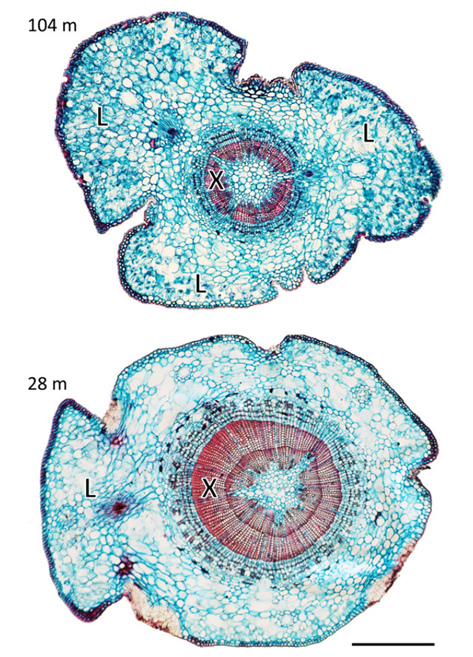
Fig. 22. Wood composition at different trunk heights. Red represents xylem area, and blue represents parenchyma area (Ishii et al., 2014).
Water in foliage and branches can be used for more than just transpiration. For example, Fig. 23 shows a decrease in embolized area after soaking a branch in water for 16 hours (Mason Earles et al., 2016). As such, water absorbed and stored in branches can be used to counter cavitation.

Fig. 23. The area in blue represents the area of wood that is embolized. A) shows the branch before the treatment. B) shows the branch after the treatment. C) shows the change in embolized area (adapted from Mason Earles et al., 2016).
Fluidics
Drought Responses
The variation between the environments of the coastal redwood sequoia (Sequoia) and the giant sequoia (Sequoiadendron Giganteum) has largely influenced many of their functions. Notably, the presence of low hydration periods in the Sequoiadendron giganteum populations results in significant risk of desiccation. Thus, the development of adaptive mechanisms to combat drought is necessary. Despite a clear decline in volumetric water content (VCW) in both genera when faced with periods of severe drought, there remains a remarkable consistency in both daytime and predawn shoot water potential in giant sequoia sapling with mean (± SD) predawn (ΨPD) values declining only to −0.69 ± 0.08 MPa compared with −2.35 ± 0.26 MPa in coast redwood (Sequoia), and daytime (ΨDT) values declining to −1.39 ± 0.11 MPa compared with −2.81 ± 0.31 MPa in Sequoia (Fig. 24). This is likely a result of these trees’ particular stomatal sensitivity. When sensing periods of drought, the sequoiadendron, which presents isohydric properties, will close its stomata (locus of gas/water exchange) in order to limit transpiration, at the cost of nutrient production, whereas the sequoia, an anisohydric plant, will not alter its stomatal state, thus resulting in increased evaporation and consequently very low stem water potential in arid conditions. In optimal conditions, the anisohydric strategy offers a clear advantage for the sequoia as it allows for more efficient resource acquisition and thus biomass development. This, in turn, may result in increased height and number of photosynthetic shoots. However, this “greedy” approach, results in high risk of xylem or even hydraulic failure through cavitation or air embolisms, once climates become less hospitable (Ambrose et al., 2015).

Fig. 24. Mean (± SE) (a,b) soil VWC, (c,d) pre-dawn shoot water potential, and (e,f) daytime shoot water potential for sequoia and sequoiadendron seedlings from six populations grown under control (well-watered) and drought (no water) water regimes at four different measurement periods. (Ambrose et al., 2015)
Additionally, giant sequoia trees allocate a significantly greater fraction of total plant dry mass to roots but a significantly lower fraction allocated to woody stems than Sequoia (Ambrose et al., 2015), a factor that may limit tree height and total leaf area, possibly contributing to the aforementioned transpiration rates and emphasizing the dichotomy between survival and competition.
Foliar Water Uptake of Fog
The Sierra Nevada region, attributable to its proximity to the Pacific Ocean, is subject to frequent fog, which has been found to be a major factor in the proliferation of coast redwoods as shown in Fig. 25 below.

Fig. 25. The relative influence of various environmental factors on redwood Sequoia sempervirens probability of presence. Note the main driver here is fog frequency, followed by soil moisture levels (Francis et al., 2020).
One possible and intuitive explanation to this phenomenon would be that fog, like rainfall, brings more moisture to the soil, which sequoias will collect through their roots. However, fog does not moisten the underlying soil significantly compared to rainfall (Francis et al., 2020), so sequoias must resolve on another mode of hydration to ensure their survival, especially during the Sierra Nevada region’s summer droughts. The solution the sequoias found through time is absorbing the fog’s water content through their leaves, something most other trees (notably, trees native to the mediterranean climate) cannot do due to the lack of frequent fog in their habitat. Instead of relying on long-term water storage, like mediterranean trees do, sequoias leverage the characteristically frequent presence of summer fog in their forests to maintain their hydration during the dry period (Burgess & Dawson, 2004; Petreshen et al., 2025).
To measure the quantity of water absorbed through this peculiar channel, Burgess & Dawson’s experiment consisted of exposing potted two-meter-tall saplings to an engineered fog, which consisted of a known proportion of deuterium-composed water. The results were as follows in Table 1.
Table 1. Isotope fog experiment results, adapted from Burgess and Dawson, 2004, (Burgess & Dawson, 2004).
| Leaf fog water proportion (%) | Water-stressed sapling | Well-watered sapling |
|---|---|---|
| Old leaves | 1.6 | 6.4 |
| Young leaves | 1.2 | 1.8 |
First, while these proportions may seem low, fog does not merely constitute input water; it also diminishes the quantity of water lost to transpiration. Because fog reduces the humidity gradient between atmospheric vapor pressure and the leaf cells, this collateral effect alone is estimated to reduce the drought period for coast redwoods by one day (Byers, 1953). Second, while the figures in Table 1 above do represent small amounts of water for both well-watered and water-stressed saplings, it has been shown that they are enough to trigger the sap flow reversal of a coast redwood (Burgess & Dawson, 2004). Sap flow reversal occurs when water is rarer near the roots than in higher branches, and its purpose is to hydrate desiccated cells and tissues at lower altitudes when the soil’s moisture isn’t sufficient. In a controlled soil environment, it essentially occurs when water is directly being absorbed by leaves (Petreshen et al., 2025). According to Limm and coworkers (2009), sap flow reversal was observed in 80% of the dominant species of redwood forests, which makes it a rather common design solution for the fog-inundated forests of the Sierra Nevada.
Conclusion
In conclusion, giant sequoias and coast redwoods employ a variety of design solutions across thermodynamics, mechanics and fluidics, which makes it stand out amongst other trees. Notably, its bark has an acute isolation capacity as it employs micro-scales made of membrane to create air gaps that make it hard for fire to penetrate and damage the tree. Sequoias also affect their microclimate to the extent that only 8 sequoia trees can measurably lower the CO2 concentration in the neighboring atmosphere via leaf-level gas exchanges. To allow them to only open and let their seeds out after forest fires so they take advantage of the ash-fertilized soil, instead of opening mechanically like most trees, Sequoia cones have tighter scale patterns and smaller resin ducts to achieve that function. As to how the giant trees stay upright, their very shallow 6-feet deep roots are in fact distributed laterally to minimize the advent of localized failure points and their trunk is conically shaped to minimize its wind drag and its chances of toppling. The sequoia’s bark is composed of a highly interconnected fibrous and hierarchical material made of highly strain resistant fibers to avoid damage from impacts with frequent Sierra Nevada rockfalls. Additionally, its xylem is among the widest of any tree to minimize sap flow resistance and the trees are composed of large proportions of parenchyma tissues to counter cavitation risks by having excess water supplies to drain air bubbles in sap. A decrease in total xylem area encouraged the increase in conduit diameter, as having a higher water conductivity allows an acceptable level of water flow despite fewer xylem tubes. Sequoias have a greedy approach to water intake, even though it increases the risk of hydraulic failure. Sequoias create negative pressure at the treetop by transpiration to help drive up sap against gravity to hydrate and nourish the topmost tissues. Finally, they absorb fog water, which is frequent in their habitat’s drought periods to combat desiccation at a level that is significant enough to cause sap flow reversal. As the tallest known living organisms, sequoias must find innovative solutions to defy the laws of physics. In the next paper of this series, we will explore how sequoias also utilize chemistry to thrive.
References
References
Al-musawi, H., Matz, P., Jakob, M., Halbauer, P., Krenke, T., & Müller, U. (2024). Stress–strain behaviour of wood in compression: Experimental and analytical investigations. Results in Engineering, 24, 103616. https://doi.org/10.1016/j.rineng.2024.103616
Ambrose, A. R., Baxter, W. L., Wong, C. S., Næsborg, R. R., Williams, C. B., & Dawson, T. E. (2015). Contrasting drought-response strategies in California redwoods. Tree Physiology, 35(5), 453-469. https://doi.org/10.1093/treephys/tpv016
Bold, G., Langer, M., Börnert, L., & Speck, T. (2020). The Protective Role of Bark and Bark Fibers of the Giant Sequoia (Sequoiadendron giganteum) during High-Energy Impacts. International Journal of Molecular Sciences, 21(9), 3355. https://doi.org/10.3390/ijms21093355
Burgess, S. S. O., & Dawson, T. E. (2004). The contribution of fog to the water relations of Sequoia sempervirens (D. Don): Foliar uptake and prevention of dehydration. Plant, Cell & Environment, 27(8), 1023–1034. https://doi.org/10.1111/j.1365-3040.2004.01207.x
Burgess, S. S. O., Pittermann, J., & Dawson, T. E. (2006). Hydraulic efficiency and safety of branch xylem increases with height in Sequoia sempervirens (D. Don) crowns [Article]. Plant, Cell and Environment, 29(2), 229-239. https://doi.org/10.1111/j.1365-3040.2005.01415.x
Burns, E. E., Campbell, R., & Cowan, P. D. (2018). State of Redwoods Conservation Report. Save The Redwoods League. https://www.savetheredwoods.org/wp-content/uploads/State-of-Redwoods-Conservation-Report-Final-web.pdf
Byers, H. R. (1953). Coast Redwoods and Fog Drip. Ecology, 34(1), 192–193. https://doi.org/10.2307/1930320
Chaffey, N. (2002). Wood formation in trees: Cell and molecular biology techniques. Taylor & Francis; WorldCat.
Clark, M. A., Douglas, M., & Choi, J. (2018). Biology 2e (2 ed.). Rice University. https://openstax.org/details/books/biology-2e
Conservancy, Y. (2016). Sequoia Science
Yosemite Conservancy
https://yosemite.org/sequoia-science/
Eckmann, T., Morach, A., Hamilton, M., Walker, J., Simpson, L., Lower, S.,…Kessi, A. (2018). Measuring and modeling microclimate impacts of Sequoiadendron giganteum. Sustainable Cities and Society, 38, 509-525. https://doi.org/https://doi.org/10.1016/j.scs.2017.12.028
Estruch, C., Curcoll, R., Morguí, J.-A., Segura-Barrero, R., Vidal, V., Badia, A.,…Villalba, G. (2024). Exploring how the heterogeneous urban landscape influences CO2 concentrations: The case study of the Metropolitan Area of Barcelona. Urban Forestry & Urban Greening, 99, 128438. https://doi.org/10.1016/j.ufug.2024.128438
Francis, E. J., Asner, G. P., Mach, K. J., & Field, C. B. (2020). Landscape scale variation in the hydrologic niche of California coast redwood. Ecography, 43(9), 1305–1315. https://doi.org/10.1111/ecog.05080
Gambolin’ Man. (2019). Redwood Regional Park_Redwood Peak Boulders [Photo]. https://www.flickr.com/photos/gambolinman/32633297577/
Ha, M., Morrow, M., & Algiers, K. (2022, July 28). 3.3.3: Secondary Stem. Biology LibreTexts. https://bio.libretexts.org/Bookshelves/Botany/Botany_%28Ha_Morrow_and_Algiers%29/03%3A_Plant_Structure/3.03%3A_Stems/3.3.03%3A_Secondary_Stem
Hanson, C. T., Chi, T. Y., Khosla, M., Baker, B. C., & Swolgaard, C. (2024, January 31). Reproduction of a serotinous conifer, the giant sequoia, in a large high-severity fire area. MDPI. https://www.mdpi.com/2571-6255/7/2/44
Ishii, H. R., Azuma, W., Kuroda, K., & Sillett, S. C. (2014). Pushing the limits to tree height: Could foliar water storage compensate for hydraulic constraints in Sequoia sempervirens? [Article]. Functional Ecology, 28(5), 1087-1093. https://doi.org/10.1111/1365-2435.12284
Kain, G., Barbu, M. C., Hinterreiter, S., Richter, K., & Petutschnigg, A. (2013). Using bark as a heat insulation material. NC State. https://bioresources.cnr.ncsu.edu/resources/using-bark-as-a-heat-insulation-material/
Kozlowski, T. T., & Pallardy, S. G. (2002). Acclimation and adaptive responses of woody plants to environmental stresses. The Botanical Review, 68(2), 270–334. https://doi.org/10.1663/0006-8101(2002)068[0270:AAAROW]2.0.CO;2
Limm, E. B., Simonin, K. A., Bothman, A. G., & Dawson, T. E. (2009). Foliar water uptake: A common water acquisition strategy for plants of the redwood forest. Oecologia, 161(3), 449–459. https://doi.org/10.1007/s00442-009-1400-3
MacDougal, D. T. (1937). ROOT SYSTEMS AND VOLUMES OF GIANT SEQUOIAS. American Journal of Botany, 24(1), 1-2. https://doi.org/10.1002/j.1537-2197.1937.tb09054.x
Mason Earles, J., Sperling, O., Silva, L. C. R., McElrone, A. J., Brodersen, C. R., North, M. P., & Zwieniecki, M. A. (2016). Bark water uptake promotes localized hydraulic recovery in coastal redwood crown [Article]. Plant Cell and Environment, 39(2), 320-328. https://doi.org/10.1111/pce.12612
Melvin T. Tyree, M. H., & Zimmermann. (2002). Xylem Structure and the Ascent of Sap (2 ed.). Springer Berlin, Heidelberg. https://doi.org/10.1007/978-3-662-04931-0
Moya, D., Lovreglio, R., Saracino, A., & de las Heras, J. (2008). (PDF) anatomic basis and insulation of serotinous cones in pinus halepensis mill. Research Gate. https://www.researchgate.net/publication/233869218_Anatomic_basis_and_insulation_of_serotinous_cones_in_Pinushalepensis_Mill
National Park Service. (2020). NPS. [Photo]. https://www.nps.gov/flfo/learn/kidsyouth/taller-than-you-thought.htm
Nelson, D. (2022). 10,000 Things of the Pacific Northwest. [Photo]. http://10000thingsofthepnw.com/2022/11/27/sequoia-sempervirens-redwood/
Niklas, K. J. (1998). The influence of gravity and wind on land plant evolution. Review of Palaeobotany and Palynology, 102(1), 1-14. https://doi.org/10.1016/S0034-6667(98)00011-6
Orlova, D. A., Panchenko, A. Yu., & Berinskii, I. E. (2023). Effective elastic properties of loosely connected fibrous bio-inspired materials. Mechanics Research Communications, 130, 104117. https://doi.org/10.1016/j.mechrescom.2023.104117
Pallardy, S. G., ČCermák, J., Ewers, F. W., Kaufmann, M. R., Parker, W. C., & Sperry, J. S. (1995). Water Transport Dynamics in Trees and Stands. In Resource Physiology of Conifers: Acquisition, Allocation, and Utilization (pp. 301-389). Elsevier Inc. https://doi.org/10.1016/B978-0-08-092591-2.50014-5
Peattie, D. C. (2013). A natural history of North American trees. Trinity University Press. http://www.myilibrary.com?id=679754
Peattie, D. C. (2007). Sequoias. In Frances Tenebaum (pp. 1–17). book, Houghton Mifflin Company.
Petreshen, J., Dymond, S. F., Keppeler, E. T., Allen, S. T., & Wagenbrenner, J. W. (2025). Fog presence and ecosystem responses in a managed coast redwood forest. Agricultural and Forest Meteorology, 368, 110525. https://doi.org/10.1016/j.agrformet.2025.110525
Piirto, D. D. (2014). (PDF) Wood of Giant Sequoia: Properties and unique CHARACTERISTICS1. Research Gate. https://www.researchgate.net/publication/237339657_Wood_of_Giant_Sequoia_Properties_and_Unique_Characteristics1
PITTERMANN, J., SPERRY, J. S., WHEELER, J. K., HACKE, U. G., & SIKKEMA, E. H. (2006). Mechanical reinforcement of tracheids compromises the hydraulic efficiency of conifer xylem. Plant, Cell & Environment, 29(8), 1618-1628. https://doi.org/10.1111/j.1365-3040.2006.01539.x
Saunders, O. (2018). Guide to using Wood Ash as an agricultural soil amendment. University of New Hampshire. https://extension.unh.edu/sites/default/files/migrated_unmanaged_files/Resource004042_Rep5718.pdf
Seidel, R., Bührig-Polaczek, A., Fleck, C., & Speck, T. (2009). Impact resistance of hierarchically structured fruit walls and nut shells in view of biomimetic applications. Proceedings of the 6th Plant Biomechanics Conference, 406–411.
Stubbs, C. J., Cook, D. D., & Niklas, K. J. (2019). A general review of the biomechanics of root anchorage. Journal of experimental botany. https://doi.org/10.1093/jxb/ery451
Tributsch, H., & Fiechter, S. (2008). The material strategy of fire-resistant tree barks. WIT Press. https://www.witpress.com/Secure/elibrary/papers/HPSM08/HPSM08005FU1.pdf
The Pine Barrens. (n.d.). Weebly. [Photo]. https://barrenschlemovitz.weebly.com/serotinous-cones.html
Urone, P. P., & Hinrichs, R. (2012). College Physics. OpenStax. https://openstax.org/books/college-physics/pages/1-introduction-to-science-and-the-realm-of-physics-physical-quantities-and-units
van Mantgem, P., & Schwartz, M. (2002). Bark heat resistance of small trees in Californian mixed conifer forests: testing some model assumptions. Elsevier. https://www.fs.usda.gov/rm/pubs/rmrs_gtr292/2003_vanmantgem.pdf
Vescia, P. (2018). Save the Redwood Leagues. [Photo]. https://www.savetheredwoods.org/press-releases/save-the-redwoods-league-has-secured-the-opportunity-to-protect-one-of-the-worlds-last-privately-owned-giant-sequoia-forests/
Wieczorek, G. F. (2002). Catastrophic rockfalls and rockslides in the Sierra Nevada, USA. In S. G. Evans & J. V. Degraff (Eds.), Catastrophic Landslides: Effects, Occurrence, and Mechanisms: Vol. XV (p. 0). Geological Society of America. https://doi.org/10.1130/REG15-p165
Williams, C. B., Anfodillo, T., Crivellaro, A., Lazzarin, M., Dawson, T. E., & Koch, G. W. (2019). Axial variation of xylem conduits in the Earth’s tallest trees [Article]. Trees - Structure and Function, 33(5), 1299-1311. https://doi.org/10.1007/s00468-019-01859-w
Zheng, S., Guldmann, J.-M., Liu, Z., & Zhao, L. (2018). Influence of trees on the outdoor thermal environment in subtropical areas: An experimental study in Guangzhou, China. Sustainable Cities and Society, 42, 482-497. https://doi.org/10.1016/j.scs.2018.07.025