
Table of Contents
Keywords: oak, Quercus, fluid dynamics, mechanical anisotropy, orthotropic elasticity, thermal properties, moisture sorption, photosynthesis, adaptive growth
Abstract
Oak trees have stood the test of time with their impressive heights and sturdy trunks. In this paper, the fluid dynamics of transport mechanisms, the structural mechanics in the radial and transverse directions of the wood, thermal properties such as thermal conductivity, specific heat capacity, and thermal diffusivity, and an analysis of the biophysics present in cell expansion and adaptive growth of oaks are described as evolutionary developments explicating the 56-million long history of these trees. Furthermore, it is shown that a good understanding of the fundamental principles of water potential and cohesion-tension theory is required to grasp the mechanisms behind water and nutrient transport. The important role of medullary rays in reinforcing radial stiffness, as well as the advantages of anisotropic wood structure in resisting fracture and distributing mechanical loads is stressed. Additionally, taking a thermodynamic perspective on the processes of moisture sorption and desorption, as well as photosynthesis highlights how energy exchange and phase transitions shape oak physiology and influence resilience. Finally, an in-depth investigation of the biophysical basis of adaptive growth in oaks is made, showing the complex dynamics that describe how mechanical stress, hydraulic demand, and environmental conditions drive the formation of structures such as tension wood and annual rings. These various physiological, structural, and thermodynamic mechanisms reveal that oaks have developed highly integrated strategies of growth and adaptation, which have provided them with remarkable resilience and dominance in diverse forest ecosystems.
Introduction
Oaks (Quercus spp.) are one of the most diverse and widespread clades of trees in the Northern Hemisphere, with around 450 species across Asia, Europe, and the Americas. They belong to the beech family (Fagaceae) and have played a central role in shaping ecosystems in many temperate and subtropical forests for millions of years (Fig. 1). Their ability to thrive for so long in different environments reflects a long evolutionary history shaped by climatic change, continental shifts, and hybridization (interbreeding of species), which together have produced a genus of exceptional diversity and ecological adaptability (Plomion et al., 2018).
Evidence from fossil data suggests that oaks originated around 56 million years ago, during the Eocene climatic optimum, a period when global temperatures were 10 ℃ higher than they are today (Hofmann et al., 2011). Within the following 10 million years, the oak genus had already split into the main groups that still exist today such as white oak (Quercus alba) and red oak (Quercus rubra). Since then, they have diversified across different regions as they were subjected to cooling periods, shifting continents, and repeated ice ages. As glaciers advanced and then melted, oaks were forced to move, often covering large distances. Fossil pollen and genetic evidence show that after the last Ice Age, oaks spread quickly in Europe, pushing the habitat boundaries by hundreds of meters from generation to generation to recolonize newly available land (Kremer & Hipp, 2020). Some long-distance dispersal also took place, when animals like birds and squirrels carried acorns far from their source (Line, 1999). These events allowed oaks to establish new populations, which later connected with others through gene flow.

Fig. 1. A black-and-white photograph illustrating the textures and branch patterns of an angel oak, a southern live oak (Quercus virginiana) located on Johns Island, S.C., estimated to be 400 to 500 years old. Dawna Moore, Alamy (Hipp et al., 2020).
Today, the results of this long history can be seen in the geography of oak diversity (Fig. 2). In Europe, repeated contractions and re-expansions produced only a few species with broad ranges, but low diversity. In contrast, North America and Asia have a lot more species. More precisely, in North America, the diverse climates from subtopic forests to arid grasslands created repeated opportunities for isolation and adaptation, allowing multiple phylogenetic groups to form at the same time. In Central America, species differentiated quickly in the mountainous and volcanic landscapes, creating many oak species to form in small and varied habitats, which later caused them to overlap and interbreed. As for Asia, climatic stability and the vast geographic span allowed ancient lineages to persist, while newer ones kept emerging (Kremer & Hipp, 2020). Together, these dispersal and diversification processes have enabled oaks to occupy almost every major climate zone of the Northern Hemisphere.

Fig. 2. Global distribution of eight oak sections across the subgenera Quercus and Cerris (Denk et al., 2017).
Oak Tree Transport Structures
In oaks, water and nutrients are transported to and from the leaves through veins that are in mesophyll tissue. On the upper side, the veins contain the xylem while on the lower side they contain the phloem (Fig. 3). In mature tree stems, the xylem has a series of layers or annual increments that are added on top of each other surrounded by the bark. As the xylem becomes older and its cells start to die it is used only for mechanical support but no longer plays a role in physiological processes. The secondary vascular tissues are made of two systems, axial and radial. The radial components are the medullary rays that play a role in carbohydrate and minerals storage and in radial translocation of water, minerals and organic compounds. These rays are oriented horizontally and contain ray parenchyma cells. They can be as large as 30 cells in width. Moreover, the longitudinal elements of the xylem mainly consist of tracheid and little axial parenchyma and epithelial cells (Pallardy & Kozlowski, 2008, pp. 9-38). Tracheids allow water conduction, where the water passes form one element to another through the small pores in their cell wall. If not for these pores there would be too big a resistance imposed by their thick cell walls (Hietz et al., 2023)

Fig. 3. This shows that within the leaf’s veins (shown as the vascular bundle in the figure), the xylem is closer to the upper side (upper epidermis), and the phloem is closer to the lower side (lower epidermis) (Ha et al., 2025, p. 400).
Water and Nutrient Transport
Water and nutrients are absorbed from the soil by the roots to be transported in the xylem (Ha et al., 2025, p. 523). Their transport is regulated by water potential, transpiration and stomatal opening and closing (Ha et al., 2025, p. 524). Water transport is enabled by water potential, the potential energy in water, denoted Ψ, where water moves from higher to lower water potential. This difference in water potential, ΔΨ, is measured when comparing the water potential between that of a given sample and that of pure water (Ψwpure H2O) defined as zero. Water potential is influenced by solute concentration, pressure, gravity, and matrix effects:

Where Ψs is the solute potential, Ψp is the pressure potential, Ψg is the gravity potential and Ψm is the matric potential. The difference in water potential can be achieved by changing any of the components of the Ψsystem equation which then controls water movement. Changing the solute potential is done when there are more solutes in an area, so water follows by osmosis thus affecting the water potential of the system and allowing for water movement. In gravitational potential, as we see gravity pulling water down toward the soil there is a decrease in the water potential between the leaves at the top of the tree and the roots (Ha et al., 2025, pp. 525-528).
This difference in water potential between the soil and atmosphere allows for transpiration to take place, forcing water up the stem. Transpiration is increased due to light, high temperatures and wind, while humidity decreases it. Light stimulates stomatal opening letting more water vapor out the leaf thus increasing transpiration. At high temperatures plants transpire more, thus more water evaporates. On the other hand, at high humidity the difference in water potential between the air and intercellular air spaces decreases, thus slowing down transpiration (Ha et al., 2025, p. 529). This is controlled by stomatal regulation, so when stomata are open water vapor is lost to the external environment, causing an increase in transpiration rate (Ha et al., 2025, pp. 533-535). Transpiration rate is also affected by the absorbed water in the roots. That is because the water lost through transpiration must be replaced by the uptake of water through the roots. If the system cannot keep up with the evaporation of water the plant will lose turgor, close the stomata and decrease the rate of transpiration. The water has to travel from the roots along the xylem to reach the leaves (Kimball, 2025, p. 770).
Cohesion-Tension Theory
According to the cohesion-tension theory (Fig. 4), transpiration is mainly what allows water to move up the xylem. The cohesion-tension theory explains that the evaporated water molecules from the leaves are replaced by others in the upstream liquid phase, which are pulled up by capillary forces. These forces come from the air-water menisci formed between the water in the pore’s mesophyll cell walls and the intercellular air space. When both transpiration and gravity act on the menisci, as water evaporates the edges of the meniscus remain intact due to the adhesion of water, where the meniscus is anchored to the cell wall surface by hydrogen bonds, and the meniscus does not increase its concavity due to surface tension. Then this surface tension causes a drop in pressure, caused by the capillary forces, allowing for water to be pulled up the xylem from the roots, against frictional resistance (Venturas et al., 2017). The cohesion of the water, where the water molecules bond to each other by hydrogen bonds, makes so that as some of the water is moved up the xylem, the other water molecules bonded to it will move up as well (Ha et al., 2025, pp. 536-538). The cohesion-tension mechanism requires very negative pressures. The soil water potential is the most important factor to take into consideration. The xylem sap pressure (Px ) must be lower or equal to the total soil water potential:

That is because some of the water entering from the roots is filtered through cell membranes at the root endodermis (Venturas et al., 2017). This process is universal within trees.

Fig. 4. This is a representation of the cohesion-tension theory (Ha et al., 2025, p.537).
Oak trees can access wetter soils deeper down. The passive process of moving such deep water up their roots is called hydraulic redistribution (HR). So, when shallow soil water is no longer available, they will use deeper soil water when necessary. It is also interesting to note that different oak species’ HR had a different percentage of the total water uptake. For example, an experiment showed that the post oak’s HR was around 50% of total water uptake while that of the turkey oak was only around 20% (The Jones Center at Ichauway, n.d.).
Mechanical Anisotropy of Oak
Oak wood is anisotropic, meaning its properties depend on orientation along three anatomical axes: longitudinal (L), radial (R), and tangential (T) (USDA Wood Handbook, 2010; Fig. 5). The longitudinal axis follows the primary load-bearing cells and fibers from root to tip, so stiffness and strength are typically highest along the grain (Schniewind & Centeno, 1983).

Fig. 5. Wood has three orthogonal axes (longitudinal, radial, and tangential) defined by the grain and growth rings. Fiber direction runs along the longitudinal plane (USDA Wood Handbook, 2010).
The two cross-grain axes run perpendicular to L: radial from pith to bark, and tangential around the circumference (along growth rings). In oak, mechanical properties in R generally exceed those in T (Reiterer et al., 2002), largely because oak has wide, frequent rays that reduce sliding between growth ring layers. Together, grain direction and ray and axial parenchyma play a large part in governing the stiffness, strength, and fracture behavior in oak.
Oak’s Anatomy and Anisotropic Hierarchy
In oak, most load-bearing cell wall polymers (cellulose) are organized into microfibrils running in the L direction. This enables efficient load transfer along the grain and defines the primary axis of mechanical superiority, meaning oak can withstand greater forces when stressed parallel rather than perpendicular to the grain (USDA Wood Handbook, 2010).
In contrast, the orthogonal directions (R and T) are considerably weaker than in L, but they are not equivalent in how they contribute to oak’s mechanical behavior. The radial direction is structurally reinforced by bands of parenchyma cells called rays, which laterally store and transport nutrients (Reiterer et al., 2002). Softwoods, like pines and spruces, typically have very small rays. Hardwoods have more complex structures than softwoods, but their rays generally remain narrow and short. Oaks stand out in hardwoods, with rays that are not only abundant but also exceptionally wide and tall (Fig. 6). These rays span dozens of cells in width and extend vertically for several millimeters, creating large radial bands that are easily visible to the naked eye as the tiger-stripe pattern seen in quarter-sawn oak. The tangential direction lacks the reinforcement of ray tissue and is disrupted by the ring structure itself, with annual growth boundaries often creating weak areas prone to splitting or shear (Stanzl-Tschegg, Frühmann, & Tschegg, 2002).

Fig. 6. The transverse microscopic section of oak wood shows its ring-porous vessel arrangement and broad medullary rays, with a 1 mm scale bar for reference (USDA Wood Handbook, 2010).
Mechanically, oak’s oversized rays provide a unique form of structural reinforcement. If the cross-section of an oak trunk is seen as a wheel, the radial bands of ray parenchyma are the spokes, cutting across the concentric tangential rings. By interrupting the weaker vessels and fibers in T, radial rays effectively “stitch” growth rings together and limit the spread of cracks along the tangential plane (Reiterer et al., 2002).
Together, these differences show how the anatomical structure in each plane yields the hierarchy for most mechanical properties in oak:

The contrast between the longitudinal, radial, and tangential directions demonstrates oak’s anisotropy. Although the longitudinal direction is far stronger, cell alignment and medullary rays give the radial axis an advantage over the tangential direction. These differences determine how oak, and other hardwoods behave mechanically across their three planes.
Orthotropic Elasticity in Oak
Elasticity describes how a material deforms under stress and returns to its original shape when a load is removed. When referring to elasticity, oak can be redefined as orthotropic, which is a special case of anisotropy where there are three mutually perpendicular planes of symmetry, with their material properties being constant in each plane (USDA Wood Handbook, 2010).
In general, Hooke’s law can be expressed as:

where stress (σ) is proportional to strain (ε) through the value of elasticity (E). However, E is not constant across all planes due to its orthotropic behavior, meaning nine independent constants are needed to fully describe how stress and strain relate across its axes. Hooke’s law for an orthotropic solid can be rewritten as:
![{ε} = [S]{σ} (5)](/bioengineering-hyperbook/sites/bioengineering-hyperbook/files/2026-07/equation_5_2.png)
where {ε} is the strain vector, {σ} is the stress vector, and [S] is the compliance matrix (Fig. 7). This matrix describes how an elastic material strains when you apply stress, and uses nine independent engineering constants EL, ER, ET, GLR, GLT, GRT, νLR, νLT, and νRT.

Fig. 7. Generalized Hooke’s law for an orthotropic material written in matrix form (Created by Neufeld, J., 2025).
The first three constants are the moduli of elasticity (EL,ER, and ET), representing the stiffness of wood along the longitudinal, radial, and tangential directions. These constants are often determined from compression or tension tests (USDA Wood Handbook, 2010). GLR,GLT, and GRT quantify the resistance to shear deformation in L, R, and T, and are most important when forces act across the grain of the wood, since cracks or failures are more likely to start in this direction. The remaining three constants are the Poisson’s ratios (νLR,νLT, and νRT). These describe how much wood shrinks or expands sideways when it is stretched in another direction. For example, νLR demonstrates how much the wood contracts in the radial direction if it is pulled along the longitudinal axis. Because wood is not the same in every direction, the sideways response is not the same in reverse (νLR≠νRL) (USDA Wood Handbook, 2010).
The values of these constants vary a lot depending on species, growth conditions, moisture content, and specific gravity (USDA Wood Handbook, 2010). Oak shows relatively high values of ER compared to many other hardwoods, suggesting reinforcement from its unique medullary rays (Reiterer et al., 2002).
Researchers Reiterer, Lichtenegger, Tschegg, and Fratzl measured radial and tangential stiffness alongside ray volume fractions in several hardwoods. For oak, tangential moduli were around 450–480 MPa and radial moduli 970–1080 MPa, giving an ER/ET ratio between 2.17 and 2.26. This ratio was linked to large ray fractions (8–14%), far higher than in species like maple or birch (Reiterer et al., 2002).
The USDA Wood Handbook (2010) details that elastic ratios at approximately 12% moisture content were compiled for a wide range of hardwood species (Fig. 8). In oak, the reported values are ET/EL=0.072–0.082 and ER/EL=0.154–0.163, meaning the radial direction is more than twice as stiff as the tangential. Compared to other hardwoods, oak’s values sit in the upper range, which again demonstrates that oak’s rays act as reinforcements that boost radial stiffness (USDA Wood Handbook, 2010).

Fig. 8 Elastic ratios of hardwoods at ~12% moisture content. Oaks exhibit relatively high radial-to-longitudinal ratios (ER/EL) compared to other species due to the reinforcing effect of their rays (USDA Wood Handbook, 2010).
Finally, elasticity in oak does not remain perfectly linear as load increases. At lower stress levels, the wood follows Hooke’s law, but the response becomes nonlinear at higher load levels. This is because of microscopic changes in structure, such as buckling of cell walls, and the formation of small cracks along the edges of annual rings (Miyauchi et al., 2007).
Oak’s Strength and Failure
The failure behavior in oak reflects both its anisotropic properties and the unique arrangement of its tissues. Fracture mechanics helps explain why cracks initiate and propagate differently depending on the loading direction (Stanzl-Tschegg, 2006). This is often described using the stress intensity factor for a crack, which is expressed as:

with σ as the applied stress, a as half the crack length, and f(a/W) as a geometry-dependent correction factor. A crack will propagate when KI exceeds the critical toughness, KIC (Stanzl-Tschegg, 2006). In wood, values of KIc have been measured in different orientations, showing higher toughness radially than tangentially due to reinforcement by rays. In the tangential plane, cracks often follow annual ring boundaries where fibers are weakly bonded, producing “ring shakes” (Fig. 9).
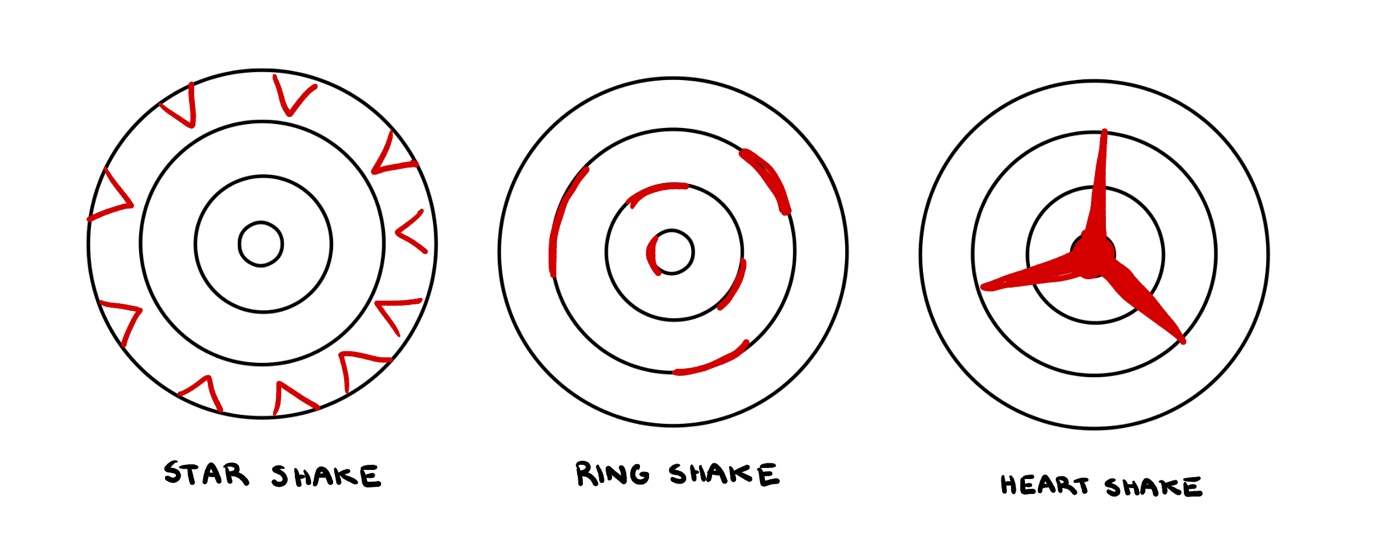
Fig. 9. Examples of timber defects, with the red representing the cracks in the wood. Star shakes radiate radially, ring shakes follow tangential growth rings, and heart shakes extend from the pith along radial planes (Created by Neufeld, J., 2025).
Fracture mechanics can also be described in terms of energy. Griffith’s criterion states that crack growth occurs when the strain energy release rate G exceeds a critical value Gc.

For oak, the specific fracture energy Gf is about 350 J/m² in the RL orientation and 270 J/m² in the TL orientation, once again showing the mechanical effect of oak’s wide and multiseriate rays (Stanzl-Tschegg et al., 2002).
This fracture behavior corresponds directly to oak’s tensile and shear strength properties. Along the grain (longitudinal axis), oak has a high tensile strength of 90–120 MPa, reflecting the alignment of cellulose microfibrils with the loading direction. In contrast, tensile strength drops dramatically perpendicular to the grain, often below 5 MPa, since stresses cross the weaker radial and tangential directions (USDA Wood Handbook, 2010). This contrast shows how oak has evolved to maximize strength where it matters most, by resisting bending and compression from gravity and other vertical loads. Oak does this while tolerating weakness across the grain, which is shown in its well-known tendency to split cleanly along radial and tangential planes. The anisotropy of oak is a structural strategy that concentrates resources along the trunk’s main axis of stress.
Thermal Properties of Oak Trees
Oak trees possess thermal properties that alter and influence how heat is absorbed, stored, and transferred through their tissues. These properties govern how oaks respond to temperature fluctuations, affecting its physiological processes in the living tree and its adaptive capabilities to physiological and environmental changes.
Thermal Conductivity
Thermal conductivity, denoted by k or λ, is a fundamental property of materials, describing their intrinsic ability to transfer heat. In the case of oaks, this property quantifies how much heat energy flows through a unit thickness of wood per unit time and area, given a specific temperature difference, as defined by Fourier’s Law:

where q is the local heat flux density in W·m2, k is the conductivity of the material in W/m·K, and ▽T is the temperature gradient in K/m (Malik et al., 2021).
With respect to wood, the thermal conductivity is not only highly dependent on wood density and moisture, but also on the relative density and proportion of earlywood/latewood (MacLean, 1941). Generally, higher density in wood leads to a higher thermal conductivity. In a thermal conductivity experiment performed by Çavuş et al., oak trees had the highest density of all the chosen tree species, as seen in Table 1, measuring at 0.841 g/cm3. When compared against these different tree species, oak trees also achieved the highest thermal conductivity, experimentally measured at 0.197 W/m·K (Çavuş et al., 2019). Although oak trees have high thermal conductivity when compared against other species of trees, they have a very low thermal conductivity overall when compared to other materials, such as metals and alloys.
Table 1. The relation between thermal conductivity and density of the tested woods in an experiment (Çavuş et al., 2019).

Furthermore, the direction of the measurements is important for thermal conductivity, with higher measurements found in the axial direction due to the orientation of the molecular chains within the cell wall (Suleiman et al., 1999). Due to the prominent and numerous medullary rays found in oak trees, it is unsurprising that they will have a higher thermal conductivity, as the rays serve as paths for heat transport. Therefore, the radial thermal conductivity of oak trees will be higher than the tangential (Vay et al., 2015). Finally, water is known to be a good heat conductor; consequently, higher amounts of water found in wood will increase their thermal conductivity. Bare oak trees are composed of approximately 50% water, and mature trees are capable of consuming and transpiring tens of thousands of gallons of water annually (Hayek, n.d.). Therefore, the high moisture content of oak trees also will contribute to its high relative thermal conductivity amongst tree species.
Specific Heat Capacity
Specific heat capacity is the amount of heat energy needed to raise the temperature of one unit of mass of a substance by one unit of temperature (Mercan et al., 2022). It is determined through the formula:

where c is the specific heat capacity, Q is the heat energy added, m is the mass of the wood, and ΔT is the change in temperature.
The specific heat capacity of wood reveals its ability to store heat, its thermal insulation properties, and its behavior during heating. A higher specific heat capacity indicates that the tree species can absorb and store more heat, influencing its role as both a thermal insulator and a material for energy storage (Radmanović et al., 2014). Oak trees have a relatively high moisture content percentage — when freshly cut, the heartwood of an oak tree can contain up to 80% moisture (Laskowska et al., 2018); thus, oak wood has a higher specific heat capacity compared to other species, contributing to its ability as a good thermal insulator. In a study conducted by Dr. Barbora Slováčková, a research assistant in the department of wood science at the Technical University of Zvolen, oak heartwood has a specific heat capacity ranging from 1.23 to 1.39 kJ/kg·K (2021). Other materials, such as bricks or concrete, have a specific heat capacity around 0.84 kJ/kg·K and 0.88 kJ/kg·K, respectively (Balaji et al., 2019). This demonstrates that oak wood, with its high specific heat capacity, can retain more thermal energy per unit mass, and is therefore considered a good natural thermal insulator.
Thermal Diffusivity
Thermal diffusivity (α) is the thermophysical property that measures how quickly heat moves through a material, relating thermal conductivity, specific heat capacity, and density (Lewis, 1996). It is determined by:

where α is the thermal diffusivity, k is the thermal conductivity, Cp is the specific heat capacity, and k is the density of the material.
When considering oak wood, the thermal diffusivity tells us at what speed temperature changes occur within the material, quantifying the tree’s ability to conduct heat relative to its ability to store it. As oaks are considered denser than many other species, they have a relatively low thermal diffusivity due to the inverse relationship between thermal diffusivity and material density (Klinger et al., 2025). This thermodynamic property of oak trees solidifies its excellent capability to store heat and act like an insulator.
Moisture Sorption and Desorption
Moisture sorption in oak wood involves both adsorption and desorption processes, in which water molecules interact with the hygroscopic wood material, establishing an equilibrium moisture content defined by sorption isotherms (Bahar et al., 2016). A sorption isotherm is the curve when the equilibrium moisture content is plotted against relative humidity at a constant temperature (Wang et al., 2011). This interaction is governed by thermodynamic processes and enthalpy-entropy compensation theory, with water binding to both primary and secondary sorption sites, which are characterized by different binding energies. Essentially, it refers to the tree’s ability to absorb and hold water primarily through their root systems from the soil and then distribute it throughout the tree’s structure. Heat supplied to wood accelerates the water migration and affects the dynamic equilibrium between the vapor and adsorbed phases during adsorption and desorption processes (Bahar et al., 2016).
During the absorption process, water vapor diffuses through the porous wood microstructure as seen in Figure 10, where it goes through the lumina (“A”), pits (“B”), and cell walls, while constantly exchanging water molecules between the water vapor and the moisture within the cell walls.

Fig. 10. Illustration depicts the process of water vapor absorption, which results in an increase in mass (moisture content, blue curve), dimensions (swelling, black arrows), and temperature (red arrows and curve) in the approach to equilibrium (Thybring & Fredriksson, 2021).
The equilibrium moisture content for oak trees varies significantly depending on the ambient relative humidity and temperature but typically ranges from 7-10% in internally heated environments to 12-14% in protected, unheated environments (Laskowska et al., 2018). These percentages represent the moisture level in which the wood will neither gain nor lose moisture in an average outdoor environment.
Photosynthesis
From a thermodynamic perspective, photosynthesis converts radiant energy into chemical energy (Fig. 11), obeying both the First Law of Thermodynamics (i.e., energy conservation) by transforming light into chemical bonds in sugars, as well as the Second Law by increasing the total entropy of the universe, as some energy is inevitable lost as heat. This process creates localized order (i.e., low entropy) within the tree, only possible due to the larger increase in entropy in its surroundings (Albarrán-Zavala & Angulo-Brown, 2007).

Fig. 11. In the light reactions of photosynthesis, water is split to release oxygen, and light energy drives the production of ATP and NADPH, which then power the Calvin cycle (Britannica, 2025).
While all trees and plants depend on photosynthesis for energy, oak trees have unique characteristics that set them apart from other species. First, according to a study by Killi et al., mature oak trees were found to “learn” to increase their rate of photosynthesis when atmospheric carbon dioxide levels rise in response to the effects of climate change (2018). This concept is examined further in our second essay. Second, oak trees are significant carbon sinks due to their long lifespans, dense wood, and extensive root systems, allowing them to store significant amounts of carbon for long periods of time (Ganatsas et al., 2022).
Growth Dynamics and Biophysical Constraints in Oak
Cell Expansion and Seasonal Ring Formation
The process of wood formation in oaks begins at the cellular level, where the physics of turgor pressure and cell wall resistance determine how new tissues expand and mature.
During the radial growth process of the tree trunk, most commonly known as the secondary growth, developing vessel elements and fibers in the cambial zone, which consists of the expanding layer that actively divides cells, grow larger as internal turgor pressure stretches their initially thin cell walls through to osmotic intake of water. The balance between this pressure and the wall’s yield threshold determines the final size of the cell cavity following Lockhart’s growth equation:

where the rate of cell volume increase dV/dt is determined by the difference between turgor pressure P and the cell wall yield threshold Y, multiplied by the wall extensibility coefficient m (Passioura & Fry, 1992). Once expansion is complete, secondary walls that are rich in structural polymers, lignin and cellulose, form around the inside of the primary wall, locking in the final enlarged shape and making the cells rigid. In oaks, the high lignin and cellulose content of secondary walls means that Y is relatively large compared to diffuse-porous hardwoods such as birch or maple. This results in slower cell expansion but produces structurally sound tissues (Alberts et al., 2002).
The effects of these cellular processes can be seen at the scale of annual growth rings. Studies of British oak sites reveal that the width of each ring depends strongly on climate during the growing season. More rainfall during the growing season and warmer early-summer temperatures typically promote wider rings, while unusually warm winters can reduce growth in the following season, most likely because they deplete the carbohydrate reserves needed for new cell production (Pilcher & Gray, 1982).
Computer models of oak development support these observations. Simulations using the HETEROFOR model suggest that the length of the growing season and the availability of water in the soil are the main factors controlling how much the trunk thickens each year. During drought, the period of cambial activity is shorter, which leads to narrower rings and lower overall productivity (de Wergifosse et al., 2022).
These patterns reflect the strong link between cell mechanics and vessel hydraulics. In spring, favorable conditions allow the formation of large earlywood vessels, and according to the Hagen-Poiseuille relation:

even small increases in vessel radius r greatly enhance conductivity Q, allowing rapid water delivery for leaf expansion. Later in the season, when soil moisture decreases, the cambium produces latewood with smaller vessels and thicker walls (Pilcher & Gray, 1982). Although this reduces water transport, it improves mechanical strength. In this way, each annual ring captures how oak growth balances hydraulic efficiency with structural resilience.
Adaptive Growth Responses
Oak trees adjust their structure as they grow throughout their lifetime in response to mechanical and environmental stresses, ensuring continued stability and functionality.
One important example of this is the production of tension wood, which forms when branches or stems lean due to the weight of the crown or the wind. In these situations, the cambium produces special fibers on the upper side of the leaning stem. These are called gelatinous fibers because they contain a layer rich in cellulose. Inside of this layer, the cellulose microfibrils are oriented almost exactly along the length of the cell, rather than at an angle like in typical fibers. As they mature and dry, the gelatinous layer contracts lengthwise, which creates a pulling force along the axis of the stem. Over time, the accumulation of contracting gelatinous fibers generates enough tension to counteract the lean, thus slowly pulling the branch or trunk upright again (Weikert, 2025). In oaks, this is especially important since their crowns are broad and heavy, which increases bending moments, causing the trees to be subjected to bending stresses at their bases or points of attachment more often (Pavlis et al., 2008). Tension wood is therefore less about providing strength and more about the ability of the tree to redirect growth in order to maintain vertical stability.
Another adaptive strategy is the development of anisotropy, meaning that their wood has different mechanical properties depending on the direction. Anisotropy is created by the presence of medullary rays, which are especially abundant in oaks because of the way the cambium grows. Burgert et al. (2001) demonstrated that in English oak (Quercus robur), the radial modulus of elasticity was more than double that of the tangential modulus, a difference directly linked to ray tissue expansion. Because rays expand outward from the cambium, they bind successive growth rings together, making them function as stiffeners that prevent splitting between rings and provide resistance against torsion when large crowns are twisted by heavy wind (Burgert et al., 2001). Thus, it can be understood that anisotropy is not only a mechanical property but also a growth pattern, where oak cambium invests in rays for both nutrient transport and structural reinforcement.
At the cellular level, oaks show another growth response through the formation of tyloses. These are balloon-like extensions of parenchyma cells that grow into vessel lumens, which are hollow passageways (Fig. 12).

Fig. 12. Radial and tangential SEM (scanning electron microscopy) photographs of the formation of tyloses in the heartwood of the English oak (Perré & Keey, 2014).
Murmanis (1975) observed that tyloses in red oak (Quercus rubra) can begin forming within hours of a tree having been cut during the growing season, but may be delayed for months if the tree is cut during inactivity. This illustrates that tylosis is an active process tied to the metabolic state of the cells (Murmanis, 1975). Recent imaging studies have made it possible to measure how much space tyloses occupy inside vessels. Kim et al. used 3D X-ray tomography to reveal that white oak (Quercus alba) vessels have 14% of their internal volume filled on average compared to only about 1.7% in red oak (2024). This comparison highlights how oak species can differ from one another, with white oak’s dense tyloses making its heartwood watertight and red oak’s sparse tyloses leaving it permeable. The hydraulic consequence of tyloses is that vessel conductivity fails, since flow is proportional to the fourth power of radius as previously seen through the Hagen-Poiseuille relation. Therefore, even a partial filling of the lumen makes the vessel useless for water transport. To compensate, oaks grow new conductive xylem annually in outer rings, ensuring a continuous water supply, even as older vessels become blocked. Although tyloses reduce flow efficiency, they provide important benefits by sealing vessels such as slowing down the spread of pathogens, and producing decay-resistant heartwood (Ruppitsch et al., 2021). And according to Kim et al. (2024), in the specific case of white oak, the abundance of tyloses makes the wood watertight, which is the reason it has been historically used for barrels.
Growth Efficiency and Trade-Offs
While oak growth begins at the cellular scale, its long-term development is ultimately determined by the costs and physical limits of sustaining the entire organism.
Using data from a study performed in Spain, Sánchez-González et al. (2005) fitted the McDill-Amateis function to height-age data for dominant cork oaks (Fig. 13), revealing rapid early height growth before a slowdown at around 18 to 20 m, even on good sites with deeper soils, higher water availability, and better climate. In contrast, diameter growth was modelled with the Richards function (Fig. 14), which captured an almost linear, long-term thickening of trunks (Sánchez-González et al., 2005). While height gains stop early in the life of oaks, their diameter continues to increase for much longer.

Fig. 13 Plot of the height-age relationship of cork oak using the McDill-Amateis function, illustrating rapid height increase followed by progressively slower growth toward an upper limit (Sánchez-González et al., 2005).

Fig. 14 Plot of diameter-age relationship of cork oak using the Richards function, illustrating a near-linear increase in diameter of the trunk (Sánchez-González et al., 2005).
This indicates a developmental preference for lateral expansion rather than continued vertical gain once height is capped. Such investment maximizes light reception while allowing for a more stable distribution of stress between the trunk and the crown. This sacrifice of rapid upward growth for longevity and structural resilience in diameter allows oaks to dominate subtropical and temperate forests for centuries (Kremer & Hipp, 2020).
Conclusion
In conclusion, the oak tree is a fascinating biological system, as its structure supports its function. Oak trees have been around for millions of years and have thus developed many design solutions to combat evolutionary obstacles. Its transport system, including the xylem and medullary rays, can transport water in both axial and radial directions. This process is done mainly by transpiration and the cohesion-tension mechanism. Environmental stressors, physical damage, or even the growth of tyloses to block pathogens and prevent liquid leakage can all partially or completely block the lumens of oak trees. In order to keep water transport continuous, oak trees produce new conductive xylem in their outer rings annually, creating a decay-resistant heartwood. To withstand drought conditions, oak’s deep roots ensure survival by accessing deeper soil water by hydraulic resistance. At the structural level, medullary rays reduce sliding between growth ring layers, acting as an orthogonal 3D weave, where differently oriented components support one another. This reinforcement doubles as a design solution to distribute stresses more evenly throughout the trunk, and results in stronger wood in the longitudinal direction compared to the radial and tangential axes. Moreover, the oak’s thermal properties allow it to be a good thermal insulator due to its high specific heat capacity, its large moisture content, and low thermal diffusivity. Additionally, the effect of gravity pulling down on the branches of oaks has resulted in oaks producing tension wood to counter the effect. Many physical laws govern the oak's biological processes: Hooke’s Law explains how stress deforms wood, the Hagen-Poiseuille equation dictates water flow, Fourier’s Law quantifies heat transfer, and Lockhart’s equation describes cell expansion. This biological design, governed by physics, allows the tree not only to sustain itself, but also to become crucial to its surrounding environment. It is thanks to their strength, long life, and transport system that they have such a significant impact on the ecosystem. Furthermore, oak trees are foundational to the function of the forests they form across the Northern Hemisphere, rightfully taking the designation as a keystone species. They foster the diversity across the tree of life, from fungi to bees, birds, and mammals. They act as carbon sinks, sequestering carbon dioxide and absorbing atmospheric pollutants to help clean the air.
References
References
Albarrán-Zavala, E., & Angulo-Brown, F. (2007). A simple thermodynamic analysis of photosynthesis. Entropy, 9(4), 152–168. https://doi.org/10.3390/e9040152
Alberts, B., Johnson, A., Lewis, J., Raff, M., Roberts, K., & Walter, P. (2002). The plant cell wall. In Molecular biology of the cell (4th ed.). Garland Science. https://www.ncbi.nlm.nih.gov/books/NBK26928/
Bahar, R., Azzouz, S., Remond, R., Ouertani, S., Elaieb, M. T., & El Cafci, M. A. (2016). Moisture sorption isotherms and thermodynamic properties of oak wood (Quercus robur and Quercus canariensis): Optimization of the processing parameters. Heat and Mass Transfer, 53(5), 1541–1552. https://doi.org/10.1007/s00231-016-1916-0
Balaji, N. C., Mani, M., & Venkatarama Reddy, B. V. (2019). Dynamic Thermal Performance of conventional and alternative building wall envelopes. Journal of Building Engineering, 21, 373–395. https://doi.org/10.1016/j.jobe.2018.11.002
Brémaud, I., Clair, B., & Gril, J. (2017). Understanding the function of rays and wood density on transverse fracture behaviour of green wood in three species. Annals of Forest Science, 74(1), 5. https://www.researchgate.net/publication/313679890
Burgert, I., Bernasconi, A., Niklas, K. J., & Eckstein, D. (2001). The influence of rays on the transverse elastic anisotropy in green wood of deciduous trees. Holzforschung, 55(5), 449–454. https://doi.org/10.1515/HF.2001.074
Çavuş, V., Şahin, S., Esteves, B., & Ayata, Ü. (2019). Determination of thermal conductivity properties in some wood species obtained from Turkey. BioResources, 14(3), 6709–6715. https://doi.org/10.15376/biores.14.3.6709-6715
Denk, T., Grimm, G. W., Manos, P. S., Deng, M., & Hipp, A. (2017). An Updated Infrageneric Classification of the Oaks: Review of Previous Taxonomic Schemes and Synthesis of Evolutionary Patterns. https://doi.org/10.1101/168146
de Wergifosse, L., André, F., Goosse, H., Boczon, A., Cecchini, S., Ciceu, A., Collalti, A., Cools, N., D’Andrea, E., De Vos, B., Hamdi, R., Ingerslev, M., Knudsen, M. A., Kowalska, A., Leca, S., Matteucci, G., Nord-Larsen, T., Sanders, T. G. M., Schmitz, A., Termonia, P., Vanguelova, E., Van Schaeybroeck, B., Verstraeten, A., Vesterdal, L., & Jonard, M. (2022). Simulating tree growth response to climate change in structurally diverse oak and beech forests. Science of the Total Environment, 806(Part 2), 150422. https://doi.org/10.1016/j.scitotenv.2021.150422
Elsevier. (2021). Microstructure and fracture mechanical response of wood. Engineering Fracture Mechanics, 253, 107881. https://www.sciencedirect.com/science/article/pii/S0013794421004616
Elsevier. (2024). Understanding the function of rays and wood density on transverse fracture behaviour of green wood in three species. Journal of Bioresources and Bioproducts, 9(4), 229–240. https://www.sciencedirect.com/science/article/pii/S2090123224005897
Encyclopædia Britannica. (n.d.). Diagram of the light reaction of photosynthesis. Encyclopædia Britannica. Retrieved September 25, 2025, from https://www.britannica.com/science/photosynthesis/Proteins#/media/1/458172/66097.
Forest Products Laboratory. (2010). Wood handbook: Wood as an engineering material (General Technical Report FPL–GTR–190). U.S. Department of Agriculture, Forest Service, Forest Products Laboratory. https://www.fs.usda.gov/research/treesearch/37440
Ganatsas, P., Tsakaldimi, M., Karydopoulos, T., Petaloudi, L.-M., Papaemmanouil, A., Papadopoulos, S., & Gerochristou, S. (2022). Carbon Pools in a 77 year-old oak forest under conversion from coppice to high forest. Sustainability, 14(21), 13764. https://doi.org/10.3390/su142113764
Ha, M., Morrow, M., & Algiers, K. (2025). Botany. Yuba College. https://bio.libretexts.org/Bookshelves/Botany/Botany_(Ha_Morrow_and_Algiers)
Hayek, J. (n.d.). What Percentage of the Mass of a Tree is Water?. Ask Extension. https://web.extension.illinois.edu/askextension/thisQuestion.cfm?ThreadID=19549&catID=192&AskSiteID=87
Hietz, P., Rosner, S., & Scheicher, K. (2023). The three-dimensional structure of wood enables horizontal water transport needed to conduct water around lesions. Scientific Reports, 13(1), 15057. https://doi.org/10.1038/s41598-023-41817-8
Hipp, A. L., Manos, P. S., & Cavender-Bares, J. (2020, August 1). How oak trees evolved to rule the forests of the Northern Hemisphere. Scientific American. https://www.scientificamerican.com/article/how-oak-trees-evolved-to-rule-the-forests-of-the-northern-hemisphere/
Hofmann, C.-C., Mohamed, O., & Egger, H. (2011). A new terrestrial palynoflora from the Palaeocene/Eocene boundary in the northwestern Tethyan realm (St. Pankraz, Austria). Review of Palaeobotany and Palynology, 166(3–4), 295–310. https://doi.org/10.1016/j.revpalbo.2011.06.003
Killi, D., Bussotti, F., Gottardini, E., Pollastrini, M., Mori, J., Tani, C., Papini, A., Ferrini, F., & Fini, A. (2018). Photosynthetic and morphological responses of oak species to temperature and [CO2] increased to levels predicted for 2050. Urban Forestry & Urban Greening, 31, 26–37. https://doi.org/10.1016/j.ufug.2018.01.012
Kim, D., Gollihue, J., Poovathingal, S. J., Akinyemi, A., Jennings, G., Sakon, J., & Stone, M. (2024). Detailed three-dimensional analyses of tyloses in oak used for bourbon and wine barrels through X-ray computed tomography. Scientific Reports, 14, 17044. https://doi.org/10.1038/s41598-024-67298-x
Kimball, J. W. (2025). Biology (3d. ed.). LibreTexts. https://www.biodiversitylibrary.org/bibliography/166246
Klinger, J., Westover, T., Saha, N., Sibbett, C., & Williams, C. L. (2025). Thermal properties of native and densified hardwood, softwoods, and agricultural residue. Biomass and Bioenergy, 195, 107711. https://doi.org/10.1016/j.biombioe.2025.107711
Kremer, A., & Hipp, A. L. (2020). Oaks: An evolutionary success story. New Phytologist, 226(4), 987–1011. https://doi.org/10.1111/nph.16274
Laskowska, A., Marchwicka, M., Boruszewski, P., & Wyszyńska, J. (2018). Chemical composition and selected physical properties of oak wood (Quercus robur L.) modified by cyclic thermo-mechanical treatment. BioResources, 13(4). https://doi.org/10.15376/biores.13.4.9005-9019
Lewis, M. J. (1996). Heat Transfer Mechanisms. Physical Properties of Foods and Food Processing Systems, 246–291. https://doi.org/10.1533/9781845698423.246
Line, L. (1999, October 1). When nature goes nuts. National Wildlife. https://www.nwf.org/Magazines/National-Wildlife/1999/When-Nature-Goes-Nuts
MacLean, J. D. (1941). Thermal conductivity of wood. Heating, Piping & Air Conditioning 13(6), 380-391. https://www.fpl.fs.usda.gov/documnts/pdf1941/macle41a.pdf
Malik, M., Bhattacharyya, S. K., & Barai, S. V. (2021). Thermal and mechanical properties of concrete and its constituents at elevated temperatures: A Review. Construction and Building Materials, 270, 121398. https://doi.org/10.1016/j.conbuildmat.2020.121398
Mercan, H., Celen, A., & Taner, T. (2022). Thermophysical and rheological properties of unitary and hybrid nanofluids. Advances in Nanofluid Heat Transfer, 95–129. https://doi.org/10.1016/b978-0-323-88656-7.00005-2
Mitigating climate change with woodland restoration & oak regeneration in Polk County, Iowa, USA. Society for Ecological Restoration. (2023, June 7). https://www.ser.org/news/641638/Mitigating-Climate-Change-with-Woodland-Restoration--Oak-Regeneration-in-Polk-County-Iowa-USA.htm
Miyauchi, K., Iida, I., Saito, Y., Sugiyama, K., & Yamamoto, H. (2007). Strain-softening behavior of wood under tension. Journal of Wood Science, 53(2), 117–123. https://doi.org/10.1007/s10086-006-0822-8
Murmanis, L. (1975). Formation of tyloses in felled Quercus rubra L. Wood Science and Technology, 9(1), 3–14. https://doi.org/10.1007/BF00351911
National Center for Biotechnology Information. (2013). Review: Wood as bio-based material. Frontiers in Plant Science, 4, 466. https://pmc.ncbi.nlm.nih.gov/articles/PMC3747806/
Pallardy, S. G., & Kozlowski, T. T. (2008). Physiology of woody plants (Third edition ed.). Elsevier. http://site.ebrary.com/id/10224995
Passioura, J. B., & Fry, S. (1992). Turgor and cell expansion: Beyond the Lockhart equation. Functional Plant Biology, 19(5), 565–576. https://doi.org/10.1071/PP9920565
Pavlis, M., Kane, B., Harris, J., & Seiler, J. (2008). The effects of pruning on drag and bending moment of shade trees. Arboriculture & Urban Forestry, 34(4), 207–215. https://doi.org/10.48044/jauf.2008.028
Perré, P., & Keey, R. B. (2014). Drying of Wood: Principles and Practices. Taylor & Francis, 36, 822–872. https://doi.org/10.1201/b17208-44
Pilcher, J. R., & Gray, B. (1982). The relationships between oak tree growth and climate in Britain. Journal of Ecology, 70(1), 297–304. https://doi.org/10.2307/2259880
Plomion, C., Aury, J.-M., Amselem, J., Leroy, T., Murat, F., Duplessis, S., Faye, S., Francillonne, N., Labadie, K., Le Provost, G., Lesur, I., Bartholomé, J., Faivre-Rampant, P., Kohler, A., Leplé, J.-C., Chantret, N., Chen, J., Diévart, A., Alaeitabar, T., Barbe, V., … Salse, J. (2018). Oak genome reveals facets of long lifespan. Nature Plants, 4(7), 440–452. https://doi.org/10.1038/s41477-018-0172-3
Radmanović, K., Đukić, I., & Pervan, S. (2014). Specific heat capacity of wood. Drvna Industrija, 65(2), 151–157. https://doi.org/10.5552/drind.2014.1333
Reiterer, A., Lichtenegger, H., Tschegg, S., & Fratzl, P. (2002). The influence of rays on the transverse elastic anisotropy in green wood of deciduous trees. Journal of Materials Science, 37(5), 881–888. https://www.researchgate.net/publication/240749892
Ruppitsch, W., Lebow, S., Lebow, P., & Taylor, A. (2021). Role of tyloses in the durability of chestnut oak. Wood & Fiber Science, 53(2), 126–146. https://doi.org/10.22382/wfs-2021-14
Sánchez-González, M., Tomé, M., & Montero, G. (2005). Modelling height and diameter growth of dominant cork oak trees in Spain. Annals of Forest Science, 62(7), 633–643. https://doi.org/10.1051/forest:2005065
Schniewind, A. P., & Centeno, J. (1983). Orthotropic fracture toughness of wood. Wood Science and Technology, 17(2), 91–103. https://core.ac.uk/download/pdf/85214038.pdf
Slováčková, B. (2021). Thermal conductivity of spruce, beech and oak heartwood degraded with Trametes versicolor L. Lloyd. Acta Facultatis Xylologiae Zvolen, 63(1), 5-15. https://doi.org/10.17423/afx.2021.63.1.01
Stanzl-Tschegg, S. E. (2006). Fracture behaviour of wood and its composites: A review. Wood Science and Technology, 40(8), 631–646. https://www.sciencedirect.com/science/article/pii/S0167844221001051
Stanzl-Tschegg, S. E., Frühmann, K., Tschegg, E. K. (2002). The radial reinforcement of the wood structure and its implication on mechanical and fracture mechanical properties—A comparison between two tree species. Holzforschung, 56(5), 507–513. https://www.researchgate.net/publication/227311773
Stanzl-Tschegg, S. E., & Navi, P. (2011). Microstructure and fracture mechanical response of wood. Engineering Fracture Mechanics, 78(17), 3475–3486. https://www.sciencedirect.com/science/article/pii/S0013794421004616
Suleiman, B. M., Larfeldt, J., Leckner, B., and Gustavsson, M. (1999). Thermal conductivity and diffusivity of wood. Wood Science and Technology 33(6), 465-473.
The Jones Center at Ichauway. (n.d.). Rainfall from below: how tree roots recirculate deep soil water. Rainfall from below: how tree roots recirculate deep soil water - Jones Center
University of Hamburg. (2003). Orthotropic fracture toughness of wood. https://core.ac.uk/download/pdf/85214038.pdf
Vay, O., De Borst, K., Hansmann, C., Teischinger, A., and Müller, U. (2015). Thermal conductivity of wood at angles to the principal anatomical directions. Wood Science and Technology 49(3), 577-589. https://doi.org/10.1007/s00226-015-0716-x
Venturas, M. D., Sperry, J. S., & Hacke, U. G. (2017). Plant xylem hydraulics: What we understand, current research, and future challenges. Journal of Integrative Plant Biology, 59(6), 356-389. https://doi.org/10.1111/jipb.12534
Wang, J., Mukhopadhyaya, P., & Morris, P. (2011). Wood sorption, capillary condensation and their implications for building envelopes of wood construction. Institute for Research in Construction, 1–13. https://nrc-publications.canada.ca/eng/view/accepted/?id=da01dd4d-2fd0-4994-8c8b-7beb7c2c8584
Weikert, S. (2025, May 19). Reaction wood in trees. PennState Extension. https://extension.psu.edu/reaction-wood-in-trees
Thybring, E. E., Fredriksson, M. (2021). Wood Modification as a Tool to Understand Moisture in Wood - Scientific Figure. ResearchGate. Retrieved September 24, 2025, from https://www.researchgate.net/figure/Sorption-kinetics-in-wood-involves-a-change-in-moisture-content-and-temperature-over_fig3_350194680.