
Table of Contents
Keywords: aerial roots, stress, fluid mechanics, hydrodynamics, adaptability, resilience, optics, cystoliths
Abstract
The Ficus genus demonstrates remarkable adaptations that can be understood through physics principles, spanning mechanics, fluid dynamics, optics, and thermodynamics. Aerial roots rely on tensile forces for anchorage and bridge formation, while drip-tips, stem fluctuations, and latex exudation exemplify fluid mechanical strategies for water regulation and wound healing. Mineral deposits in the Ficus leaves scatter light into deeper tissues to enhance photosynthesis, and leaf thermoregulation maintains optimal temperatures under varying conditions. Together, these physical mechanisms shape the survival, adaptability, and ecological success of Ficus trees across diverse environments.
Introduction
In several cultures, the Ficus aurea, otherwise known as the “strangler fig” is revered for its rope-like roots, which twist around the trunk of its host tree, creating a pseudo-trunk as seen in Figure 1. The Ficus aurea was considered the realm of the evil spirits and gods, a place of supernatural power.

Fig.1. The pseudo-trunk of a strangler fig. The Ficus chokes and eventually kills the host tree beneath it with its roots (Aumeeruddy-Thomas & Hossaert-McKey, 2024).
The Ficus species has evolved and developed unique physical adaptations that can be understood through the lens of physics. They endure mechanical stresses by relying on structural properties in their trunks and roots. They maintain homeostasis through thermoregulatory mechanisms that balance heat exchange in diverse climates. Their leaves employ optical strategies that maximize light capture while reducing energy loss, ensuring efficient photosynthesis even in shaded environments. Finally, Ficus trees regulate internal and external water flow through fluid mechanics, including drip tips that shed water efficiently, stem diameter fluctuations that monitor hydration, and latex exudation that assists rapid wound healing. These four areas show how the survival and ecological success of Ficus trees are tightly coupled to the physical principles that govern their biology.
The Ficus genus’ origins date to approximately 75 million years ago, making the tree one of the most ancient angiosperms on Earth. The tropical Ficus tree genus contains extreme ecological diversity, ranging from massive banyan trees to one-meter-tall shrubs. In addition to being a keystone species in rainforests and savannas, birds and mammals rely on the plant’s fig fruit.
To reproduce more efficiently, Ficus species such as the Ficus Caria co-evolved with the wasp, forming a Ficus-wasp nursery mutualistic relationship. The wasp helps the tree reproduce through pollination, while the tree's fruit, the fig, provides a breeding site for wasp larvae. Each Ficus has a distinct pollinating wasp attracted to its unique scent. When a female wasp enters its host fig’s ostiole, as seen in Figure 2, it loses its wings and antennas, releases any pollen from its pockets and dies after laying her eggs in the flower’s ovule. After the larvae develop, the adult males leave the fig through the fig cavity to mate with other females in the fig. Female wasps collect pollen before leaving to search for another fig at the appropriate receptive stage which is usually far as the fig ripening on a tree is synchronized to limit inbreeding of trees. Once all pollinators are gone, the fig grows into a mature fruit which animals eat, propagating its seeds (Aumeeruddy-Thomas & Hossaert-McKey, 2024).

Fig. 2. The ostiole of a fig and a wasp entering. The ostiole morphology varies across figs allowing only certain species of wasp to enter (Aumeeruddy-Thomas & Hossaert-McKey, 2024).
Mechanical Forces in Ficus Tree Aerial Roots
Aerial roots are common in Ficus trees, they grow from underside of its branches and grow in the air, outside the soil. Eventually, the roots grow long enough to reach for the soil away from the original tree and anchor into the ground undergoing tensile stress.
An aerial root goes through three phases of growth. First, the root is flee-hanging and grows until it inevitably reaches the soil. Second, there is an initial anchoring into the soil accompanied by an increase of root diameter. At this phase, the wood is under tension and contracts. Lastly, the diameter of the branch increases and the tension in the wood decreases as it is now big enough to support its weight. The Ficus uses tension to stabilize their roots during the aerial root growth (Zimmermann et al., 1968).
Tensile stress is the tension throughout the internal Ficus root. The tensile forces within the roots allow them to transition from slack to tight once the root reaches the ground, ensuring a secure anchorage into the earth. The aerial root branches develop negative gravitropism (growth away from gravity) as a response to gravitational forces through the generation of tensile growth stress in the longitudinal direction: this is viewed as contractions in the root (Yamamoto et al., 2022). The tensile force contractions are caused by the tissue known as tension wood, which is produced during the flee-hanging phase of the aerial root growth. The production of such tissues ceases once the root implants into the soil and grows to a diameter of approximately 4-15 mm. At this point, the parent tree no longer needs to keep the branch taut as the root can support itself.
Compared to the normal wood fibers, the tension wood fibers have a much thicker gelatinous layer called the G layer, which is shown in figure 3. In the gelatinous layer, the microfibers are aligned such that they are mostly parallel to the fiber axis (axial) as the tension in an aerial root is commonly symmetric about a vertical axis; there is no gravity-induced redistribution like in the asymmetric formation of tension wood in a branch or stem (Zimmermann et al., 1968). The fibers tend to contract as the root grows: the contractions occur in crystallized, longitudinally cellulose microfibers, located in the G fibers (Yamamoto et al., 2022).

Fig. 3. A representation of the internal fibers in tension wood (with G-fiber layer) compared to no-tension, normal wood fibers (Yamamoto et al., 2022).
Less G-fibers are produced when the root grows in diameter as the larger roots have a stronger grip on the soil. Similarly, roots with smaller diameter have more G-fibers, and thus more tensile strength. The strain of the roots is related to stress through Hooke’s law:

where σ is the tensile stress in a root, E is the modulus of elasticity ∈ and is the root strain. The strain is inversely related to the root diameter. The smaller the root diameter, the higher the strain will be. This was measured using strain gauges placed parallel to the length of the root in an experiment testing the relationship between root diameter and strain, performed by Abasolo et al., 2009. It is possible as well that smaller roots, which are younger, require more support from the parent tree and thus have higher strain (Abasolo et al., 2009).
The contraction force induced by the tensile stress in the branches is observed when a flee-hanging root is planted in a pot of soil: as shown in figure 4, once the root anchors, a contraction shortens the stem and is strong enough to lift a pot off the ground (Zimmermann et al., 1968).

Fig. 4. An aerial root planted in a pot of soil. The force of a contraction in the root can lift the pot (Zimmermann et al., 1968).
Aerial Root Living Bridges
The aerial roots of the Ficus elastica were used by Khasi and Jaintia indigenous of subtropic Meghalaya as bridges to cross rivers; an example of a root bridge is shown in figure 5. To create such structures, the hanging growing aerial roots are guided to the soil on the side of the river opposite of the parent tree.

Fig. 5. An aerial root bridge in Nongbareh village in Meghalaya, India (Ludwig et al.,2019).
In such bridges, the aerial roots which grow horizontally undergo beam-like mechanical bending whereas the vertical roots undergo axial compression and tension from the parent root. In response to the forces, the roots react to mechanical loading through adaptive secondary growth by forming tension-wood in each section (Ludwig et al.,2019).
In a study by Ludwig et al., 2009, roots growing horizontally were seen to have an “inverted T” cross-section (as shown in figure 6) quantified by the T ratio: the ratio between the largest and smallest widths in the T’s minor axis. The T shaped cross-section’s area is approximated by the Nicoll & Rya cross-sectional area formula. Other horizontal roots were seen to have an elliptical shape (as shown in figure 6) for which the ratio between the major and minor axis are taken along with the area.

Fig. 6. The inverted T- cross-section (a) and an elliptical cross-section (b) of horizontal aerial roots. In a) the T-ratio of the root = d1/d2 and the Nicoll & Raya cross-sectional area is shown in equation (1). In b) the area is shown in equation (2) (Ludwig et al., 2019).
The horizontal beam-like roots experience more gravitational force on their lower side and compression on their upper surface due to loads moving across the bridge. Thickening growth is a reaction to such stresses creating the elliptical and inverted T shapes horizontally. The horizontal roots behave mechanically as beams do under the influence of forces: as a beam is bent, the fibers found on the top side of the beam elongate under tension (positive stress) while the fibers on the bottom become shorter under compression (negative stress); the bending of a beam is shown in figure 7. There exists a neutral line in the middle of the beam where the fibers do not change. The farther a fiber is from the neutral axis, the more it stretches or compresses depending on its position in the beam (Roark & Young, 2001). Therefore, like a beam, the material in roots (tissue) reacts to the mechanical forces. Through secondary adaptive growth, the root develops stronger, more lignified tissues on the outside to resist the bending forces.
The fiber stress σ of a beam at any point q is:

where I is the moment of inertia of the beam with respect to the neutral axis, M is the bending moment at the part of the beam containing q and γ is the vertical distance from the neutral axis point to q (Roark & Young, 2001).

Fig. 7. a) an elastic beam (with a modulus of elasticity E) under a load. b) an enlarged view at a point on the elastic beam under a load (Roark & Young, 2001).
The horizontal root shapes are a result of adaptive secondary growth, a phenomenon in which additional xylem provide more mechanical support in areas under more tension. The tissues rearrange themselves into the inverted T shape and ellipse cross sections to better resist deformation (Ludwig et al., 2019).
The T shape and ellipse behave similarly to I-beams as they distribute their cross-sectional area further from their x-axis, increasing the root shape’s moment of inertia and thus, reducing the amount of stress they undergo while bending. A structure's moment of inertia is defined as the amount of area a shape distributes around an axis. If an object’s area is distributed further from a given axis, then object has a higher moment of inertia and resists bending more (is more rigid). The moment of inertia of an object is defined as the following definite integral:

Where I is the moment of inertia, y is the distance from each smaller x-axis in the structure to the main x-axis of the cross section dA is the differential element of the cross-sectional area and H is the height.
The I beam (figure 8), like the inverted T and ellipse shape, distributes its cross-sectional area more towards the edges, giving it a higher moment of inertia which allows it to resist deformation better under bending stress.

Fig. 8. An I-beam. Where x is the cross-section main x-axis from which the distance y is calculated (Ochshorn, 2020). The I beam has an area A= BH - bh and an x-component moment of inertia

where B is the largest width of the I beam, b is the smaller width shown in figure 8, H is the height of the beam from the outmost edges and h is the height from the inner edges of the I beam, which are also both shown in figure 8.
However, in the vertical tree trunks, the cross-sectional areas are mostly circular shaped as the vertical tree trunks are subject to tension, compression and shearing forces parallel to the main root axis and do not require the stability from an elliptical or inverted T shaped root. The vertical roots behave like vertical beams which stretch due to tension and shorten under compression. If a load is applied parallel to a bar, the bar elongates under tension but shortens under compression. For loads applied at right angles to the beam, the beam contracts under tension or expands under compression (Roark & Young, 2001). On any cross section of the vertical roots, there is uniform tensile stress σ where:

On any oblique section of the root, there is normal stress σθ where:

and uniform shear stress τθ where:

P is the applied load, A is the cross-sectional area before the deformation caused by loading and θ= the angle to the car at which the stress is applied (Roark & Young, 2001)
The Ficus aerial roots in such living bridge structures adapt to the stresses of loads walking across them through secondary adaptive growth. Their evolutionary modification of the root shape allowed them to support villagers crossing for generations.
Fluid Mechanics of Ficus Trees
Drip-Tip Hydrodynamics
Many Ficus species display leaves with an elongated apex known as a drip tip, which enhances water drainage efficiency during rainfall (Gao et al., 2020). On a flat or rounded leaf, water droplets adhere to the surface through surface tension, often spreading into films that remain on the surface. However, the geometry of a drip tip creates a reverse curvature at the leaf apex. This curvature alters the Laplace pressure gradient acting on a droplet, reducing the threshold for detachment and allowing water to fall from the leaf at smaller volumes (Liu et al., 2023). The Laplace pressure across a droplet is described by the Young-Laplace equation:

where γ is the surface tension and R1 and R2 are the principal radii of curvature. By introducing a sharper taper at the lead tip, Ficus trees reduce the effective radius of curvature, increasing the pressure gradient that drives water droplets away from the surface (Fig. 9). This mechanism explains why drip tips display higher dripping frequency and lower retention volumes compared to rounded or flat leaf tips (Gao et al., 2020).
This efficient process has ecological and physiological benefits. Rapid water shedding minimizes the risk of fungal growth and leaf surface damage caused by resting water on the surface of the leaf. Additionally, clearing the leaf surface ensures the transmission of photosynthetically active radiation to the mesophyll. Studies have shown that even thin films of water on the cuticle can reduce light transmission and lower carbon assimilation rates (Gao et al., 2020). By promoting fast drainage, drip tips maintain optical clarity and protect photosynthetic efficiency.
At the ecosystem level, drip tips may also influence water distribution in the soil. High-frequency dripping patterns concentrate water at the base of Ficus trees, generating localized areas of elevated soil moisture that may benefit root growth or understorey species.

Fig. 9. Morphological and hydrodynamic analysis of Ficus leaf apices. (a) Geographic distribution of different apex shapes relative to regional humidity. (b) Flow visualization of water dripping from five apex morphologies. (c) Drip frequency and (d) droplet volume for each shape, showing that caudate apices generate higher drip frequencies and smaller droplets. (e–g) Geometric measurements of bodhi leaves, indicating that optimal drainage occurs at a reverse curvature ratio of approximately 0.6. Together, these results demonstrate that the reverse curvature and elongated tail optimize water shedding efficiency (Liu et al., 2023).
Stem Diameter Fluctuations and Water Transport
Beyond external drainage mechanisms, Ficus trees also demonstrate internal water regulation through changes in stem diameter. These fluctuations are caused by the daily cycle of transpiration and rehydration, the anatomy of these stems can be seen in Figure 10. During the day, water is drawn upward through the xylem under negative pressure generated by transpiration, a process described by the cohesion-tension theory. This negative pressure reduces the water potential within elastic tissues, leading to measurable radial shrinkage of the stem. At night, when the stomata close and transpiration slow, water refills the xylem and stem tissues, causing the diameter to expand (van de Put et al., 2021).
Studies of Ficus benjamina have demonstrated that these fluctuations, which occur on the scale of tens of micrometers, are reliable indicators of water status. Continuous monitoring revealed that stem shrinkage corresponded strongly with both reductions in soil water availability and high vapor pressure deficits in the surrounding atmosphere. As soil moisture decreased, shrinkage amplitude increased, while rehydration events restored the stem diameter. Changes in diameter occurred prior to visible wilting, making them a sensitive, non-invasive tool for detecting drought stress (van de Put et al., 2021).
From a mechanical perspective, stem diameter variation can be modeled as elastic deformation. Hooke’s law describes the proportional relationship between applied stress and resulting strain (Equation 1). In this context, reductions in water potential act as stressors, and radial connection of the stem represents strain. By treating the stem as a pressurized cylinder, it is possible to approximate how changes in xylem tension produce measurable diameter changes.
The real-world significance of these findings is substantial. Automated dendrometers now allow continuous monitoring of stem diameter in real time, providing growers with early warning of drought stress. For urban environments, such monitoring can help optimize irrigation schedules and prevent damage during heat waves. More broadly, stem diameter fluctuations exemplify the coupling between plant hydraulics and biomechanics, where fluid movement within tissues translates directly into measurable mechanical changes.

Fig. 10. Cross-sectional anatomy of a Ficus stem highlighting tissues involved in diameter fluctuations. The elastic storage tissue and xylem are indicated, which together regulate radial expansion and contraction in response to changes in water potential. Daily shrinkage and swelling of these tissues reflect transpiration-driven water movement, making stem diameter a sensitive proxy for plant water status (van de Put & Steppe, 2021).
Latex Self-Healing and Rheology
When Ficus bark or leaves are injured, latex secretion provides a rapid and effective self-healing mechanism. Latex is stored in elongated canals called laticifers and is exuded under pressure when tissues are damaged. Initially the latex behaves as a viscous liquid that flows into the fissure, coating and sealing exposed surfaces. Rheological studies show that Ficus latex is a non-Newtonian fluid, with viscosity decreasing under shear stress and increasing over time due to coagulation (Bauer et al., 2014). Coagulation is the process in which liquid thickens and forms a semisolid or solid mass. This property allows latex to flow efficiently into fissures immediately after damage and ensures that the fluid quickly solidifies once in place.
In laboratory experiments, coagulation of Ficus benjamina latex occurred within approximately thirty minutes, transforming the fluid into a solid plug (Bauer et al., 2014). This transition significantly alters the mechanical properties of the wound site. Tensile testing of bark samples has shown that latex coagulation restores structural integrity soon after injury. In controlled fissuring experiments, tensile strength increased markedly within the first hour of coagulation, demonstrating that latex not only seals wounds but also contributes mechanically to tissue stability (Bauer et al., 2012).
The non-Newtonian properties of Ficus latex play a central role in this process. Right after an injury occurs, the shear stress created as latex flows from the wound lowers its effective viscosity, enabling it to rapidly spread over the exposed tissue (Fig. 11). Eventually, motion slows, and the latex begins to dry, viscosity rises sharply, leading to solidification. This indicates that Ficus species have developed an efficient ability to provide quick coverage while ensuring strong reinforcement (Bauer et al., 2014).
Environmental factors influence this balance. Under warmer conditions, the latex remains fluid for longer, covering larger wound areas but producing a somewhat weaker plug once coagulated. In cooler or drier environments, flow is slower, resulting in a stiffer plug that is more resistant to rupture. This illustrates how the same material adjusts to different climates, ensuring effective wound repair in both humid tropical and drier subtropical settings (Bauer et al., 2014).
Beyond wound healing, latex also functions as a defense mechanism. The coagulated plug forms a physical barrier against pathogen invasion, while the sticky consistency can deter or immobilize herbivores. In this way, Ficus latex integrates fluid mechanics with both ecological defense and mechanical repair.

Fig. 11. Stress–strain curves of Ficus bark under three conditions: uninjured (solid line), recently injured (dotted line), and 30 minutes after injury (dashed line). Recently injured bark showed greatly reduced tensile strength, but strength is partially restored after 30 minutes due to coagulation of latex at the wound site. This rapid recovery illustrates how latex acts as a self-healing biomaterial that restores mechanical integrity shortly after injury (Bauer et al., 2012).
Optical Properties: Light Distribution by Biominerals in Ficus Leaves
While the characteristic feature of Ficus sp. is flowering within a syconium fruit, the genus is also known for having characteristic mineral deposits within their leaf structure. These deposits can be classified in three major forms: amorphous calcium carbonate cystoliths, calcium oxalates, and silica phytoliths (Pierantoni et al., 2018). In addition to potential roles in defense, the provision of structural rigidity, and the maintenance of homeostasis, it has been proposed that insoluble mineral crystals play a central role in enhancing photosynthesis. Photosynthesis is a fundamental energy-converting process in plants that transforms solar energy into chemical energy stored as sugar. Photosynthetic reactions occur primarily in the chloroplasts, and the efficiency is influenced not only by the biochemical pathways but also by optical properties within the leaves. While photosynthesis has been studied extensively, emerging research over the past decade has revealed an intriguing contribution played by mineral deposits embedded within the leaves, with research in Ficus sp. having played a central role in the elucidation of this function.
Mesophyll cells within the leaves are the primary sites of photosynthesis. As seen in Figure 12, the upper, adaxial side of the leaf contains dense palisade mesophyll cells packed with chlorophyll-rich chloroplasts that absorb most of the incoming light. Beneath them lies the spongy mesophyll in the lower abaxial side of the leaf where there is more open space allowing for gas exchange (Rudall, 2020).

Fig. 12. Transverse section of a leaf showing major tissue layers and structures (Rudall, 2020).
Chlorophyll concentration in the mesophyll creates a gradient of light absorption, with intense light in upper layers and diminishing light towards the lower parts of the leaf. This gradient creates varying light environments, affecting photosynthetic efficiency. Much of the intense light saturates the upper mesophyll layers and can be wasted – dissipating as heat or fluorescence - while the deeper cells receive inadequate illumination (Gal et al., 2012). To counter this structural disadvantage, certain leaves have evolved mineral deposits which function to scatter light deeper into the leaf, thereby reducing light at the saturated surface level and enhancing the capture of energy in the layers of tissue that are normally limited to light exposure (Ball, 2012). In particular, cystoliths are formed in specialized enlarged epidermal cells and protrude into the palisade mesophyll, providing this optical function, especially under high light conditions where excess light could otherwise be detrimental. See Figure 13 for examples of cystolith morphology (Pierantoni et al., 2018).

Fig. 13. MicroCT images of cystoliths deposited in the upper (1) and lower (2) epidermis of Ficus leaves. (1) Elongated cystoliths: A, F. binnendijkii; B, F. lutea; C, F. elastica; D, F. microcarpa. (2) Rounded cystoliths: A, F. varifolia; B, F. carica; C, F. mucoso; D, F. sp. Bar = 50 μm (Pierantoni et al., 2018).
2012 Foundational Study by Gal et al. on Light-Scattering Biominerals
Pioneering work in the optical functioning of leaf mineral deposits occurred in 2012 (Gal et al., 2012). Using a combination of imaging techniques, leaf cystoliths were characterized based on morphology, size and spatial distribution. In the main species examined, Ficus microcarpa, densities could reach up to 30 cystoliths per square millimeter and form structures up to 80 micrometers long. The researchers observed that cystoliths were composed of amorphous calcium carbonate bodies and were present in the leaves in a regular arrangement within the epidermis. Classical roles for these crystals did not fully explain the irregular geometry nor their regular distribution pattern within the leaf. It was proposed that the cystoliths might also have an optical role in scattering incoming light internally, redistributing the energy to increase photosynthetic efficiency (Gal et al., 2012).
In a dark-adapted leaf, all photosynthesis reaction centers are open. As illumination intensity increases, these centers close because electron acceptors become fully reduced, leading to an increase in fluorescence. This fluorescence represents light that is wasted energy (Gal et al., 2012).
To test the functional cystolith light scattering hypothesis, the researchers constructed a custom micro-fluorometer based on Pulse-Amplitude-Modulated (PAM) fluorometry, as illustrated in Figure 14, to measure chlorophyll-a fluorescence as a measure of wasted energy indicative of photosynthetic performance. The device could focus light on a 60μm spot and detecting fluorescence from a tenfold larger area.

Fig. 14. Modulated fluorometer setup. Yellow transmittance imaging identifies the measurement spot. A red laser illuminates a 60 μm area (red circles), while fluorescence is collected from a region 10× larger (dashed purple) (Gal et al., 2012).
Leaf spots containing cystoliths were distinguished by higher transmittance (1.5%) compared to sites lacking them (0.5%). As seen in Figure 15, measurements compared areas with cystoliths (“on”) and without cystoliths (“off”) in dark-adapted leaves. Fluorescence responses were analyzed using the kinetics coefficient (τ), which reflects the speed of fluorescence rise, and the steady-state fluorescence yield (S.S.F.Y.), which indicates the level of unused, “wasted” light. Stronger light flux resulted in faster kinetics and higher steady-state yields, whereas weaker light gave slower rises and lower yields. Results consistently showed that, at identical light intensity, light passing through leaf areas with cystoliths produced slower kinetics and lower steady-state yields compared to off sites. The observations were consistent with cystoliths reducing light absorption by the upper mesophyll, redirecting more light deeper into the leaf, leading to a more balanced light distribution and enhanced photosynthetic efficiency (Gal et al., 2012).

Fig. 15: (A) Two spots on an F. microcarpa leaf (“on” and “off”) were illuminated sequentially with three light intensities: bright (1600 μmol photons m⁻² s⁻¹, red), medium (970, orange), and dim (310, green). Measurements were taken after 5 min dark adaptation between steps. (B) Kinetics coefficient τ (s), which decreases with stronger light. (C) Steady-state fluorescence yield (S.S.F.Y.), which increases with stronger light (Gal et al., 2012).
Using microCT reconstructions, the researchers also confirmed that the mineral spacing (roughly 200 micrometers between cystoliths) provided nearly continuous coverage for scattering cones, ensuring even light distribution to lower tissues. Additional optical experiments demonstrated that both cystoliths and similar calcium oxalate druses scattered visible light at angles up to 30 degrees. The mathematical and anatomical modeling suggested that these internal scatterers could redirect as much as 5% of incident sunlight from the upper to lower leaf layers. Under full sunlight, this transfer could represent up to a 50% relative increase in usable light in the lower mesophyll, which is the area responsible for upwards of half of total carbon fixation, helping to smooth the steep internal light gradient that is otherwise a hallmark of leaf tissue (Gal et al., 2012).
Optical Modeling Research of Light Scattering in Leaves
This concept of the leaf as an optical structure was pursued in a 2023 study by Xu et al. who provided a physics-based explanation for the universal spectral signature of leaves by modeling the leaf structure as a multiple-scattering medium. The core hypothesis was that the remarkable similarity between a leaf's reflectance (R) and transmittance (T) spectra is an emergent property of light interaction within a stack of individual light scatterers, composed primarily of the mesophyll cells, but also mineral crystals, rather than a simple consequence of pigment absorption alone. Their research moved beyond treating the leaf according to a simple Beer-Lambert relationship, which describes how light decreases in intensity as it passes through a uniform, purely absorbing medium. This law expresses absorbance (A) as a function of the molar absorptivity (ε), the concentration of the absorbing substance (c) and the path length the light travels (l), summarized as:

While the absorption by chlorophyll dictates the reduction in the visible spectrum (blue/red), the Beer-Lambert law cannot explain the high near-infrared (NIR) reflectance plateau or the convergence of R and T. Xu & Ye demonstrate that when chloroplast-containing cells are stacked, the system no longer behaves as a simple absorber. Instead, each cell acts as a scattering unit due to the refractive index difference between the cell wall (and contents) and the surrounding air spaces. This introduces diffraction and Mie scattering at the cellular level, as light waves interact with these discrete, particle-like structures. As the number of stacked cell layers increases, light undergoes multiple scattering. This process randomizes the path of photons, effectively creating a diffuse light field within the stack. In the NIR region, where pigment absorption is minimal, the probability of a photon being scattered either backwards (reflected) or forwards (transmitted) becomes equal. This is why R and T converge to similar, high values, forming the characteristic NIR plateau, as observed in Figure 16. The leaf achieves a state approximating an optical diffuser, where its macroscopic properties are defined by collective microscopic scattering.
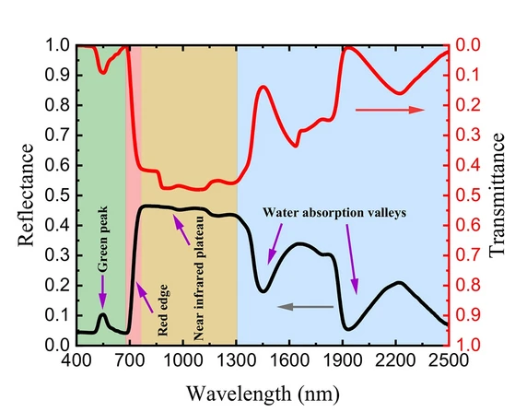
Fig. 16: An example of the solar spectral reflectance and transmittance of Cinnamomum leaves where the NIR plateau can be observed. (Xu & Ye, 2023).
The strength of this scattering is tied to how different the refractive indices (RI) of leaf structures are compared to their surroundings. This principle, emphasized in recent optical materials research (Addadi et al., 2024), shows that the ratio of refractive indices between the scatterer and the surrounding medium (n1/n2) governs how strongly light bends, reflects, or scatters. This dependence is evident in three key examples:
Snell’s law shows that the bending of a light ray at a boundary depends on the RI ratio. If n1 and n2 are very different, the ray bends more strongly.

Similarly, Fresnel’s reflection coefficient at normal incidence demonstrates that the reflectivity increases with RI contrast: 

The same relationship emerges in Mie scattering theory, where the amplitude for a spherical inclusion scale as:

making it clear that scattering efficiency is highly sensitive to refractive index as a greater mismatch produces stronger scattering.
Light scattering is actively exploited by plants. The cystoliths of Ficus, with their high refractive index, behave as strong Mie scatterers, redistributing light into the leaf interior. As such, they represent an evolutionary refinement: by adding specialized, strong scatterers within specific cells, a plant can further engineer the light field, enhancing light capture, protecting against photodamage, and achieving ecological advantage.
Thermodynamics in Ficus Trees
Ficus leaves are complicated thermal structures that constantly balance incoming energy in the form of radiation through multiple pathways: sensible heat, heat transpiration through water molecules (latent heat removal), conduction to supportive tissues, and storage. The standard leaf energy-balance equation is shown as: net radiation (Rn) is equal to sensible heat (H) plus latent heat (LE) plus storage (G) and is a useful equation for Ficus leaves as it shows why evaporative cooling usually dominates normal thermal regulating methods in warm conditions (Chandra, 2003).

Leaf-level Energy Exchange: Mechanics/Measured Magnitudes
In Ficus trees, the change in energy through transpiration is positively affected under warm, moist conditions. A 2015–2019 sap-flow study of Ficus concinna in Shenzhen, China, measured Ficus’s seasonal transpiration and determined the cooling that transpiration provides for its leaves. The study revealed July’s mean values of 1.98 mm/d transpiration, absorbed heat energy Q ≈ 4.91 MJ/m2d, which brought the temperature reduction to ΔT ≈ 3.93 °C/m2d (measurements describe the cooling effect that can be attributed to transpiration within the study’s timeframe) (Hayat et al., 2022). These results demonstrate that Ficus species in a subtropical setting can produce noticeable cooling through transpiration, especially in summer.
Alternatively, when a Ficus leaf takes in solar radiation, it has two main channels to funnel energy into: sensible heat, and reradiation. However, these pathways depend strongly on leaf shape, climate, and age. Measurements on fig leaves show that older leaves of some Ficus species lose much more energy through transpiration and conduction across their surfaces than younger leaves, which alters how the canopy of leaves exchanges heat with the air. In seedlings of Ficus glomerata, energy patterns revealed an “under-temperature”, where young leaf temperatures were slightly below expected in hot months, while older leaves showed increased transpiration rates and larger energy losses to transpiration and conduction. These age effects change the leaf-to-air temperature gradients, which controls the leaf’s ability to perform convection and conduction between itself and the surrounding air (Chandra, 2003).
What drives leaf cooling in Ficus? (Environmental Controls)
The constant sap-flow monitoring of Ficus concinna showed that transpiration's cooling effect is seasonal and is affected by environmental factors. Hayat et al. find that daily transpiration combines with ‘shortwave radiation’ (Rs) in late spring, with air temperature (Ta) and ‘soil volumetric water content’ (SWC) in mid-summer, and with ‘vapor-pressure deficit’ (VPD) in autumn. These main seasonal variables were responsible for substantial proportions of the variability (49% in spring, 82% in summer, 74% in autumn). Over a full year, Ta, SWC and precipitation together represented nearly 89% of the variation in transpiration (Values shown below in figure 17). This means that the capacity for ‘leaf evaporative cooling’ in Ficus is strongly affected by soil moisture and changes in atmospheric conditions. For example, when soil water is normal, leaves convert more incoming radiation into latent heat removal (transpiration through water molecules) and stronger local cooling. Alternatively, when that soil dries, that cooling potential declines (Hayat et al., 2022).

Fig. 17. Linear relationships between daily mean transpiration (Tr) and selected main environmental variables, including air temperature (Ta - a), shortwave radiation (Rs - b), vapor pressure density (VPD - c), and volumetric soil water content (SWC - d) (Hayat et al., 2022).
Hayat et al. also observe that the highest cooling effects occur during warmer, wetter years, as both energy input (through radiation and temperature) and water availability (through the humid air) permit high transpiration rates. Contrarily, during dry years, Ficus transpiration becomes less sensitive to radiation and more sensitive to soil moisture, which indicates a method of water conservation that reduces cooling through evaporation (Hayat et al., 2022).
Leaf Structure, Age, and Boundary-Layer Effects
Leaf geometry and age alter how energy is spread out. Large Ficus leaves tend to develop thicker outer layers, which can reduce convectional heat loss from the surface and increase the importance of latent cooling and reradiation. Leaf-energy work on Ficus glomerata seedlings found that as leaves age, the total energy absorbed per unit area and the energy lost through transpiration both increases, while leaf temperatures and radiative heat losses decline. This alludes to older leaves having the ability to exert stronger cooling on their immediate climate than younger leaves. This effect matters for canopy climate, as older leaf cohorts within a canopy can be disproportionately responsible for canopy cooling from evaporation (Chandra, 2003).
Thermoregulation under stress: drought and heat
When Ficus trees experience drought or high vapor-pressure changes, their physical response shifts. An MDPI paper (Yuan et al., 2024) reviewed multiple studies showing that during drought, Ficus species commonly; reduce the rate of gas and water vapor exchange through its stomata (shown in Figure 18 as the closing of stomata), lower ‘photosynthetic rates’ (Pn), increase ‘non-photochemical quenching’ (NPQ), and sometimes drop leaves to reduce plant-wide water loss. These responses protect hydraulic integrity (a plant’s ability to move water from roots to leaves) while also reducing its latent heat dissipation, causing leaf temperatures to rise. Yuan et al. also document that some Ficus (ex. Ficus carica) can keep a form of “drought memory” that makes post-drought recovery more efficient, which affects how quickly evaporative cooling can restart after the Ficus is reintroduced to water.

Fig. 18. Stomatal regulation under drought stress in Ficus leaves. This shows the role of guard cells in regulating leaf gas exchange and cooling through evaporation. When stomata are open, carbon dioxide enters for photosynthesis while water vapor exits through transpiration. Under drought stress, the Ficus stomata are enticed to close. As a result, transpiration rates decrease, reducing evaporative cooling while conserving water (modified from Yuan et al., 2024).
The synthesis by Yuan et al. also notes molecular / biochemical responses that are active during heat and drought stress. Those responses do not replace evaporative cooling but help to maintain cellular function when the leaf temperature goes beyond the optimal values for photosynthesis (Yuan et al., 2024).
Synthesis and Implications
The thermodynamics of Ficus leaves explain their role as efficient thermal regulators, constantly balancing absorbed radiation with dissipation pathways through latent heat, conduction, and reradiation. Long-term measurements on Ficus concinna confirm that transpiration is the more dominant cooling mechanism, with hot summer conditions showing nearly a 4 °C reduction in leaf temperature (Hayat et al., 2022). Environmental factors, especially soil moisture, air temperature, vapor-pressure, and radiation, play key roles in regulating this cooling ability, with soil water levels proving crucial in keeping high transpiration rates (Hayat et al., 2022).
At the same time, Ficus species are resilient under environmental stress, using both physical and biochemical traits to maintain their stability. During drought, the closure of stomata and reduced Pn conserve water but decrease latent heat dissipation, leading to high leaf temperatures. To respond to this, species like Ficus carica use protective strategies like the formation of a “drought memory” that accelerates recovery when water returns (Yuan et al., 2024). These adjustments ensure that cooling can resume once normal conditions return, which helps the plant to survive. Taken together, the thermodynamic methods of Ficus leaves have two main areas of importance: maintaining an internal balance while simultaneously regulating the thermal environment around them.
Conclusion
The genus Ficus demonstrates how biological success is rooted in the integration of fundamental physical principles. One mechanical challenge is stability, especially for aerial roots that must resist gravitational forces while spanning gaps. The Ficus addresses this though cellulose-rich G-Fiber structures capable of tensile stress and contraction. More specifically, through the principles of beam-like mechanical bending, the horizontal aerial roots can modify their root structure to better carry loads in root bridges. Another problem is excess surface water on leaves, which promotes fungal growth and limits photosynthesis. The drip-tip morphology solves this by guiding droplets off the leaf through reverse curvature and elongated apices, minimizing water retention and maintaining optical clarity for photosynthetically active radiation to reach mesophyll tissues. Ficus trees also face the issue of water stress during drought. Stem diameter fluctuations provide a sensitive measure of hydration status, while species like Ficus carica use protective strategies like forming a “drought memory” that accelerates recovery once water becomes available again (Yuan et al., 2024). These solutions ensure stability in water transport and cooling processes even under stress. Physical injury presents a major threat to the Ficus. Rheological studies show that Ficus latex, a non-Newtonian fluid, flows efficiently under shear to cover wounds through coagulation. This self-healing system restores tensile strength and prevents further water loss or harmful invasions. Finally, Ficus leaves must overcome light saturation in upper tissues that limits light penetration. Mineral deposits such as cystoliths and silica phytoliths scatter light deeper into the mesophyll, balancing illumination across leaf layers and improving photosynthetic efficiency. These processes not only help to maintain system stability but also demonstrate the complicated balance between energy exchanges and plant survival under varying conditions. Overall, these features show how mechanical, fluid, optical, and thermal principles converge to shape Ficus form and function. Ficus acts as an engineer of nature, with each adaptation modeling how physical laws can be harnessed by a living system into design strategies that support survival.
References
References
Abasolo, W.P., Yoshida, M., Yamamoto, H., & Okuyama, T. (2009). Stress Generation In Aerial Roots Of Ficus Elastica (Moraceae). IAWA Journal, 30(2), 216-224. https://doi.org/10.1163/22941932-90000216
Addadi, L., Leeor Kronik, Leiserowitz, L., Oron, D., & Weiner, S. (2024). Organic Crystals and Optical Functions in Biology: Knowns and Unknowns. Advanced Materials, 36(38). https://doi.org/10.1002/adma.202408060
Aumeeruddy-Thomas, Y., & Hossaert-McKey, M. (2024). Fig trees and humans : ficus ecology and mutualisms across cultures. Berghahn Books. https://search.ebscohost.com/login.aspx?direct=true&scope=site&db=nlebk…
Ball, P. (2012). Why leaves have stones. Nature Materials, 11(4), 271–271. https://doi.org/10.1038/nmat3290
Chandra, S. (2003). Effect of leaf age on transpiration and energy budget in Ficus glomerata Roxb. Physiology and Molecular Biology of Plants, 9(2), 255–260. https://www.researchgate.net/publication/285942080_Effect_of_leaf_age_on_transpiration_and_energy_budget_in_Ficus_glomerata_Roxb
Cornish, K., Brichta, J.L. Some Rheological Properties of Latex from Parthenium argentatum Gray Compared with Latex from Hevea brasiliensis and Ficus elastica. Journal of Polymers and the Environment 10, 13-18 (2002). https://doi.org/10.1023/A:1021061805077
Gal, A., Brumfeld, V., Weiner, S., Addadi, L., & Oron, D. (2012). Certain Biominerals in Leaves Function as Light Scatterers. Advanced Materials, 24(10), OP77–OP83. https://doi.org/10.1002/adma.201104548
Bauer, G., Speck T. (2012, March) Restoration of tensile strength in bark samples of Ficus benjamina due to coagulation of latex during fast self-healing of fissures, Annals of Botany, Volume 109, Issue 4, , Pages 807–811, https://doi.org/10.1093/aob/mcr307
Hayat, M., Xiang, J., Yan, C., Xiong, B., Qin, L., Khan, A., Wang, B., Khan, M., Zou, Z., & Qiu, G. (2022). Environmental control on transpiration and its cooling effect of Ficus concinna in a subtropical city, Shenzhen, southern China. Agricultural and Forest Meteorology, 312, 108715. https://doi.org/10.1016/j.agrformet.2021.108715
Liu S, Zhang C, Shen T, Zhan Z, Peng J, Yu C, Jiang L, Dong Z. (2023 Sep 23). Efficient agricultural drip irrigation inspired by fig leaf morphology. Nat Commun.14(1):5934. doi: 10.1038/s41467-023-41673-0. PMID: 37741843; PMCID: PMC10518012.
Ludwig, F., Middleton, W., Gallenmüller, F., Rogers, P., & Speck, T. (2019). Living bridges using aerial roots of Ficus elastica – an interdisciplinary perspective. Scientific Reports, 9(1). https://doi.org/10.1038/s41598-019-48652-w
Ochshorn, J. (n.d.). Chapter 1 – Introduction to structural design: Strength of Materials. Strength of materials: Jonathan Ochshorn’s Structural Elements text, Third Edition. https://jonochshorn.com/structuralelements/book/1.08-strength.html#:~:t…;
Pierantoni, M., Tenne, R., Rephael, B., Brumfeld, V., van Casteren, A., Kupczik, K., Oron, D., Addadi, L., & Weiner, S. (2018). Mineral Deposits in Ficus Leaves: Morphologies and Locations in Relation to Function1. Plant Physiology, 176(2), 1751–1763. https://doi.org/10.1104/pp.17.01516
Roark, R. J., & Young, W. C. (1989). Roark’s formulas for stress and strain (6th ed). McGraw-Hill.
Rudall, P. J. (2020). Leaf. Cambridge University Press EBooks, 54–71. https://doi.org/10.1017/9781108782104.005
T. Wang, Y. Si, H. Dai, C. Li, C. Gao, Z. Dong, & L. Jiang. (2020) Apex structures enhance water drainage on leaves, Proc. Natl. Acad. Sci. U.S.A. 117 (4) 1890-1894, https://doi.org/10.1073/pnas.1909924117
Van de Put, H., & Steppe, K. (2021). Automated detection of atmospheric and soil drought stress in Ficus benjamina using stem diameter measurements and modelling. Irrigation Science, 40(1), 29–43. https://doi.org/10.1007/s00271-021-00757-9
Yuan, S., Yin, T., He, H., Liu, X., Long, X., Dong, P., & Zhu, Z. (2024). Phenotypic, metabolic and genetic adaptations of the Ficus species to abiotic stress response: A comprehensive review. International Journal of Molecular Sciences, 25(17), 9520. https://doi.org/10.3390/ijms25179520
Yamamoto, H., Sujan, K. C., Matsuo-Ueda, M., Yoshida, M., & Chen, S. (2022). Microscopic mechanism of contraction of tension wood G-fiber due to boiling. Cellulose, 29(14), 7935–7954. https://doi.org/10.1007/s10570-022-04742-z
Xu, K., & Ye, H. (2023). Light scattering in stacked mesophyll cells results in similarity characteristic of solar spectral reflectance and transmittance of natural leaves. Scientific Reports, 13(1), 4694. https://doi.org/10.1038/s41598-023-31718-1
Zimmermann, M. H., Wardrop, A. B., & Tomlinson, P. B. (1968). Tension Wood in aerial roots of Ficus benjamina L. Wood Science and Technology, 2(2), 95–104. https://doi.org/10.1007/bf00394958