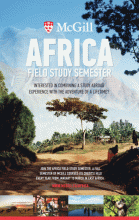
Here are excerpts from what our Winter 2006 participants had to say about the Canadian Field Studies in Africa / Africa Field Study Semester program.
Real, practical work helps you to further understand what you like and dislike when it comes to career work. You get to see unique things that you'd never be able to experience in Canada, which is not representative of the entire world. Through the program's approach and course structure, no experience is un-academic or wasted. This is an academic experience that changes your life. Every single day is a brand new, eye-opening experience.
Stephanie Bell, Queen's, Life Science
East Africa is probably one of the most sensational locations possible to have a field course. The cultural, environmental, and visual contrast to Western society make it one of the most educational sites available.
The McGill CFSIA is an excellent approach because it is interactive and research-based. Rather than being ferried around form place to place in a glass bubble, the program allows direct interaction with the people that our research is based upon. Prepare yourself to be immersed in a world drastically different from Canada and put in situations that will be both enjoyable and uncomfortable, and will invoke emotions that are difficult to cope with. But what you will leave with is a sensational experience and the most significant education university can give.
I feel that this program gave me not only an amazing experience but significantly improved my ability to learn and perform.
Gian Stefano Brigidi, McGill, B.Sc. Biology
While in the field one learns in a way impossible in a traditional classroom. Concepts are brought to life in the people one meets, problems one sees and experiences one has. Many of the most important issues dealt with in traditional classes back home are here in a literal laboratory for study. I can't think of a better learning environment for discussing poverty, biodiversity, HIV/AIDS, peace and conflict, governance, etc. The CFSIA format is a perfect blend of security and freedom while in Africa. One always feels safe and at home without being smothered. This trip is worth every cent. You'll do things you never thought you could, and bond with a group of fantastic people. In 2 weeks I have had a richness of experience here on this program at least equal to my past 4.5 years at McGill.
Derek Brine, McGill, B.Eng., Mechanical Engineering
There is no more powerful of an educational experience then to actually live in the world that you study. East Africa is perfect for both development and natural science studies due to the sheer diversity of peoples, and environments that we can be exposed to.
Alexandre Corriveau-Bourque, McGill, International Development Studies/Anthropology
It was an amazing way to finish my undergraduate degree, and motivates me to continue my education and inspires me to make valuable use of the knowledge I've gained. If given a second chance to do it all over, I would, in a second. Don't give up this opportunity.
Leah Dalrymple, Guelph, B.Sc. Biology
Do it. You will never have an experience like it. You will see so many different things and experience it with other students. Everyday there is something new. It made the undergraduate experience one that I'll never forget. I will carry what I learned, saw, and experienced in Africa for the rest of my life.
Brian Doonan, McGill, Environment
You will never get a learning experience like this. The program gives you the opportunity to do things you couldn't do as a normal tourist. I have learned much more in these field courses than any class taken back at McGill as you are able to observe the material in the flesh, as it is easier to remember things you have seen rather than things you have read. This has really wrapped up my undergraduate degree and given it more significance.
Catherine Dubuc, McGill, International Development Studies/Sociology/African Studies
I am taking International Development at McGill and no matter how many papers, books and newspapers you read as well as papers we write, you have no idea what the reality is in developing countries unless you have been there and spoken directly to the citizens. This field study semester has given me the real picture of what is going on.
Heather Finlay, McGill, International Development
All aspects of life, whether intellectual or emotional, are taken care of. It is a well-rounded approach with multiple dimensions. The program makes the best possible use of the opportunities in East Africa and is able to provide students with an integrated and rich experience. This is an amazing program and you will not regret your decision to participate any second. You will meet so many interesting people, see so many wonderful things, and have numerous new and exciting experiences. At the end of each day I told myself that this must have been the best day in my life, but 24 hours later I decided that the next day was at least equally good if not better.
Kathrin Gottwald, McGill, International Development Studies
Prepare yourself to live the most rewarding, most encompassing, most life-changing, most fulfilling, and most amazing experience of your academic career, if not of your life.
Raphaël Goulet, McGill, Wildlife Biology
It was phenomenal: the educational experience, the personal experience and the cultural experience. The CFSIA combines a multitude of disciplines and allows students to practically apply knowledge learned. Even though my background is in kinesiology I was able to explore different disciplines such as conservation, international development & zoology. If you are even contemplating the program I encourage you to venture out of the institutional realm of education and live it. Not only do you learn a lot but you have an incredible time and meet awesome people.
Jane Harbottle, McGill, B.Ed. Kinesiology
You get real knowledge from actually seeing things and experiencing what you are being taught. You experience a wide variety of people, cultures, wildlife, environments, and landscapes that you can't encounter anywhere else. Be willing to experience anything and everything and throw away all of the perceptions you've heard about regarding Africa until you see it for yourself.
Zachary Itzkowitz, McGill, Biology
You can never learn in books what you learn in the field. A whole semester's study can be encapsulated in one experience. The connections that McGill has on the ground in East Africa are amazing. The CFSIA program gives you a good taste of very different parts of East Africa in one semester. I learned more this CFSIA semester than I did in my entire university experience. The professors are all amazing and they all become great friends. You get the academic experience McGill offers plus you'll have so much fun doing it.
Nikko Izu, McGill, International Development Studies/Social Studies of Medicine
CFSIA is the experience of a lifetime. There is absolutely no better way to spend a semester then traveling around Africa. The things you'll see are indescribable and the people you'll meet, amazing. I would do the program again if I could. It was the greatest undergraduate semester that anyone could have.
Martin Kastner, McGill, B.Sc. Biology
The CFSIA exposes us to a tremendous amount (and diversity) of situations, places, and communities in east Africa. The security, logistics, and overall care of the students were great; as were the many opportunities we were provided to learn and to access local resources for study. This experience has been a life-changing one for me. I've learned more than I ever imagined I could in a single semester. I've also seen places of incredible beauty and met countless generous and kind people. I've become more aware than ever of the injustices that still rule our world, but also of the great initiatives that are taking place to try to correct these injustices. East Africa is stunning and you'll love every moment that you have there!
Sarah Katz-Lavigne, McGill, International Development Studies
East Africa is a place where many different issues (i.e. poverty, education, wildlife management, etc.) are confronted daily. This gives students an opportunity to approach their field of study in a place where the issues are of vital importance as well as interlinked with development and conservation. Students gain a fantastic opportunity not only to practice their skills but to observe the benefits and practicality of interdisciplinary approaches to those key issues. The McGill program allows students to travel through East Africa safely while still being able to interact with local people. People are intensely aware of what issues they face, and have profound insights in how to address these. Talking to individuals about their daily lives shines a light on how the state of their environment affects them. No policy maker, developmental or biological (as many of us are training to be) should be unaware of the views and priorities of the people they influence. If you see yourself in the future as working internationally, with local populations or international organizations this program is essential.
Aliya Kelly, McGill, B.Sc. Biology/International Development Studies
The CFSIA program offers a realistic introduction to African culture and biology, giving students an in-depth understanding of lifestyles, ecology, etc. while being safe and protected. There are many aspects (like the homestay) that would not be available if you were traveling on your own, or at least you might not know the option is available.
Do it. This is the best way to travel around Africa. This is my last semester and what a way to finish my degree! It was school, we had to write papers, do project assignments you'd expect with normal university courses but got so many bonuses with experiencing real-life Africa (vs. text-book Africa) and really getting to know the areas we visited. It was an incredible experience that will always stand out in my memories of undergrad
Julia Kilgour, University of Toronto, Zoology
I learned more in the first week here than I have during any one semester at home. It taught me where I can go and the opportunities available for the future.
Alexandra Macpherson, McGill, BA Environment/Development
East Africa lets both arts and science students study amazing examples of what we have been learning about, and opens our eyes to other disciplines. I would never have had the courage or confidence to think I could come here, but this program made it possible. There is no way to sum up this program: it is and is not everything you could imagine it would be. Fun times, sad times, stressful, peaceful, mind boggling, annoying, uplifting, busy, relaxed, rushed, eventful, boring, humbling, entertaining, and empowering. Whatever you want it to be, it will be amazing.
Sara McCarthy, University of Guelph, Zoology
This was the most valuable experience I have had. It has given me the experience to bridge my biology background with many social and political issues. Experiencing life and issues in another part of the world will allow you to be a more informed global citizen. No matter what your field of study, this program will change your life.
Colleen Prince, Guelph, Marine & Freshwater Biology
We were able to see and do things you could not do otherwise. The amount of visits that were organized for us was amazing. Plus the people we were able to meet were also incredible. Do it! I've learned a lot through this experience on many levels.
Sam Miglin, Bishops University, Biology
You can read papers, see pictures, hear professors, but you never truly understand a land and its people until you see the land and hear its people face to face. Through no other experience could we talk to Nobel Peace Prize nominees, UN HABITAT officials, and superintendents of hospitals.
East Africa is relatively secure and it offers an incredible breadth of ecosystems and people. We've been from Mount Kenya down to the Coast, through the Mara and the Great Rift Valley to western Uganda, all in 10 weeks time. The contacts and links established with East Africans and East African institutions have provided an invaluable learning experience. The research-based assignments and projects really got us out into the field asking questions and learning more than we'd ever learn at home, from the different social issues that help perpetuate HIV/AIDS to how to carry out a conversation with someone who barely speaks English.
This is your opportunity to do something you will likely never have the chance to do again, and it will change your life. The people and places you see leave an incredible impression, and will help you to figure out your priorities for the future. I have been so incredibly inspired by the people I have met here, and I believe if it were not for this trip I would be back on campus, still apathetic about the university learning experience. Now I have so many great goals and I am finally aware of my objectives in life.
Carolyn Prouse, Queen's University, Physical and Health Education
Do it. If you have a real interest in learning, this trip is for you. No amount of money could replace this experience. In a one hour walk through the forest of Kibale I learnt more than I would in an entire semester of a class. This is practical knowledge with real experience to back it up. I also got a chance to do some field work and see where my interests actually lie. This has opened doors for me to continue studying in these fields in the future.
Charles Tabone, Queen's, Biology
East Africa provides a rich variety of settings in many disciplines - for example, our biology classes have visited and studied rainforests, papyrus swamps, acacia woodlands, savannah grasslands, bamboo forests, lowland montane forests, coasted plains, mangroves, intertidal areas, coral reefs, and open water (to name a few!). We got to see all sorts of varied locations, learn about the natural history, the history, etc. and then go out and interact with the people who study and work in those locations in order to apply our knowledge, explore it, expand it, and hopefully in some way make the exchange reciprocal. Do it. Save your money, get all the immunizations, and come to East Africa.
Jade Shiller, UBC, Marine Biology
Field courses are the reason I entered McGill Biology! Barbados, New Brunswick, Mont Saint-Hilaire... and now Africa. It's here that we learn why we learn.
Julian Xue, McGill, B.Sc. Biology
Field courses allow you to truly understand the importance of the issues you're studying-it's invaluable to be able to speak with Maasai pastoralists about their land rights issues instead of just reading about them. You gain a vast amount of knowledge outside of instruction time, and therefore end up broadening your field of interests. About this program, I say: Do it, if you can. And if you can't, then find a way, and do it. The experiences you have on this program are unique. They provide you with an insider's sort of pass to East Africa. Educationally, it is the most significant experience of my life, and personally, it was altering, challenging, and just incredibly fun! This field course has had a larger impact within my pedagogical career than any other course or program-it has broadened my interests immensely, and has given me both ideas and viable options for post-graduate work.
Dominique Zipper, McGill, BA
If you want to see difference - experience what you learn in person and not from a textbook in the library - the CFSIA will offer that. The professors will take you to the heart of cultures, people, and environments in East Africa. More importantly, you will find similarity between people from the most diverse backgrounds, and find common ground and connections with inspiring people, both Kenyans and fellow students. I was inspired by the incredible wildlife and ecological diversity of a developing country, heavily impacted by the need I saw around me, awed by the resourcefulness of the people here, and spurred to continue international development as my field of study.
Katie Zulak, Queen's, B.A. Biology/Development Studies