
subscribe 

2025 Patterson Distinguished Service Medal
Professor Parisa A. Ariya was selected as the recipient of the 2025 Patterson Distinguished Service Medal, an award widely regarded as the most prestigious Canadian distinction recognizing exceptional contributions to meteorology. Meteorology is a broad discipline within the atmospheric sciences and encompasses several specialized research areas, including atmospheric chemistry, atmospheric physics, dynamic meteorology, hydrology, climatology, and climate change.
Published: 10 Sep 2026

How does an atmospheric aerosol particle become an ice crystal, and can we observe this transformation as it happens?
A new Tools of the Trade article by Dr. Devendra Pal, published in Nature Reviews Chemistry, highlights a McGill-developed experimental platform that provides a real-time view of aerosol-driven ice nucleation.
Published: 3 Sep 2026

Tomislav Friščić returns to McGill’s Department of Chemistry as an Eddie Goldenberg Research Chair of Canada
Professor Tomislav Friščić will return to the Department of Chemistry as one of McGill University’s six inaugural Eddie Goldenberg Research Chairs of Canada.
Published: 27 Aug 2026

Passing of Nobel Laureate Rudy Marcus, McGill Chemistry Alumnus
McGill Chemistry Department shares the news of the passing of Prof. Rudy Marcus, CALTECH Professor and Nobel Laureate. A Montrealer and alumnus of our Chemistry Department at McGill University, where he conducted his undergraduate and graduate studies, his work over decades was inspirational to many generations of chemists worldwide.
Published: 11 Aug 2026
2025 Patterson Distinguished Service Medal
Professor Parisa A. Ariya was selected as the recipient of the 2025 Patterson Distinguished Service Medal, an award widely regarded as the most prestigious Canadian distinction recognizing exceptional contributions to meteorology. Meteorology is a broad discipline within the atmospheric sciences and encompasses several specialized research areas, including atmospheric chemistry, atmospheric physics, dynamic meteorology, hydrology, climatology, and climate change.
Published: 14 Jul 2026

Derek G. Gray (1941-2026)
It is with a heavy heart that we write to inform you that our dear colleague and friend Dr. Derek G. Gray, Professor Emeritus, passed away on Saturday May 30th
Published: 8 Jun 2026

David Harpp (1937-2026)
It is with a heavy heart that we write to inform you that Dr David Harpp, Tomlinson Professor Emeritus in Science Education, our colleague, but also to many of us in the department a teacher, mentor and friend for many decades, passed away Saturday February 14th, peacefully and in the presence of those closest to him.
Published: 19 Feb 2026

Dr. Alison Bain (PhD’21) named to C&EN’s 2025 Talented 12
Congratulations to Dr. Alison Bain, who completed her PhD in the Preston Group at McGill in 2021, on being selected for Chemical & Engineering News’s Talented 12 list for 2025. Now an Assistant Professor of Chemistry at Oregon State University, Dr. Bain continues to develop state-of-the-art optical trapping techniques to study aerosols at the single-particle level.
Published: 23 May 2025
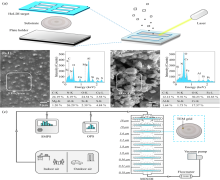
A HoLDI mass spectrometry platform for airborne nanoplastic detection
· There are no established protocols for nanoplastic detection within complex environmental matrices.
· Mass spectrometry (MS) analysis of environmental nanoplastics is impeded by methodological constraints.
· Ariya's lab, namely Zi Wang, present a versatile platform evolved from matrix-assisted laser desorption/ionization (MALDI) MS for airborne nano/microplastic research.
Published: 25 Mar 2025

MC2 in Cordoba U
Representing McGill University’s Chemistry Department, the MC² facility, and the QCAM-FRQNT strategic cluster, Petr Fiurasek was honored to be invited to the University of Córdoba to deliver two lectures. One presentation was part of the advanced characterization course for physics master’s students. Beyond the scientific discussions, the visit aimed to foster collaboration between the University of Córdoba and Quebec universities through MITACS and various mobility programs
Published: 29 Nov 2024
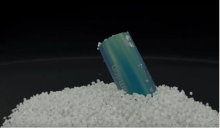
Eric McCalla Na-ion battery research is in the news
The Eric McCalla lab's work improving Na-ion battery cathodes has been highlighted in a nice article and video by Patrick de Bellefeuille
Published: 26 Nov 2024
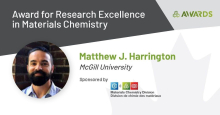
Matt Harrington receives the 2024 Award for Excellence in Materials Research Chemical Institute of Canada
The Award for Research Excellence in Materials Chemistry is presented to a Canadian citizen or landed immigrant who has made an outstanding contribution to materials chemistry while working in Canada. Congratulations to Professor Matthew J. Harrington of McGill University on being the recipient of this award. https://buff.ly/48ZBMhp
Published: 26 Nov 2024

New sustainable catalyst: Fast, selective, reductive conversion of CO2!
Anthropogenic climate change drastically affects our planet, with CO2 being the most critical gaseous driver. Here, we present a fast, effective, and sustainable route for coupling diverse alcohols, amines and amides with CO2 via heterogenization of a natural metal-based homogeneous catalyst through decorating on functionalized graphene oxide.
Published: 24 Sep 2024

Highly functionalized all-cellulose nanocomposites via bacteria-enabled in-situ modifications
Dr. Seyed Mohammad Amin Ojagh, from Prof. van de Ven's research group and his colleagues, introduced a novel class of highly functionalized nanocellulose-based materials for diverse applications, recently published in the Chemical Engineering Journal. This study involved the in-situ modification of bacterial cellulose (BC) with hairy nanocellulose (HNC), resulting in nanocomposites with enhanced physicochemical properties compared to BC alone.
Published: 12 Sep 2024
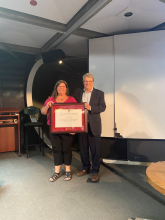
The Faculty of Science Excellence award goes to... Chantal!
Kudos to Chantal who received the Faculty of Science Excellence award, a testament to her exceptional contributions to our graduate students and department at large over the past 38 years. Chantal's work is multifaceted, and the success of our nowadays well over 230 Graduate Student Population hinges in great part on her relentless work in our department.
Published: 27 May 2024